
 Cyber Strategy
 Cyber Secure
 Cyber Operations
 Cyber Response
 Cyber Resilience
Vulnerability Assessment for Kuwait businesses is now a practical security requirement for organizations that depend on web applications, cloud systems, internal networks, payment platforms, customer portals, and third-party integrations. DTS Solution supports organizations in Kuwait with vulnerability assessment, scanning, penetration testing, infrastructure security, remediation planning, and wider cybersecurity advisory. DTS Solution also lists a Kuwait office in Kuwait City, which gives local teams regional expertise with on-ground presence.
For many Kuwaiti organizations, the problem is not that vulnerabilities are rare. The problem is that they are often invisible until a scan, audit, breach attempt, or customer issue brings them forward. Unpatched systems, exposed services, outdated software, weak configurations, insecure APIs, open ports, unsupported devices, and forgotten assets can sit quietly for months.
A vulnerability assessment helps security teams find these weaknesses before they become incidents.
What is a vulnerability assessment?
A vulnerability assessment is a structured process for identifying, classifying, prioritizing, and reporting security weaknesses across systems, applications, networks, and infrastructure. Fortinet describes vulnerability assessment as an evaluation method that helps organizations review systems for possible weaknesses, assign severity levels, and recommend mitigation or remediation.
For Kuwait businesses, this can include external infrastructure, internal networks, firewalls, servers, endpoints, cloud platforms, databases, web applications, mobile apps, APIs, and payment systems.
The purpose is not only to produce a list of findings. The real value comes from knowing which weaknesses matter most, what business systems they affect, how they should be fixed, and who owns remediation.
Why the Numbers Alone Justify This Work
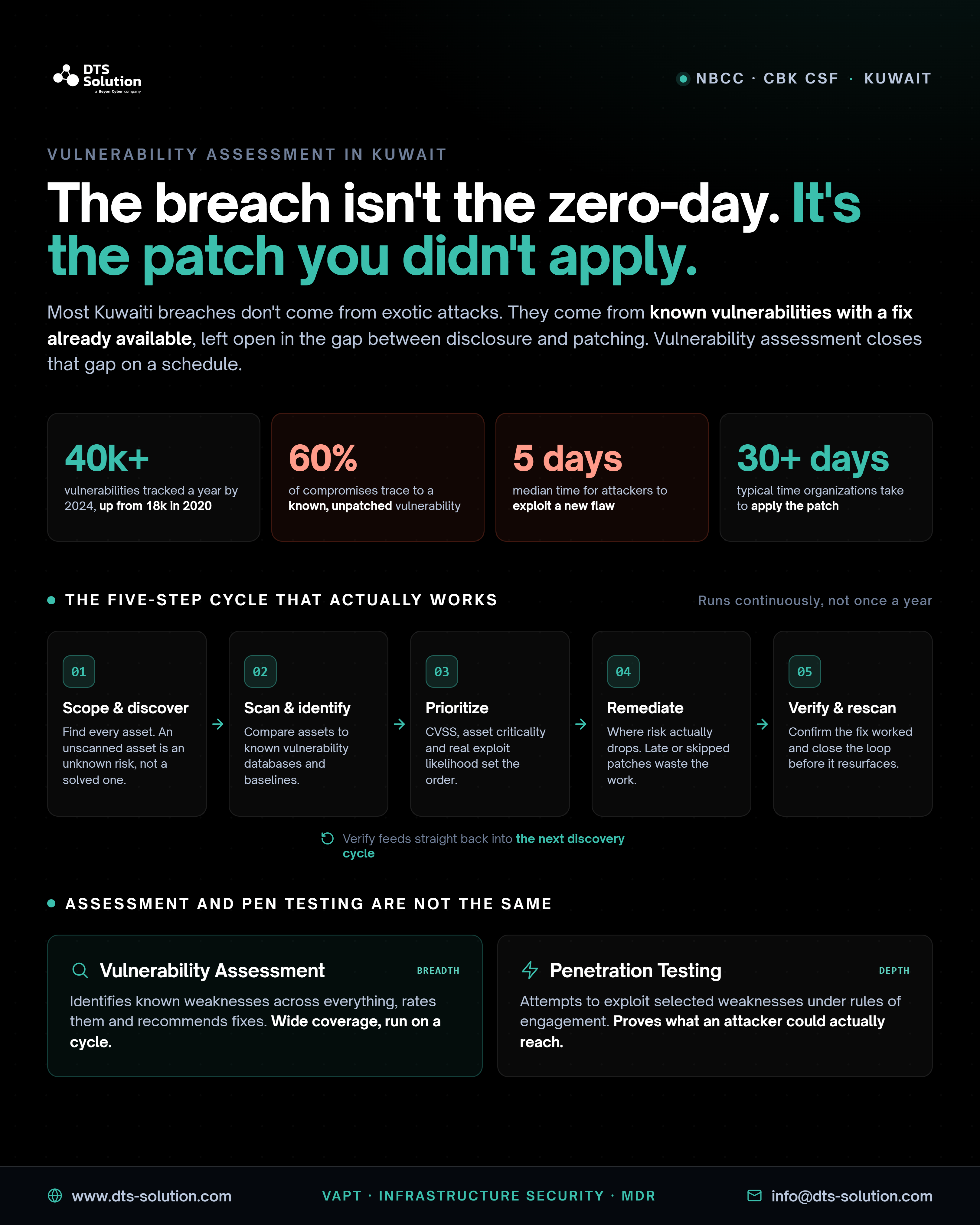
Recorded software vulnerabilities have more than doubled since 2020, climbing from roughly 18,000 tracked issues to over 40,000 a year by 2024, with no sign of the pace slowing down. Recent industry research puts a sharp point on this: less than one percent of these vulnerabilities ever get actively weaponized against real organizations, which sounds reassuring until the harder statistic lands: 60 percent of security compromises trace back to a known, unpatched vulnerability that already had a fix available.
The gap between discovery and remediation is where the real damage happens. Attackers exploit a newly disclosed vulnerability in a median of five days. Organizations typically take a month or longer to apply the corresponding patch. That gap, more than any single sophisticated attack technique, explains why so many breaches trace back to something that was already fixable.
Vulnerability assessment is not the same as penetration testing
Vulnerability assessment and penetration testing are related, but they are not the same.
A vulnerability assessment identifies known weaknesses, rates them, and recommends fixes. Penetration testing goes further by attempting to exploit selected weaknesses under approved rules of engagement.
DTS Solution’s Vulnerability Assessment and Scanning service goes beyond automated scans by adding manual validation and analysis to reduce false positives and provide a more accurate view of the security posture. DTS also provides external and internal assessment models, including black box, grey box, and white box approaches.
For higher-risk systems, DTS Solution Penetration Testing can help validate whether exploitable weaknesses could lead to privileged access, data exposure, or deeper compromise. DTS states that its penetration testing engagements identify threats to the organization, key assets at risk, and potential attack paths.
In practice, many organizations need both. Vulnerability assessment gives breadth. Penetration testing gives exploit validation.
Why Kuwait's Regulatory Environment Makes This Non-Negotiable
Kuwait’s National Basic Cybersecurity Controls and the CBK Cybersecurity Framework for financial institutions both expect organizations to identify and remediate vulnerabilities on an ongoing basis, not just before a scheduled audit. DTS Solution’s work on CITRA compliance for Kuwait’s telecom and digital service providers reflects the same pattern across Kuwait’s regulatory bodies: continuous evidence of active risk management, not a single point-in-time report filed away after an audit.
For organizations still treating vulnerability assessment as an annual checkbox, this creates a real compliance gap. Auditors increasingly expect a documented, repeatable cycle of scanning, prioritization, and remediation, with proof that the cycle actually runs on schedule.
The Five-Step Cycle That Actually Works
Scope and discovery: Every asset that could carry risk needs to be identified first. A vulnerability that never gets scanned does not stop existing. It just becomes an unknown risk instead of a documented one.
Scanning and identification: Automated tools compare every discovered asset against known vulnerability databases and configuration baselines.
Prioritization and analysis: Not every finding deserves the same urgency. CVSS scoring, asset criticality, and real-world exploitation likelihood together determine what gets fixed first.
Remediation and patching: This is where the actual risk reduction happens, and where many organizations quietly fall short. Patches applied late, or not at all, leave the assessment’s value unrealized.
Verification and rescan: Confirming that a fix actually worked closes the loop and prevents the same vulnerability from resurfacing in the next cycle unnoticed.
Common Mistakes Kuwaiti Organizations Make
Treating a single annual scan as sufficient. Vulnerabilities appear constantly between scheduled assessments. A scan run once a year misses months of new exposure.
Stopping at the scan report. A list of vulnerabilities without a documented remediation plan and follow-through is a report nobody acted on, which satisfies neither security nor compliance intent.
Confusing vulnerability assessment with penetration testing. Buying one when a specific compliance requirement calls for the other creates a gap that surfaces during the next audit.
Delaying patches over operational concerns. Fear of breaking a production system is understandable, but it is exactly the reasoning that leaves known, exploitable gaps open for weeks past a responsible remediation window.
Where DTS Solution fits
DTS Solution Infrastructure Security supports enterprise infrastructure security through practical experience and security engineering expertise. This connects directly with vulnerability assessment because many findings involve network exposure, firewall rules, DNS security, mail security, endpoint controls, and infrastructure configuration.
For organizations that need a wider program, DTS Solution can connect vulnerability assessment with penetration testing, compliance consulting, incident response, managed detection, and cyber risk advisory. This helps Kuwait businesses move from one-time scanning to a managed improvement cycle.
Vulnerability Assessment for Kuwait businesses is now a practical security requirement for organizations that depend on web applications, cloud systems, internal networks, payment platforms, customer portals, and third-party integrations. DTS Solution supports organizations in Kuwait with vulnerability assessment, scanning, penetration testing, infrastructure security, remediation planning, and wider cybersecurity advisory. DTS Solution also lists a Kuwait office in Kuwait City, which gives local teams regional expertise with on-ground presence.
For many Kuwaiti organizations, the problem is not that vulnerabilities are rare. The problem is that they are often invisible until a scan, audit, breach attempt, or customer issue brings them forward. Unpatched systems, exposed services, outdated software, weak configurations, insecure APIs, open ports, unsupported devices, and forgotten assets can sit quietly for months.
A vulnerability assessment helps security teams find these weaknesses before they become incidents.
What is a vulnerability assessment?
A vulnerability assessment is a structured process for identifying, classifying, prioritizing, and reporting security weaknesses across systems, applications, networks, and infrastructure. Fortinet describes vulnerability assessment as an evaluation method that helps organizations review systems for possible weaknesses, assign severity levels, and recommend mitigation or remediation.
For Kuwait businesses, this can include external infrastructure, internal networks, firewalls, servers, endpoints, cloud platforms, databases, web applications, mobile apps, APIs, and payment systems.
The purpose is not only to produce a list of findings. The real value comes from knowing which weaknesses matter most, what business systems they affect, how they should be fixed, and who owns remediation.
Why the Numbers Alone Justify This Work
Recorded software vulnerabilities have more than doubled since 2020, climbing from roughly 18,000 tracked issues to over 40,000 a year by 2024, with no sign of the pace slowing down. Recent industry research puts a sharp point on this: less than one percent of these vulnerabilities ever get actively weaponized against real organizations, which sounds reassuring until the harder statistic lands: 60 percent of security compromises trace back to a known, unpatched vulnerability that already had a fix available.
The gap between discovery and remediation is where the real damage happens. Attackers exploit a newly disclosed vulnerability in a median of five days. Organizations typically take a month or longer to apply the corresponding patch. That gap, more than any single sophisticated attack technique, explains why so many breaches trace back to something that was already fixable.
Vulnerability assessment is not the same as penetration testing
Vulnerability assessment and penetration testing are related, but they are not the same.
A vulnerability assessment identifies known weaknesses, rates them, and recommends fixes. Penetration testing goes further by attempting to exploit selected weaknesses under approved rules of engagement.
DTS Solution’s Vulnerability Assessment and Scanning service goes beyond automated scans by adding manual validation and analysis to reduce false positives and provide a more accurate view of the security posture. DTS also provides external and internal assessment models, including black box, grey box, and white box approaches.
For higher-risk systems, DTS Solution Penetration Testing can help validate whether exploitable weaknesses could lead to privileged access, data exposure, or deeper compromise. DTS states that its penetration testing engagements identify threats to the organization, key assets at risk, and potential attack paths.
In practice, many organizations need both. Vulnerability assessment gives breadth. Penetration testing gives exploit validation.
Why Kuwait's Regulatory Environment Makes This Non-Negotiable
Kuwait’s National Basic Cybersecurity Controls and the CBK Cybersecurity Framework for financial institutions both expect organizations to identify and remediate vulnerabilities on an ongoing basis, not just before a scheduled audit. DTS Solution’s work on CITRA compliance for Kuwait’s telecom and digital service providers reflects the same pattern across Kuwait’s regulatory bodies: continuous evidence of active risk management, not a single point-in-time report filed away after an audit.
For organizations still treating vulnerability assessment as an annual checkbox, this creates a real compliance gap. Auditors increasingly expect a documented, repeatable cycle of scanning, prioritization, and remediation, with proof that the cycle actually runs on schedule.
The Five-Step Cycle That Actually Works
Scope and discovery: Every asset that could carry risk needs to be identified first. A vulnerability that never gets scanned does not stop existing. It just becomes an unknown risk instead of a documented one.
Scanning and identification: Automated tools compare every discovered asset against known vulnerability databases and configuration baselines.
Prioritization and analysis: Not every finding deserves the same urgency. CVSS scoring, asset criticality, and real-world exploitation likelihood together determine what gets fixed first.
Remediation and patching: This is where the actual risk reduction happens, and where many organizations quietly fall short. Patches applied late, or not at all, leave the assessment’s value unrealized.
Verification and rescan: Confirming that a fix actually worked closes the loop and prevents the same vulnerability from resurfacing in the next cycle unnoticed.
Common Mistakes Kuwaiti Organizations Make
Treating a single annual scan as sufficient: Vulnerabilities appear constantly between scheduled assessments. A scan run once a year misses months of new exposure.
Stopping at the scan report: A list of vulnerabilities without a documented remediation plan and follow-through is a report nobody acted on, which satisfies neither security nor compliance intent.
Confusing vulnerability assessment with penetration testing: Buying one when a specific compliance requirement calls for the other creates a gap that surfaces during the next audit.
Delaying patches over operational concerns: Fear of breaking a production system is understandable, but it is exactly the reasoning that leaves known, exploitable gaps open for weeks past a responsible remediation window.
Where DTS Solution fits
DTS Solution Infrastructure Security supports enterprise infrastructure security through practical experience and security engineering expertise. This connects directly with vulnerability assessment because many findings involve network exposure, firewall rules, DNS security, mail security, endpoint controls, and infrastructure configuration.
For organizations that need a wider program, DTS Solution can connect vulnerability assessment with penetration testing, compliance consulting, incident response, managed detection, and cyber risk advisory. This helps Kuwait businesses move from one-time scanning to a managed improvement cycle.
Final note
Vulnerability Assessment for Kuwait businesses should be treated as a recurring security practice, not a one-off technical task. Systems change, vendors change, cloud services change, and new vulnerabilities are published constantly.
The strongest approach is simple: know your assets, scan regularly, validate findings, prioritize based on business risk, fix what matters, and retest.
DTS Solution helps Kuwait organizations turn vulnerability assessment into practical risk reduction by combining scanning, manual validation, remediation planning, infrastructure security, and deeper testing where required.
Final note
Vulnerability Assessment for Kuwait businesses is now a practical security requirement for organizations that depend on web applications, cloud systems, internal networks, payment platforms, customer portals, and third-party integrations. DTS Solution supports organizations in Kuwait with vulnerability assessment, scanning, penetration testing, infrastructure security, remediation planning, and wider cybersecurity advisory. DTS Solution also lists a Kuwait office in Kuwait City, which gives local teams regional expertise with on-ground presence.
For many Kuwaiti organizations, the problem is not that vulnerabilities are rare. The problem is that they are often invisible until a scan, audit, breach attempt, or customer issue brings them forward. Unpatched systems, exposed services, outdated software, weak configurations, insecure APIs, open ports, unsupported devices, and forgotten assets can sit quietly for months.
A vulnerability assessment helps security teams find these weaknesses before they become incidents.







 Dubai
Dubai