
 Cyber Strategy
 Cyber Secure
 Cyber Operations
 Cyber Response
 Cyber Resilience
Telecommunications and digital services form the backbone of Kuwait’s economy.
From mobile networks and cloud services to digital platforms and internet service providers, organizations in this sector handle vast amounts of customer information and support services that millions of people rely on every day. As cyber threats continue targeting critical infrastructure and data-driven services, regulatory oversight has become increasingly important.
This is where the Communications and Information Technology Regulatory Authority (CITRA) plays a central role.
CITRA’s regulatory framework extends beyond licensing and telecommunications oversight. It increasingly addresses cybersecurity, cloud governance, data protection, and operational resilience for organizations operating within Kuwait’s communications and technology sectors.
For telecom operators and digital service providers, compliance is no longer simply a regulatory obligation. It has become a critical component of maintaining customer trust, operational resilience, and long-term business sustainability.
DTS Solution supports telecom operators and digital service providers in Kuwait through cybersecurity advisory, regulatory compliance, security engineering, and managed security capabilities aligned with local requirements.
What CITRA Does
CITRA was established to regulate telecommunications and information technology services across Kuwait. Its mandate covers spectrum allocation, licensing of telecom operators, consumer protection, and increasingly, cybersecurity oversight for the infrastructure that underpins the country’s digital economy.
As more services move onto cloud platforms and mobile networks carry more sensitive data, CITRA’s cybersecurity expectations have grown alongside that shift. The authority now expects regulated entities to run structured security programs covering governance, risk management, access control, monitoring, and incident response, rather than relying on ad hoc technical fixes.
Who Falls Under CITRA's Scope
Telecom operators are the obvious target, but the list extends further. Internet service providers, cloud service providers, virtual telecom service distributors, technology vendors supporting critical communications, and managed service providers all sit within CITRA’s reach in one capacity or another.
CITRA has also been tightening rules around the distribution layer. A 2025 draft regulation for mobile and virtual telecom service distributors set out licensing conditions, including a requirement for distributors to operate as a Kuwaiti LLC or joint-stock company with at least ten branches, an annual licence fee, and a bank guarantee. Distributors must maintain system security, identify staff clearly, and report contracts and renewals to CITRA in advance. Telecom companies, in turn, are barred from working with unlicensed distributors and must report violations when they occur. This signals a broader pattern: CITRA is extending compliance obligations down the supply chain, not just to the operators at the top of it.
Core Areas of a CITRA Cybersecurity Program
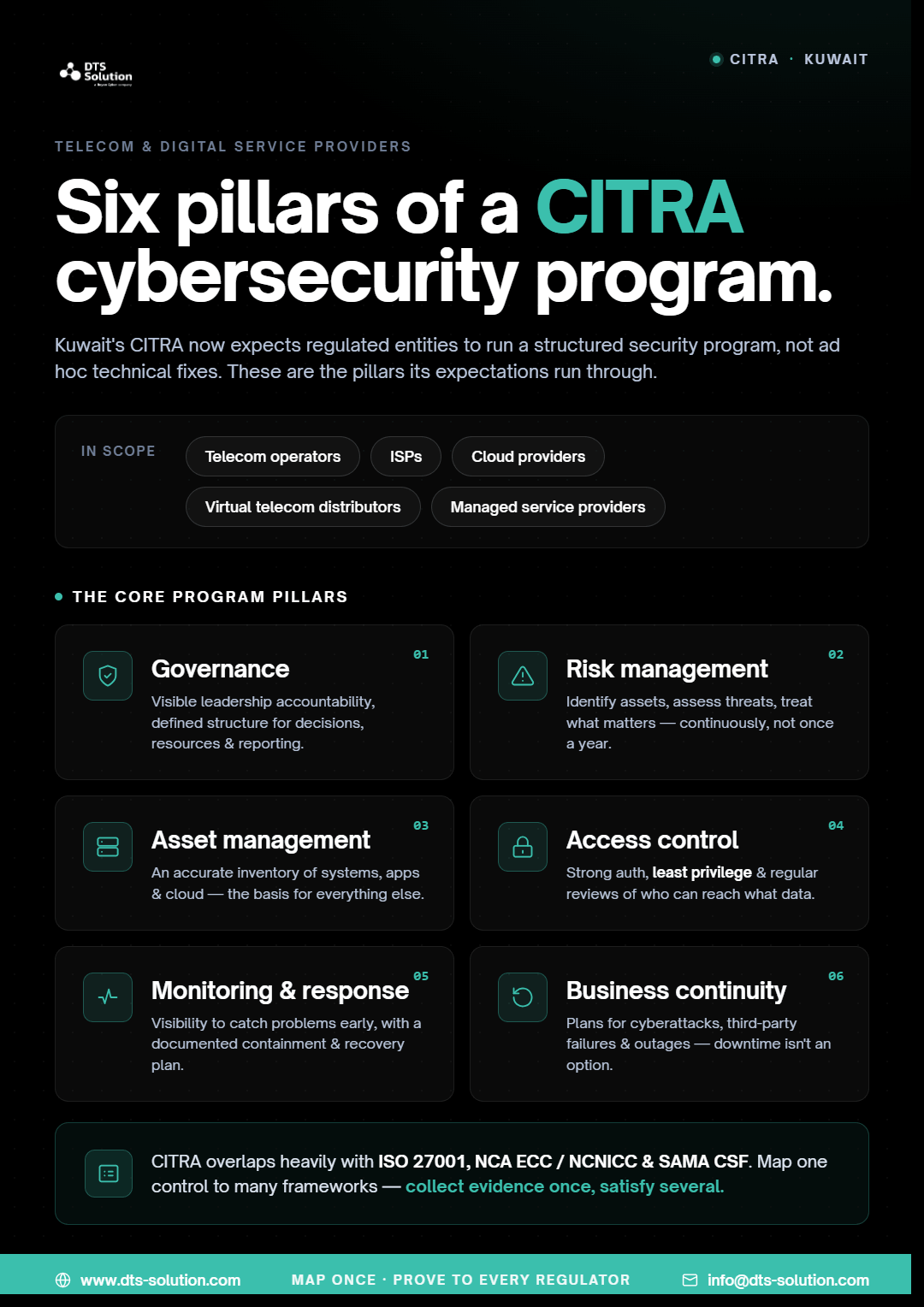
A handful of pillars run through CITRA’s expectations for regulated entities.
Governance. Leadership needs visible accountability for cybersecurity. That means a defined structure for decision-making, resource allocation, and reporting on security performance, rather than security sitting as a side function within IT.
Risk management. Providers are expected to identify assets, assess threats against them, and treat the risks that matter most. This is meant to be continuous, not a once-a-year exercise ahead of an audit.
Asset management. Knowing what systems, applications, and cloud resources exist across the organization is the basis for everything else. Without an accurate inventory, risk assessments and incident response plans rest on guesswork.
Access control. Strong authentication, least-privilege access, and regular reviews of who can reach what data reduce the most common cause of breaches: accounts with more permission than they need.
Monitoring and incident response. Providers need visibility into network and system activity to catch problems early, paired with a documented plan for containment, investigation, and recovery when something goes wrong.
Business continuity. Telecom and digital infrastructure cannot afford extended downtime. Continuity planning has to account for cyberattacks, third-party failures, and infrastructure outages alike.
Where Compliance Overlaps With Other Frameworks
CITRA’s expectations don’t sit in isolation. Many providers operating in Kuwait already work against ISO 27001, NIST CSF, PCI DSS, or other sector-specific requirements. There’s meaningful overlap between these frameworks around governance, access control, and incident response, which means a provider building toward ISO 27001 is already covering much of what CITRA asks for.
The catch is that overlap doesn’t mean duplication is harmless. Managing CITRA, ISO 27001, and other applicable frameworks as separate spreadsheets and policy sets creates duplicate work and leaves gaps where one framework’s wording differs slightly from another’s. A GRC platform built for control mapping lets providers map a single control to multiple frameworks at once, so evidence collected for one requirement satisfies several without re-doing the work each time. Complyan, a product of DTS Solution, supports this approach by centralizing control mapping, evidence, ownership, and reporting.
CITRA’s expectations don’t sit in isolation. Many providers operating in Kuwait and the wider Gulf already work against ISO 27001, the NCA’s ECC and NCNICC controls, or SAMA’s cybersecurity framework if they touch the financial sector. There’s meaningful overlap between these frameworks around governance, access control, and incident response, which means a provider building toward ISO 27001 is already covering much of what CITRA asks for.
The catch is that overlap doesn’t mean duplication is harmless. Managing CITRA, ISO 27001, and any sector-specific GCC framework as separate spreadsheets and policy sets creates duplicate work and leaves gaps where one framework’s wording differs slightly from another’s. A GRC platform built for control mapping lets providers map a single control to multiple frameworks at once, so evidence collected for one requirement satisfies several without re-doing the work each time.
Common Difficulties Providers Run Into
Three problems show up repeatedly. First, fragmented ownership: policies live with one team, risk registers with another, and audit evidence somewhere else entirely, so nobody has a full picture of compliance status. Second, manual evidence gathering: teams spend weeks before an audit chasing screenshots, logs, and sign-offs instead of working from a live record. Third, weak visibility into third parties: distributors, cloud vendors, and contractors introduce risk that often goes untracked until something fails.
For organizations managing multiple regulatory obligations across the Gulf, building a structured compliance automation approach addresses all three by centralizing evidence, automating reminders for control reviews, and giving a single dashboard view of where gaps remain.
Data Protection Is Receiving Greater Attention
Data privacy and protection requirements continue to evolve throughout the Gulf region, including Kuwait.
Telecom operators and digital service providers process large volumes of customer information, usage records, transactional data, and business communications. This creates significant obligations around data handling and security.
Organizations must ensure that information is collected, processed, stored, and shared appropriately while maintaining effective safeguards against unauthorized access or misuse.
As regulatory expectations mature, organizations that already maintain strong data governance practices will be better positioned to adapt to future requirements.
Third-Party Risk Cannot Be Ignored
Modern telecommunications and digital services rely heavily on external vendors.
Cloud providers, software vendors, managed service providers, contractors, and business partners all play important roles in service delivery.
These relationships also introduce risk.
A weakness in one supplier can affect the security and availability of multiple organizations simultaneously. Recent supply chain incidents across the technology industry have demonstrated how trusted third parties can become attractive targets for attackers.
CITRA compliance increasingly requires organizations to evaluate third-party relationships carefully, assess vendor risks, and maintain appropriate oversight of external service providers.
Third-party governance has become a core component of modern cybersecurity programs.
Telecommunications and digital services form the backbone of Kuwait’s economy.
From mobile networks and cloud services to digital platforms and internet service providers, organizations in this sector handle vast amounts of customer information and support services that millions of people rely on every day. As cyber threats continue targeting critical infrastructure and data-driven services, regulatory oversight has become increasingly important.
This is where the Communications and Information Technology Regulatory Authority (CITRA) plays a central role.
CITRA’s regulatory framework extends beyond licensing and telecommunications oversight. It increasingly addresses cybersecurity, cloud governance, data protection, and operational resilience for organizations operating within Kuwait’s communications and technology sectors.
For telecom operators and digital service providers, compliance is no longer simply a regulatory obligation. It has become a critical component of maintaining customer trust, operational resilience, and long-term business sustainability.
DTS Solution supports telecom operators and digital service providers in Kuwait through cybersecurity advisory, regulatory compliance, security engineering, and managed security capabilities aligned with local requirements.
What CITRA Does
CITRA was established to regulate telecommunications and information technology services across Kuwait. Its mandate covers spectrum allocation, licensing of telecom operators, consumer protection, and increasingly, cybersecurity oversight for the infrastructure that underpins the country’s digital economy.
As more services move onto cloud platforms and mobile networks carry more sensitive data, CITRA’s cybersecurity expectations have grown alongside that shift. The authority now expects regulated entities to run structured security programs covering governance, risk management, access control, monitoring, and incident response, rather than relying on ad hoc technical fixes.
Who Falls Under CITRA's Scope
CITRA was established to regulate telecommunications and information technology services across Kuwait. Its mandate covers spectrum allocation, licensing of telecom operators, consumer protection, and increasingly, cybersecurity oversight for the infrastructure that underpins the country’s digital economy.
As more services move onto cloud platforms and mobile networks carry more sensitive data, CITRA’s cybersecurity expectations have grown alongside that shift. The authority now expects regulated entities to run structured security programs covering governance, risk management, access control, monitoring, and incident response, rather than relying on ad hoc technical fixes.
Core Areas of a CITRA Cybersecurity Program
A handful of pillars run through CITRA’s expectations for regulated entities.
Governance. Leadership needs visible accountability for cybersecurity. That means a defined structure for decision-making, resource allocation, and reporting on security performance, rather than security sitting as a side function within IT.
Risk management. Providers are expected to identify assets, assess threats against them, and treat the risks that matter most. This is meant to be continuous, not a once-a-year exercise ahead of an audit.
Asset management. Knowing what systems, applications, and cloud resources exist across the organization is the basis for everything else. Without an accurate inventory, risk assessments and incident response plans rest on guesswork.
Access control. Strong authentication, least-privilege access, and regular reviews of who can reach what data reduce the most common cause of breaches: accounts with more permission than they need.
Monitoring and incident response. Providers need visibility into network and system activity to catch problems early, paired with a documented plan for containment, investigation, and recovery when something goes wrong.
Business continuity. Telecom and digital infrastructure cannot afford extended downtime. Continuity planning has to account for cyberattacks, third-party failures, and infrastructure outages alike.
Where Compliance Overlaps With Other Frameworks
CITRA’s expectations don’t sit in isolation. Many providers operating in Kuwait already work against ISO 27001, NIST CSF, PCI DSS, or other sector-specific requirements. There’s meaningful overlap between these frameworks around governance, access control, and incident response, which means a provider building toward ISO 27001 is already covering much of what CITRA asks for.
The catch is that overlap doesn’t mean duplication is harmless. Managing CITRA, ISO 27001, and other applicable frameworks as separate spreadsheets and policy sets creates duplicate work and leaves gaps where one framework’s wording differs slightly from another’s. A GRC platform built for control mapping lets providers map a single control to multiple frameworks at once, so evidence collected for one requirement satisfies several without re-doing the work each time. Complyan, a product of DTS Solution, supports this approach by centralizing control mapping, evidence, ownership, and reporting.
Common Difficulties Providers Run Into
Three problems show up repeatedly. First, fragmented ownership: policies live with one team, risk registers with another, and audit evidence somewhere else entirely, so nobody has a full picture of compliance status. Second, manual evidence gathering: teams spend weeks before an audit chasing screenshots, logs, and sign-offs instead of working from a live record. Third, weak visibility into third parties: distributors, cloud vendors, and contractors introduce risk that often goes untracked until something fails.
For organizations managing multiple regulatory obligations across the Gulf, building a structured compliance automation approach addresses all three by centralizing evidence, automating reminders for control reviews, and giving a single dashboard view of where gaps remain.
Data Protection Is Receiving Greater Attention
Data privacy and protection requirements continue to evolve throughout the Gulf region, including Kuwait.
Telecom operators and digital service providers process large volumes of customer information, usage records, transactional data, and business communications. This creates significant obligations around data handling and security.
Organizations must ensure that information is collected, processed, stored, and shared appropriately while maintaining effective safeguards against unauthorized access or misuse.
As regulatory expectations mature, organizations that already maintain strong data governance practices will be better positioned to adapt to future requirements.
Third-Party Risk Cannot Be Ignored
Modern telecommunications and digital services rely heavily on external vendors.
Cloud providers, software vendors, managed service providers, contractors, and business partners all play important roles in service delivery.
These relationships also introduce risk.
A weakness in one supplier can affect the security and availability of multiple organizations simultaneously. Recent supply chain incidents across the technology industry have demonstrated how trusted third parties can become attractive targets for attackers.
CITRA compliance increasingly requires organizations to evaluate third-party relationships carefully, assess vendor risks, and maintain appropriate oversight of external service providers.
Third-party governance has become a core component of modern cybersecurity programs.
Building Toward Compliance
A few practical steps make the difference between a program that survives one audit and one that holds up year after year.
Get executive sponsorship early, since security initiatives stall without budget and authority behind them. Centralize governance so policy management, risk tracking, and audit evidence live in one place rather than scattered across teams. Move from periodic checks to continuous monitoring wherever the budget allows, since point-in-time snapshots miss the gaps that open up between audits. Build third-party oversight into the program from the start, particularly given CITRA’s growing focus on distributors and service partners. And revisit the program regularly rather than treating certification as a finish line.
How DTS Solution Supports CITRA Compliance in Kuwait
- DTS Solution assists telecom operators and digital service providers with CITRA scope reviews, gap assessments, cybersecurity governance, control implementation, and audit readiness.
- DTS Solution helps providers strengthen network and cloud security, monitoring, incident response, business continuity, and third-party oversight through advisory, engineering, and managed security services.
- DTS Solution covers the compliance cycle from assessment and remediation planning to evidence management and continuous control monitoring, helping teams maintain a clear view of CITRA readiness.
Organizations in Kuwait can contact DTS Solution to assess their current CITRA posture and define a practical compliance roadmap.
Closing Thoughts
CITRA’s requirements reflect where Kuwait’s telecom and technology sectors are headed: more scrutiny on distributors, tighter expectations around cybersecurity governance, and closer alignment with international standards like ISO 27001. For telecom operators, ISPs, and digital service providers, building a structured, well-documented security program isn’t just about passing an audit. It’s about keeping services running and customer data protected in a market that depends on both.
Providers that treat CITRA alongside other regional frameworks, rather than as a separate checklist, tend to spend less time on compliance overhead and more time on the controls that actually reduce risk.
Building Toward Compliance
A few practical steps make the difference between a program that survives one audit and one that holds up year after year.
Get executive sponsorship early, since security initiatives stall without budget and authority behind them. Centralize governance so policy management, risk tracking, and audit evidence live in one place rather than scattered across teams. Move from periodic checks to continuous monitoring wherever the budget allows, since point-in-time snapshots miss the gaps that open up between audits. Build third-party oversight into the program from the start, particularly given CITRA’s growing focus on distributors and service partners. And revisit the program regularly rather than treating certification as a finish line.
How DTS Solution Supports CITRA Compliance in Kuwait
- DTS Solution assists telecom operators and digital service providers with CITRA scope reviews, gap assessments, cybersecurity governance, control implementation, and audit readiness.
- DTS Solution helps providers strengthen network and cloud security, monitoring, incident response, business continuity, and third-party oversight through advisory, engineering, and managed security services.
- DTS Solution covers the compliance cycle from assessment and remediation planning to evidence management and continuous control monitoring, helping teams maintain a clear view of CITRA readiness.
Organizations in Kuwait can contact DTS Solution to assess their current CITRA posture and define a practical compliance roadmap.
Closing Thoughts
CITRA’s requirements reflect where Kuwait’s telecom and technology sectors are headed: more scrutiny on distributors, tighter expectations around cybersecurity governance, and closer alignment with international standards like ISO 27001. For telecom operators, ISPs, and digital service providers, building a structured, well-documented security program isn’t just about passing an audit. It’s about keeping services running and customer data protected in a market that depends on both.
Providers that treat CITRA alongside other regional frameworks, rather than as a separate checklist, tend to spend less time on compliance overhead and more time on the controls that actually reduce risk.
See also:




 Dubai
Dubai