
 Cyber Strategy
 Cyber Secure
 Cyber Operations
 Cyber Response
 Cyber Resilience
CBK CORF Kuwait has replaced the old conversation around the 2020 Cybersecurity Framework with a stronger focus on cyber and operational resilience. Launched by the Central Bank of Kuwait on 3 December 2025, the Cyber and Operational Resilience Framework applies to local banks and financial institutions in Kuwait and marks a clear transition from foundational cybersecurity compliance to a resilience-first regulatory model. For financial institutions that need compliance advisory, cyber risk support, technical assurance, incident response, and managed security operations, DTS Solution helps Kuwait-based teams prepare for this new regulatory expectation.
The shift matters because CORF is not simply a renamed version of the CBK Cybersecurity Framework. The 2020 CSF focused on building cybersecurity control foundations across the banking sector. CORF raises the expectation by asking regulated entities to show that critical services can withstand disruption, recover within defined limits, manage third-party dependencies, and prove control maturity through evidence.
From CBK CSF 2020 to CBK CORF 2025
The Central Bank of Kuwait describes CORF as the next step in its regulatory strategy, moving from foundational cybersecurity compliance under the 2020 Cybersecurity Framework to a resilience-first and maturity-oriented model in 2025.
That transition changes the way banks and financial institutions should approach compliance. Under the old model, many teams focused heavily on control implementation, policies, audit evidence, and cybersecurity governance. Those remain important, but CORF pushes further. It asks whether the institution can keep critical operations running during cyber incidents, technology failures, third-party outages, payment disruption, cloud service issues, and wider operational stress.
For boards, CISOs, risk teams, compliance leaders, and internal audit, the question is no longer only “Are the controls implemented?” The stronger question is “Can the institution continue operating when those controls are tested?”
Who falls under CBK CORF?
RSM Kuwait’s point of view on CORF states that the framework applies to Kuwaiti banks, foreign banks operating in Kuwait, exchange companies, finance companies, e-payment of funds companies, credit information companies, and open banking service providers.
This broad scope matters because the financial sector is now more connected than before. A banking service may depend on payment processors, cloud providers, outsourced operations, fintech integrations, open banking providers, call centers, managed service providers, and security vendors. CORF recognizes that operational resilience is not controlled by the bank alone. It depends on the full chain of people, process, technology, and third-party service delivery.
What changed structurally?
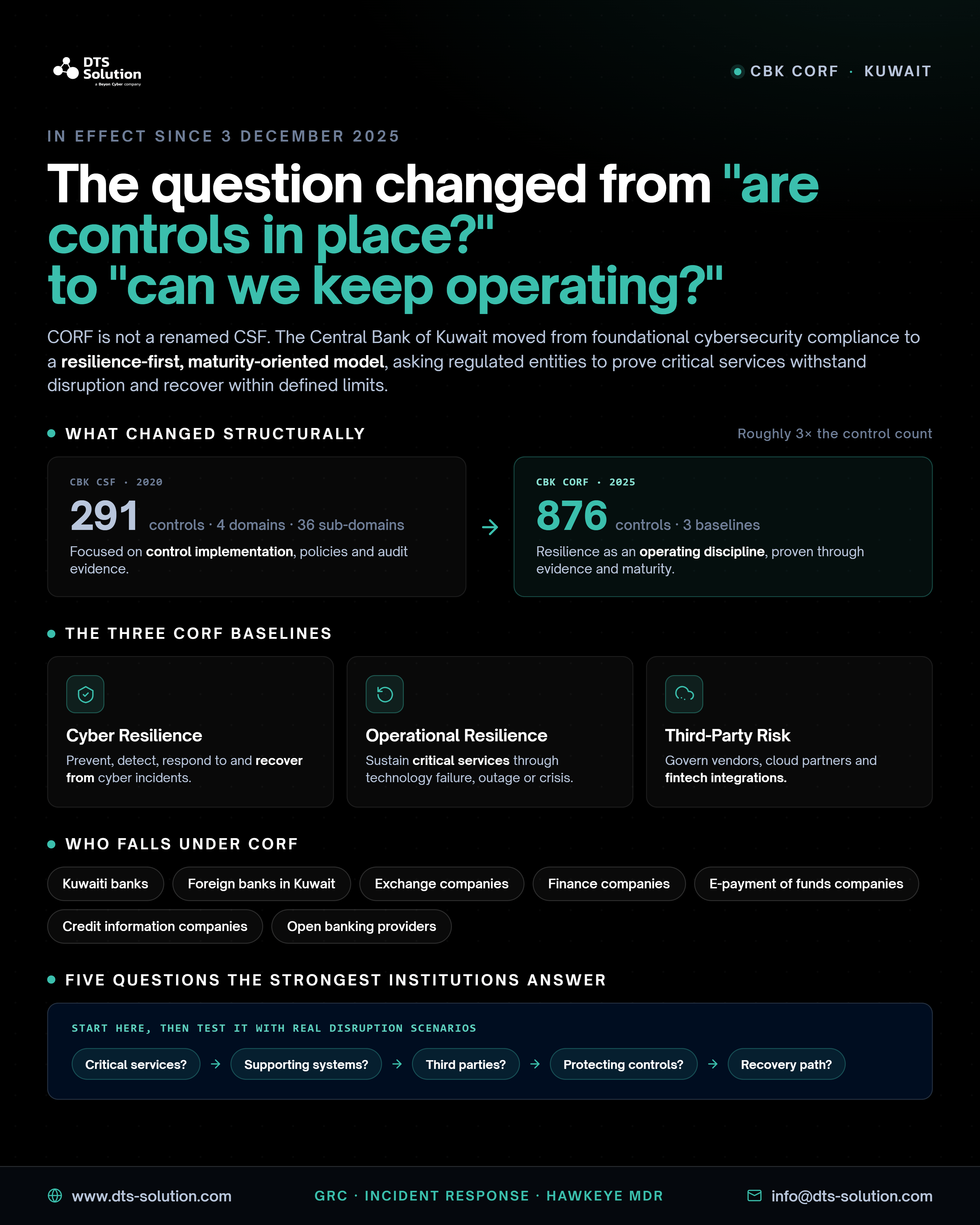
The old CBK CSF had 4 domains, 36 sub-domains, and 291 controls. CORF is significantly larger. RSM’s analysis states that CORF is structured around 3 baselines and has 876 controls across cyber resilience, operational resilience, and third-party risk management.
That expansion is the real story. CORF is not asking institutions to only secure systems. It is asking them to manage resilience as an operating discipline.
The three major areas are:
Cyber Resilience: How well the institution prevents, detects, responds to, and recovers from cyber incidents.
Operational Resilience: How well the institution sustains critical services through technology failure, service disruption, process breakdown, or crisis events.
Third-Party Risk Management: How well the institution governs vendors, outsourced service providers, cloud partners, fintech integrations, and other external dependencies.
This structure forces financial institutions to connect cybersecurity with business continuity, incident response, vendor oversight, crisis management, and executive accountability.
CORF Raises the Bar Beyond Control Mapping
CBK CSF gave financial institutions a structured way to document cybersecurity controls, map evidence, and prepare for regulatory review. CORF expands that expectation into cyber and operational resilience.
A bank may have strong access controls, but can critical payment services continue during a major outage? Incident response policies may be approved, but have teams tested them against realistic disruption scenarios? A third-party provider may submit a SOC 2 report, but that does not confirm how the vendor will support recovery during a live banking incident.
CORF brings these questions into focus because resilience depends on performance under pressure. Policies, dashboards, and control registers will not be enough if critical services cannot recover within acceptable timelines.
Evidence will also become harder to manage. Financial institutions will need proof of resilience testing, critical service mapping, recovery objectives, incident escalation, third-party dependency analysis, crisis communication, cyber monitoring, remediation tracking, and management oversight.
The shift is clear: CBK CORF expects institutions to show that controls are working, services can withstand disruption, and recovery plans have been tested before a crisis exposes the gaps.
Immediate Priorities for Financial Institutions
CORF should not sit with cybersecurity alone: Banks and financial institutions need a working group that brings together cybersecurity, IT operations, business continuity, enterprise risk, legal, procurement, internal audit, cloud teams, and business owners.
Start by mapping the move from CSF to CORF: Institutions that already worked toward CBK CSF should identify which controls carry forward, which areas have expanded, and which resilience requirements now need fresh evidence.
Critical business services should come next: Payment processing, digital banking, ATM services, card operations, treasury functions, customer authentication, settlement processes, and regulatory reporting all need to be mapped to the systems, teams, vendors, and recovery processes that support them.
Third-party dependencies also need closer review: Banks should know which providers support critical services, how incidents will be reported, what happens if a provider fails, and what evidence proves the vendor can meet resilience expectations.
Testing should become part of the compliance calendar: Tabletop exercises, cyber crisis simulations, incident response drills, recovery testing, and third-party disruption scenarios will give leadership a clearer view of resilience gaps before CBK scrutiny or a real incident exposes them.
How DTS Solution Supports CORF Readiness
CBK CORF raises the bar from cybersecurity compliance to cyber and operational resilience. That means financial institutions need more than a gap assessment. They need a clear view of critical services, supporting systems, third-party dependencies, response capability, recovery readiness, and the evidence needed to prove control maturity.
DTS Solution supports Kuwaiti financial institutions through this transition by combining regulatory advisory, technical assurance, incident response, and managed security operations. The work starts with understanding how the institution currently aligns with CBK CORF, then identifying the gaps that could affect resilience, audit readiness, or continuity of critical banking services.
For banks, exchange companies, payment firms, and financial service providers, this support can include CORF readiness assessment, control mapping, third-party risk review, cyber resilience testing, incident response planning, tabletop exercises, evidence preparation, and executive reporting.
The value is not only in identifying what is missing. It is in helping teams turn CORF into an operating program with clear owners, measurable remediation, tested recovery processes, and leadership visibility.
DTS Solution’s financial services cybersecurity experience, GRC advisory capability, incident response practice, and managed detection services help institutions connect compliance requirements with real operational resilience. That is what CBK CORF now demands: not only stronger controls, but proof that the organization can withstand disruption and recover with discipline.
Final note
CBK CORF has been in effect since December 2025, and it changes the compliance conversation for Kuwait’s financial sector. The old CSF mindset of control implementation and audit readiness is no longer enough. Banks and financial institutions now need to prove that their critical services can withstand disruption, recover quickly, and manage third-party exposure with discipline.
The strongest institutions will be those that can answer five questions clearly: which services are critical, which systems support them, which third parties they depend on, what controls protect them, and how recovery will work when something fails.
DTS Solution helps Kuwait’s financial institutions make that transition from cybersecurity compliance to cyber and operational resilience.
CBK CORF Kuwait has replaced the old conversation around the 2020 Cybersecurity Framework with a stronger focus on cyber and operational resilience. Launched by the Central Bank of Kuwait on 3 December 2025, the Cyber and Operational Resilience Framework applies to local banks and financial institutions in Kuwait and marks a clear transition from foundational cybersecurity compliance to a resilience-first regulatory model. For financial institutions that need compliance advisory, cyber risk support, technical assurance, incident response, and managed security operations, DTS Solution helps Kuwait-based teams prepare for this new regulatory expectation.
The shift matters because CORF is not simply a renamed version of the CBK Cybersecurity Framework. The 2020 CSF focused on building cybersecurity control foundations across the banking sector. CORF raises the expectation by asking regulated entities to show that critical services can withstand disruption, recover within defined limits, manage third-party dependencies, and prove control maturity through evidence.
From CBK CSF 2020 to CBK CORF 2025
The Central Bank of Kuwait describes CORF as the next step in its regulatory strategy, moving from foundational cybersecurity compliance under the 2020 Cybersecurity Framework to a resilience-first and maturity-oriented model in 2025.
That transition changes the way banks and financial institutions should approach compliance. Under the old model, many teams focused heavily on control implementation, policies, audit evidence, and cybersecurity governance. Those remain important, but CORF pushes further. It asks whether the institution can keep critical operations running during cyber incidents, technology failures, third-party outages, payment disruption, cloud service issues, and wider operational stress.
For boards, CISOs, risk teams, compliance leaders, and internal audit, the question is no longer only “Are the controls implemented?” The stronger question is “Can the institution continue operating when those controls are tested?”
Who falls under CBK CORF?
RSM Kuwait’s point of view on CORF states that the framework applies to Kuwaiti banks, foreign banks operating in Kuwait, exchange companies, finance companies, e-payment of funds companies, credit information companies, and open banking service providers.
This broad scope matters because the financial sector is now more connected than before. A banking service may depend on payment processors, cloud providers, outsourced operations, fintech integrations, open banking providers, call centers, managed service providers, and security vendors. CORF recognizes that operational resilience is not controlled by the bank alone. It depends on the full chain of people, process, technology, and third-party service delivery.
What changed structurally?
The old CBK CSF had 4 domains, 36 sub-domains, and 291 controls. CORF is significantly larger. RSM’s analysis states that CORF is structured around 3 baselines and has 876 controls across cyber resilience, operational resilience, and third-party risk management.
That expansion is the real story. CORF is not asking institutions to only secure systems. It is asking them to manage resilience as an operating discipline.
The three major areas are:
Cyber Resilience: How well the institution prevents, detects, responds to, and recovers from cyber incidents.
Operational Resilience: How well the institution sustains critical services through technology failure, service disruption, process breakdown, or crisis events.
Third-Party Risk Management: How well the institution governs vendors, outsourced service providers, cloud partners, fintech integrations, and other external dependencies.
This structure forces financial institutions to connect cybersecurity with business continuity, incident response, vendor oversight, crisis management, and executive accountability.
CORF Raises the Bar Beyond Control Mapping
CBK CSF gave financial institutions a structured way to document cybersecurity controls, map evidence, and prepare for regulatory review. CORF expands that expectation into cyber and operational resilience.
A bank may have strong access controls, but can critical payment services continue during a major outage? Incident response policies may be approved, but have teams tested them against realistic disruption scenarios? A third-party provider may submit a SOC 2 report, but that does not confirm how the vendor will support recovery during a live banking incident.
CORF brings these questions into focus because resilience depends on performance under pressure. Policies, dashboards, and control registers will not be enough if critical services cannot recover within acceptable timelines.
Evidence will also become harder to manage. Financial institutions will need proof of resilience testing, critical service mapping, recovery objectives, incident escalation, third-party dependency analysis, crisis communication, cyber monitoring, remediation tracking, and management oversight.
The shift is clear: CBK CORF expects institutions to show that controls are working, services can withstand disruption, and recovery plans have been tested before a crisis exposes the gaps.
Immediate Priorities for Financial Institutions
CORF should not sit with cybersecurity alone: Banks and financial institutions need a working group that brings together cybersecurity, IT operations, business continuity, enterprise risk, legal, procurement, internal audit, cloud teams, and business owners.
Start by mapping the move from CSF to CORF: Institutions that already worked toward CBK CSF should identify which controls carry forward, which areas have expanded, and which resilience requirements now need fresh evidence.
Critical business services should come next: Payment processing, digital banking, ATM services, card operations, treasury functions, customer authentication, settlement processes, and regulatory reporting all need to be mapped to the systems, teams, vendors, and recovery processes that support them.
Third-party dependencies also need closer review: Banks should know which providers support critical services, how incidents will be reported, what happens if a provider fails, and what evidence proves the vendor can meet resilience expectations.
Testing should become part of the compliance calendar: Tabletop exercises, cyber crisis simulations, incident response drills, recovery testing, and third-party disruption scenarios will give leadership a clearer view of resilience gaps before CBK scrutiny or a real incident exposes them.
How DTS Solution Supports CORF Readiness
CBK CORF raises the bar from cybersecurity compliance to cyber and operational resilience. That means financial institutions need more than a gap assessment. They need a clear view of critical services, supporting systems, third-party dependencies, response capability, recovery readiness, and the evidence needed to prove control maturity.
DTS Solution supports Kuwaiti financial institutions through this transition by combining regulatory advisory, technical assurance, incident response, and managed security operations. The work starts with understanding how the institution currently aligns with CBK CORF, then identifying the gaps that could affect resilience, audit readiness, or continuity of critical banking services.
For banks, exchange companies, payment firms, and financial service providers, this support can include CORF readiness assessment, control mapping, third-party risk review, cyber resilience testing, incident response planning, tabletop exercises, evidence preparation, and executive reporting.
The value is not only in identifying what is missing. It is in helping teams turn CORF into an operating program with clear owners, measurable remediation, tested recovery processes, and leadership visibility.
DTS Solution’s financial services cybersecurity experience, GRC advisory capability, incident response practice, and managed detection services help institutions connect compliance requirements with real operational resilience. That is what CBK CORF now demands: not only stronger controls, but proof that the organization can withstand disruption and recover with discipline.
Final note
CBK CORF has been in effect since December 2025, and it changes the compliance conversation for Kuwait’s financial sector. The old CSF mindset of control implementation and audit readiness is no longer enough. Banks and financial institutions now need to prove that their critical services can withstand disruption, recover quickly, and manage third-party exposure with discipline.
The strongest institutions will be those that can answer five questions clearly: which services are critical, which systems support them, which third parties they depend on, what controls protect them, and how recovery will work when something fails.
DTS Solution helps Kuwait’s financial institutions make that transition from cybersecurity compliance to cyber and operational resilience.





 Dubai
Dubai