
 Cyber Strategy
 Cyber Secure
 Cyber Operations
 Cyber Response
 Cyber Resilience
Pentesting in Saudi Arabia has moved from a routine technical exercise to a board-level assurance requirement for CISOs. As Saudi organizations expand cloud workloads, customer-facing applications, mobile channels, APIs, and connected infrastructure, security leaders need penetration testing programs that reveal exploitable weaknesses, support regulatory evidence, and drive remediation beyond the report. DTS Solution assists CISOs in Saudi Arabia with penetration testing programmes that support regulatory evidence, remediation validation, and measurable risk reduction.
For CISOs, the real question is no longer whether to test. It is how often to test, what to include in scope, how to select the right provider, and how to convert findings into measurable risk reduction.
Why Pentesting Matters for Saudi Arabia's CISOs
Saudi Arabia’s cyber maturity has grown quickly because regulation, national infrastructure investment, and sector modernization are moving together. Government entities, banks, fintechs, healthcare providers, telecom operators, energy organizations, and cloud service providers all face higher expectations from regulators, customers, boards, and partners.
A penetration test gives the CISO a controlled view of how attackers may chain weaknesses across systems. A vulnerability scan may show missing patches or exposed services. A proper pentest goes further by testing whether those weaknesses can lead to privilege escalation, data exposure, lateral movement, payment fraud, account takeover, or disruption of critical services.
That distinction matters in Saudi Arabia because compliance evidence must increasingly prove operational security, not only policy maturity.
Saudi Arabia’s National Cybersecurity Authority (NCA) treats penetration testing as a mandatory control under the Essential Cybersecurity Controls (ECC). It is not an optional add-on. Government entities, critical infrastructure operators, and many private organizations working with sensitive data or government contracts fall within scope. For a CISO, that means pentesting sits alongside governance and risk management as a core compliance deliverable. It ties directly into frameworks like the ECC and, for financial institutions, the SAMA Cybersecurity Framework.
What the NCA Requires
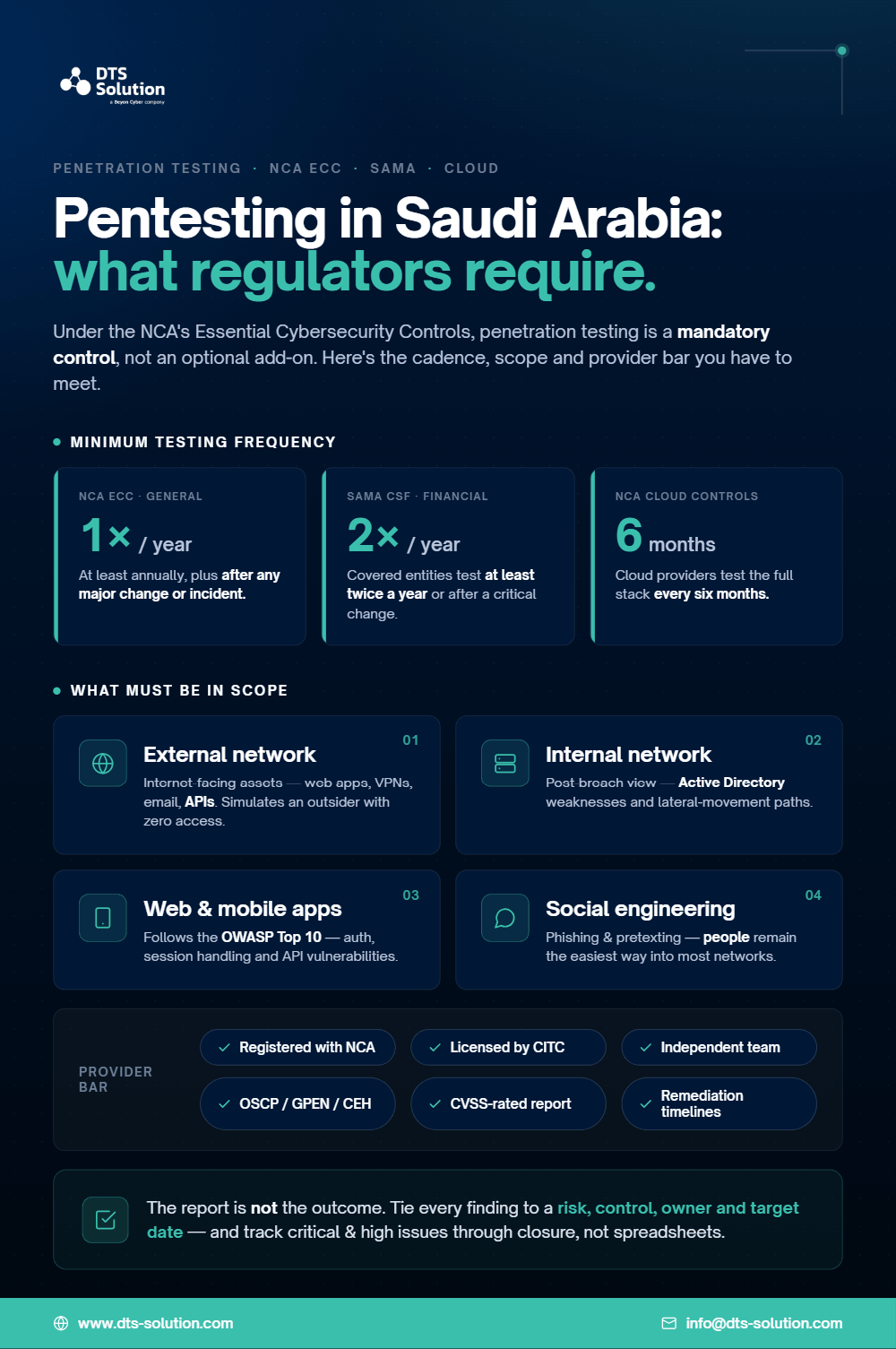
The ECC lays out specific expectations CISOs need to build into their annual security calendar:
- A full penetration test must run at least once a year. Additional rounds follow major infrastructure changes or security incidents.
- Testing has to be carried out by an independent team, separate from whoever builds or manages the systems in scope.
- Providers must be registered with the NCA and licensed by CITC. Testers should hold recognized certifications such as OSCP, GPEN, or CEH.
- Final reports need a documented methodology, CVSS-rated vulnerabilities, reproduction steps, and remediation timelines.
Skipping any of these steps can leave an organization technically “tested” but still out of compliance.
The regulatory angle CISOs cannot ignore
Saudi Arabia’s National Cybersecurity Authority Essential Cybersecurity Controls set minimum cybersecurity requirements for information and technology assets, with scope covering government organizations and private sector entities that own, operate, or host Critical National Infrastructure. The ECC also encourages other organizations in the Kingdom to use the controls as a cybersecurity baseline.
For financial institutions, the Saudi Central Bank rulebook is explicit. Covered entities should conduct comprehensive vulnerability assessments across application and infrastructure layers, and should perform penetration testing at least twice a year or after a major or critical change.
Cloud also requires special attention. NCA Cloud Cybersecurity Controls state that penetration testing for cloud service providers must cover the cloud technology stack and be conducted at least once every six months. This is important for CISOs using SaaS platforms, hosting providers, managed cloud services, or hybrid cloud architecture.
The point is simple: pentesting cannot be treated as an annual PDF created for audit season. For many Saudi organizations, testing has to be tied to risk, regulatory scope, system change, and cloud exposure.
Scope: Where Pentesting Should Look
A test that only covers a company website misses most of the real risk. The NCA expects scope to cover four areas at minimum.
External network testing covers internet-facing assets like web applications, VPN gateways, email systems, and APIs. It simulates an outsider with zero prior access.
Internal network testing looks at what happens once an attacker is already inside, whether through a breach or a compromised employee account. This includes Active Directory weaknesses and lateral movement paths.
Web and mobile application testing follows the OWASP Top 10. It checks authentication, session handling, and API vulnerabilities.
Social engineering testing measures how employees respond to phishing and pretexting attempts. People remain the easiest way into most networks.
Choosing a pentesting partner in Saudi Arabia
A strong provider should bring more than automated tools. The CISO should look for regional regulatory knowledge, clear methodology, qualified testers, safe testing procedures, strong reporting, and a remediation workshop after delivery.
Before approving a provider, ask these questions:
- Are the testers qualified for the systems being tested?
- Does the methodology cover reconnaissance, exploitation, privilege escalation, impact analysis, and retesting?
- Will the report map findings to business risk and relevant controls?
- Will the provider support evidence needed for NCA, SAMA, ISO 27001, PCI DSS, or internal audit?
- How will sensitive data, credentials, logs, and exploit evidence be handled?
- Will there be a formal retest after remediation?
DTS Solution provides penetration testing and cybersecurity services for organizations across Saudi Arabia, including Riyadh-based support for security assessments, compliance advisory, managed SOC, incident response, and GRC consulting. You can also explore DTS Solution’s dedicated penetration testing services for more detail.
Pentesting in Saudi Arabia has moved from a routine technical exercise to a board-level assurance requirement for CISOs. As Saudi organizations expand cloud workloads, customer-facing applications, mobile channels, APIs, and connected infrastructure, security leaders need penetration testing programs that reveal exploitable weaknesses, support regulatory evidence, and drive remediation beyond the report. DTS Solution assists CISOs in Saudi Arabia with penetration testing programmes that support regulatory evidence, remediation validation, and measurable risk reduction.
For CISOs, the real question is no longer whether to test. It is how often to test, what to include in scope, how to select the right provider, and how to convert findings into measurable risk reduction.
Why Pentesting Matters for Saudi Arabia's CISOs
Saudi Arabia’s cyber maturity has grown quickly because regulation, national infrastructure investment, and sector modernization are moving together. Government entities, banks, fintechs, healthcare providers, telecom operators, energy organizations, and cloud service providers all face higher expectations from regulators, customers, boards, and partners.
A penetration test gives the CISO a controlled view of how attackers may chain weaknesses across systems. A vulnerability scan may show missing patches or exposed services. A proper pentest goes further by testing whether those weaknesses can lead to privilege escalation, data exposure, lateral movement, payment fraud, account takeover, or disruption of critical services.
That distinction matters in Saudi Arabia because compliance evidence must increasingly prove operational security, not only policy maturity.
Saudi Arabia’s National Cybersecurity Authority (NCA) treats penetration testing as a mandatory control under the Essential Cybersecurity Controls (ECC). It is not an optional add-on. Government entities, critical infrastructure operators, and many private organizations working with sensitive data or government contracts fall within scope. For a CISO, that means pentesting sits alongside governance and risk management as a core compliance deliverable. It ties directly into frameworks like the ECC and, for financial institutions, the SAMA Cybersecurity Framework.
What the NCA Requires
The ECC lays out specific expectations CISOs need to build into their annual security calendar:
- A full penetration test must run at least once a year. Additional rounds follow major infrastructure changes or security incidents.
- Testing has to be carried out by an independent team, separate from whoever builds or manages the systems in scope.
- Providers must be registered with the NCA and licensed by CITC. Testers should hold recognized certifications such as OSCP, GPEN, or CEH.
- Final reports need a documented methodology, CVSS-rated vulnerabilities, reproduction steps, and remediation timelines.
Skipping any of these steps can leave an organization technically “tested” but still out of compliance.
How CSCC Differs From the Essential Cybersecurity Controls (ECC)
Organizations already complying with the NCA Essential Cybersecurity Controls sometimes assume that CSCC introduces an entirely separate compliance program.
In practice, the relationship is different.
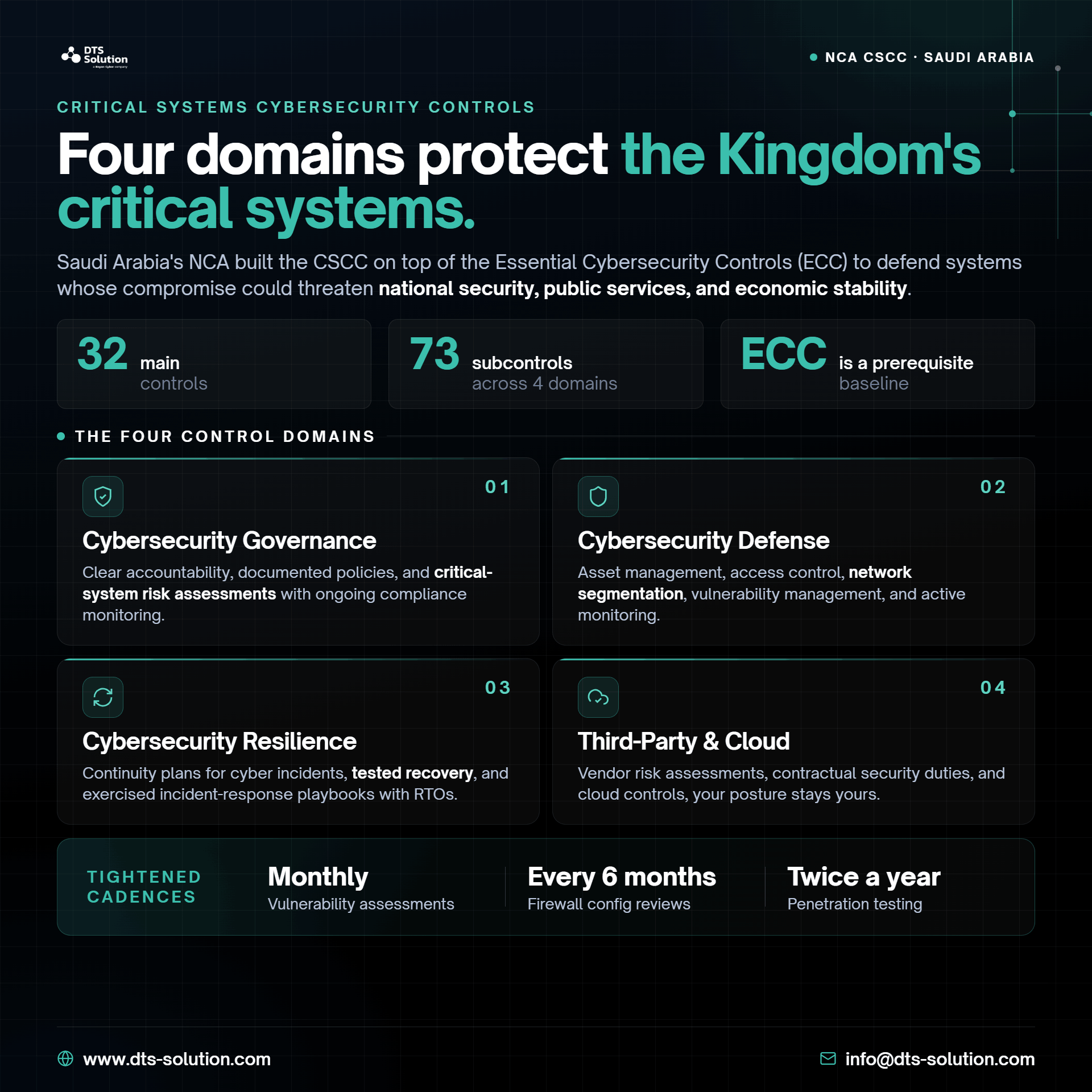
The ECC establishes the baseline cybersecurity requirements expected across regulated organizations. CSCC builds on that foundation by introducing additional controls that address the higher risks associated with critical systems.
These additional requirements strengthen areas such as:
- Critical asset identification
- Operational resilience
- Secure architecture
- Network segregation
- Third-party access
- Continuous monitoring
- Incident response
- Disaster recovery
- System availability
Organizations operating critical systems should therefore view CSCC as an extension of existing cybersecurity governance rather than a replacement for ECC.
The regulatory angle CISOs cannot ignore
Saudi Arabia’s National Cybersecurity Authority Essential Cybersecurity Controls set minimum cybersecurity requirements for information and technology assets, with scope covering government organizations and private sector entities that own, operate, or host Critical National Infrastructure. The ECC also encourages other organizations in the Kingdom to use the controls as a cybersecurity baseline.
For financial institutions, the Saudi Central Bank rulebook is explicit. Covered entities should conduct comprehensive vulnerability assessments across application and infrastructure layers, and should perform penetration testing at least twice a year or after a major or critical change.
Cloud also requires special attention. NCA Cloud Cybersecurity Controls state that penetration testing for cloud service providers must cover the cloud technology stack and be conducted at least once every six months. This is important for CISOs using SaaS platforms, hosting providers, managed cloud services, or hybrid cloud architecture.
The point is simple: pentesting cannot be treated as an annual PDF created for audit season. For many Saudi organizations, testing has to be tied to risk, regulatory scope, system change, and cloud exposure.
Scope: Where Pentesting Should Look
A test that only covers a company website misses most of the real risk. The NCA expects scope to cover four areas at minimum.
External network testing covers internet-facing assets like web applications, VPN gateways, email systems, and APIs. It simulates an outsider with zero prior access.
Internal network testing looks at what happens once an attacker is already inside, whether through a breach or a compromised employee account. This includes Active Directory weaknesses and lateral movement paths.
Web and mobile application testing follows the OWASP Top 10. It checks authentication, session handling, and API vulnerabilities.
Social engineering testing measures how employees respond to phishing and pretexting attempts. People remain the easiest way into most networks.
Choosing a pentesting partner in Saudi Arabia
A strong provider should bring more than automated tools. The CISO should look for regional regulatory knowledge, clear methodology, qualified testers, safe testing procedures, strong reporting, and a remediation workshop after delivery.
Before approving a provider, ask these questions:
- Are the testers qualified for the systems being tested?
- Does the methodology cover reconnaissance, exploitation, privilege escalation, impact analysis, and retesting?
- Will the report map findings to business risk and relevant controls?
- Will the provider support evidence needed for NCA, SAMA, ISO 27001, PCI DSS, or internal audit?
- How will sensitive data, credentials, logs, and exploit evidence be handled?
- Will there be a formal retest after remediation?
DTS Solution provides penetration testing and cybersecurity services for organizations across Saudi Arabia, including Riyadh-based support for security assessments, compliance advisory, managed SOC, incident response, and GRC consulting. You can also explore DTS Solution’s dedicated penetration testing services for more detail.
The report is not the outcome
Many pentesting programs fail after the final report. Findings are presented, severity ratings are debated, and remediation gets delayed because ownership is unclear. This weakens both security and compliance posture.
CISOs should insist on a remediation plan that includes asset owner, risk owner, target date, compensating controls, evidence requirement, and retest status. Critical and high-risk findings should be tracked through closure, not left in spreadsheets or email threads.
This is where governance matters. A platform such as Complyan Cyber Risk Management can help security and GRC teams connect pentest findings to risks, controls, owners, and mitigation plans. For organizations preparing for assessments, Complyan Audit and Compliance Management can also support gap assessments, evidence collection, and framework alignment across standards such as NCA, SAMA, ISO 27001, NIST CSF, PCI DSS, and SWIFT. Complyan, a product of DTS Solution, supports structured control mapping, evidence management, and remediation tracking.
For CISOs managing supplier exposure, pentesting should also feed third-party risk decisions. A vulnerable vendor portal, weak API integration, or insecure managed service can affect the enterprise even when internal controls are mature. Complyan Third-Party Risk Management gives teams a structured way to track vendor risk, due diligence, and remediation.
Common Mistakes CISOs Should Watch For
A handful of pitfalls show up repeatedly across Saudi organizations:
Treating pentesting as an annual checkbox instead of a continuous practice tied to change management.
Narrow scoping that leaves cloud environments, third-party integrations, or OT systems untested.
Hiring uncertified or unlicensed providers, which puts NCA compliance at risk even when the test itself is technically sound.
No remediation follow-through, leaving documented risks unresolved past the 30 or 90-day windows.
How often should CISOs test?
The right frequency depends on regulatory obligations, sector, system criticality, change volume, and business exposure. Twice a year may be the minimum for some financial entities. Cloud service providers may face six-month testing expectations under NCA Cloud Cybersecurity Controls. High-change teams may need testing after every major release, architecture shift, cloud migration, acquisition, or internet-facing deployment.
A practical model is to run full-scope testing on a defined cycle, then use targeted tests for major changes. Red team exercises, social engineering simulations, and purple team workshops can also be added for mature organizations that want to test detection and response, not only prevention.
Final note for CISOs
Pentesting in Saudi Arabia is now part of cyber governance, regulatory readiness, and board-level risk management. The value is not in proving that vulnerabilities exist. The value is in finding the weaknesses that matter, fixing them quickly, proving closure, and using the results to strengthen the wider security program.
For CISOs, the best pentesting programs are not isolated projects. They are planned, scoped, risk-ranked, retested, and connected to compliance evidence.
The report is not the outcome
Many pentesting programs fail after the final report. Findings are presented, severity ratings are debated, and remediation gets delayed because ownership is unclear. This weakens both security and compliance posture.
CISOs should insist on a remediation plan that includes asset owner, risk owner, target date, compensating controls, evidence requirement, and retest status. Critical and high-risk findings should be tracked through closure, not left in spreadsheets or email threads.
This is where governance matters. A platform such as Complyan Cyber Risk Management can help security and GRC teams connect pentest findings to risks, controls, owners, and mitigation plans. For organizations preparing for assessments, Complyan Audit and Compliance Management can also support gap assessments, evidence collection, and framework alignment across standards such as NCA, SAMA, ISO 27001, NIST CSF, PCI DSS, and SWIFT.
For CISOs managing supplier exposure, pentesting should also feed third-party risk decisions. A vulnerable vendor portal, weak API integration, or insecure managed service can affect the enterprise even when internal controls are mature. Complyan Third-Party Risk Management gives teams a structured way to track vendor risk, due diligence, and remediation.
Common Mistakes CISOs Should Watch For
A handful of pitfalls show up repeatedly across Saudi organizations:
- Treating pentesting as an annual checkbox instead of a continuous practice tied to change management.
- Narrow scoping that leaves cloud environments, third-party integrations, or OT systems untested.
- Hiring uncertified or unlicensed providers, which puts NCA compliance at risk even when the test itself is technically sound.
- No remediation follow-through, leaving documented risks unresolved past the 30 or 90-day windows.
How often should CISOs test?
The right frequency depends on regulatory obligations, sector, system criticality, change volume, and business exposure. Twice a year may be the minimum for some financial entities. Cloud service providers may face six-month testing expectations under NCA Cloud Cybersecurity Controls. High-change teams may need testing after every major release, architecture shift, cloud migration, acquisition, or internet-facing deployment.
A practical model is to run full-scope testing on a defined cycle, then use targeted tests for major changes. Red team exercises, social engineering simulations, and purple team workshops can also be added for mature organizations that want to test detection and response, not only prevention.
Final note for CISOs
Pentesting in Saudi Arabia is now part of cyber governance, regulatory readiness, and board-level risk management. The value is not in proving that vulnerabilities exist. The value is in finding the weaknesses that matter, fixing them quickly, proving closure, and using the results to strengthen the wider security program.
For CISOs, the best pentesting programs are not isolated projects. They are planned, scoped, risk-ranked, retested, and connected to compliance evidence.





 Dubai
Dubai