
 Cyber Strategy
 Cyber Secure
 Cyber Operations
 Cyber Response
 Cyber Resilience
ISO 42001 for Saudi Arabia is becoming a practical priority for organizations using artificial intelligence across customer service, analytics, fraud detection, automation, cybersecurity, HR, finance, healthcare, government services, and internal productivity tools. For Saudi organizations that need AI governance, AI security testing, risk assessment, and compliance readiness, DTS Solution Saudi Arabia supports secure AI adoption through advisory, GRC, compliance consulting, red teaming, and its S3CURE/AI framework.
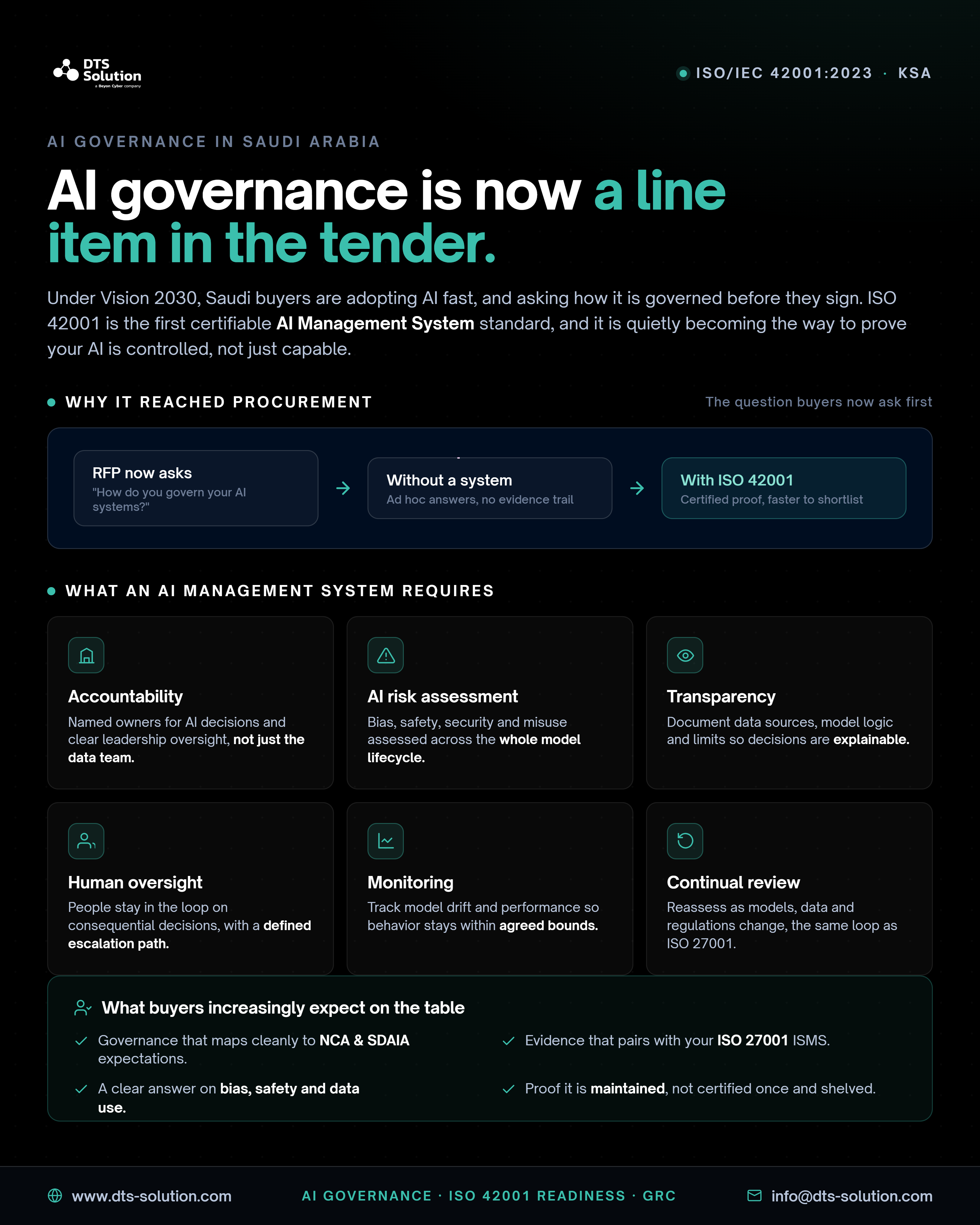
ISO/IEC 42001:2023 is the international standard for Artificial Intelligence Management Systems. ISO describes it as a standard that specifies requirements for establishing, implementing, maintaining, and continually improving an AI management system within an organization. It is designed for organizations that provide or use AI-based products or services.
For Saudi organizations, the timing matters. AI adoption is growing across public sector programs, financial services, telecom, healthcare, retail, energy, and enterprise operations. At the same time, AI risk is becoming a board-level and regulatory concern. SDAIA has also launched a national AI risk management framework to provide a unified national methodology for identifying, assessing, treating, and monitoring AI risks.
What ISO 42001 means
ISO 42001 gives organizations a structured management system for AI. It helps teams define policies, objectives, responsibilities, risk controls, monitoring, review cycles, and evidence for AI systems.
This matters because AI risk is not limited to the model itself. Risk can appear in training data, prompts, system integrations, user permissions, APIs, vendor tools, cloud environments, decision logic, output handling, and human review.
A Saudi bank may use AI for fraud triage. A healthcare provider may use AI to classify documents. A government entity may use AI to improve citizen services. A retail business may use AI for customer support. In each case, the organization needs to know what the AI system does, what data it uses, who owns it, how outputs are checked, and what happens when it fails.
A useful external reference is the official ISO/IEC 42001:2023 standard page.
Why Saudi Arabia Is Moving Faster Than Most
The signal here is unusually direct. The Saudi Data and Artificial Intelligence Authority became one of the first entities in the world to achieve ISO 42001 certification, in June 2024, for its own AI management system. When the national body responsible for regulating AI certifies itself before any private sector organization has done the same, the message to the market is unambiguous: this is the standard Saudi Arabia is building its AI governance expectations around.
Vision 2030 gives this real economic weight. AI is projected to contribute roughly 135 billion dollars to Saudi GDP by 2030, and giga-projects, smart city initiatives, and government digital services are all being built with AI woven directly into how they operate. The Kingdom’s Personal Data Protection Law, enforced since September 2024 with fines reaching 5 million riyals, already touches AI-driven data processing directly, and a dedicated Saudi AI law is expected within the next two years, likely incorporating ISO 42001 principles as a baseline expectation rather than a voluntary add-on.
Why ISO 42001 matters in Saudi Arabia
Saudi organizations are adopting AI through SaaS platforms, copilots, customer portals, document automation, security tools, analytics products, and third-party systems. Some use AI directly. Others inherit AI through vendors.
That creates a governance problem. Security and compliance teams may not have a complete list of AI tools in use. Procurement may not ask the right vendor questions. Legal may not know which data is being processed. Business teams may rely on AI-generated output without a clear review process.
ISO 42001 helps bring order to this. It gives leadership a way to manage AI through ownership, risk assessment, controls, evidence, and continual review.
For CISOs, compliance leaders, and technology executives in Saudi Arabia, the message is simple: AI must have an owner, a purpose, a risk rating, approved data handling rules, security controls, and a review process.
The Governance Gap Most Organizations Are Sitting In
Three patterns show up repeatedly across organizations still early in their AI governance journey.
Undocumented AI use: Teams adopt AI tools without formal risk assessments or audit trails, and when a regulator or procurement body eventually asks for evidence of governance, there is nothing to produce.
Framework fragmentation: Organizations bolt AI risk onto their existing ISO 27001 or NCA-aligned cybersecurity controls as an afterthought, missing the AI-specific risks those frameworks were never designed to address, such as model bias, data provenance, and explainability.
Supplier chain exposure: Even a well-governed internal AI program can be undermined by vendors and subcontractors operating without equivalent oversight, since a growing share of Saudi procurement now expects visibility into supplier AI governance as a contract condition.
Building on What Already Exists, Not Starting Over
The efficient path into ISO 42001 rarely means starting from a blank page. Organizations that already run an ISO 27001 program, align with NCA’s Essential Cybersecurity Controls, and operate audit workflows can extend that same infrastructure to cover AI governance rather than building an entirely separate compliance track.
Map the AI inventory first: Every AI system in use needs to be documented: what it does, who owns it, what data it processes, and what decisions it actually influences. This step alone surfaces more shadow AI usage than most organizations expect.
Run a gap assessment against ISO 42001 specifically: Existing controls from ISO 27001 or SDAIA’s ethics principles satisfy some requirements already. The gap assessment identifies exactly where new or extended controls are genuinely needed, particularly around data lineage, model explainability, and human oversight of high-risk AI decisions.
Map controls across frameworks in one place: DTS Solution’s Complyan platform builds exactly this kind of cross-framework control mapping, letting organizations reference ISO 42001 against ISO 27001, PDPL, and NCA requirements simultaneously instead of managing AI governance as a separate, duplicated project.
Extend vendor risk management to cover AI suppliers specifically: Standard vendor questionnaires rarely ask the right questions about a supplier’s own AI governance, data handling, or certification status. This needs to be added deliberately rather than assumed.
Build continuous evidence collection from the start: AI governance is not a once-a-year audit exercise. SDAIA and sector regulators are moving toward continuous assurance expectations, which means evidence needs to accumulate as a byproduct of daily operation, not get assembled the week before a review.
AI risk assessment must be specific
General technology risk assessments are not enough for AI. ISO 42001 expects organizations to manage risks and opportunities linked to AI use. ISO also notes that the standard helps organizations manage AI-specific challenges such as ethical considerations, transparency, and continuous learning.
A practical AI risk assessment should ask direct questions.
Could the AI system expose sensitive data?
Could it produce incorrect decisions?
Could users rely on output without review?
Could prompts reveal internal information?
Could a vendor store or reuse submitted data?
Could attackers manipulate the model or output?
Could the system create bias, compliance issues, or audit gaps?
The goal is to define where AI is safe, where stronger controls are required, and where usage should be restricted.
Where DTS Solution fits
DTS Solution Generative AI Security supports organizations through S3CURE/AI, a framework focused on AI governance, risk modeling, LLM red teaming, penetration testing, AI validation, threat modeling, and infrastructure hardening. DTS states that S3CURE/AI is built around ISO/IEC 42001, OWASP LLM Top 10, MITRE ATLAS, and the NIST AI RMF.
This is important because ISO 42001 readiness should not be treated as paperwork only. AI systems need governance and technical validation.
For example, an AI chatbot may need privacy review and prompt injection testing. An AI document assistant may need access control review. A fraud model may need auditability and human oversight. A GenAI workflow connected to internal systems may need threat modeling before rollout.
ISO 42001 for Saudi Arabia is becoming a practical priority for organizations using artificial intelligence across customer service, analytics, fraud detection, automation, cybersecurity, HR, finance, healthcare, government services, and internal productivity tools. For Saudi organizations that need AI governance, AI security testing, risk assessment, and compliance readiness, DTS Solution Saudi Arabia supports secure AI adoption through advisory, GRC, compliance consulting, red teaming, and its S3CURE/AI framework.
ISO/IEC 42001:2023 is the international standard for Artificial Intelligence Management Systems. ISO describes it as a standard that specifies requirements for establishing, implementing, maintaining, and continually improving an AI management system within an organization. It is designed for organizations that provide or use AI-based products or services.
For Saudi organizations, the timing matters. AI adoption is growing across public sector programs, financial services, telecom, healthcare, retail, energy, and enterprise operations. At the same time, AI risk is becoming a board-level and regulatory concern. SDAIA has also launched a national AI risk management framework to provide a unified national methodology for identifying, assessing, treating, and monitoring AI risks.
What ISO 42001 means
ISO 42001 gives organizations a structured management system for AI. It helps teams define policies, objectives, responsibilities, risk controls, monitoring, review cycles, and evidence for AI systems.
This matters because AI risk is not limited to the model itself. Risk can appear in training data, prompts, system integrations, user permissions, APIs, vendor tools, cloud environments, decision logic, output handling, and human review.
A Saudi bank may use AI for fraud triage. A healthcare provider may use AI to classify documents. A government entity may use AI to improve citizen services. A retail business may use AI for customer support. In each case, the organization needs to know what the AI system does, what data it uses, who owns it, how outputs are checked, and what happens when it fails.
A useful external reference is the official ISO/IEC 42001:2023 standard page.
Why Saudi Arabia Is Moving Faster Than Most
The signal here is unusually direct. The Saudi Data and Artificial Intelligence Authority became one of the first entities in the world to achieve ISO 42001 certification, in June 2024, for its own AI management system. When the national body responsible for regulating AI certifies itself before any private sector organization has done the same, the message to the market is unambiguous: this is the standard Saudi Arabia is building its AI governance expectations around.
Vision 2030 gives this real economic weight. AI is projected to contribute roughly 135 billion dollars to Saudi GDP by 2030, and giga-projects, smart city initiatives, and government digital services are all being built with AI woven directly into how they operate. The Kingdom’s Personal Data Protection Law, enforced since September 2024 with fines reaching 5 million riyals, already touches AI-driven data processing directly, and a dedicated Saudi AI law is expected within the next two years, likely incorporating ISO 42001 principles as a baseline expectation rather than a voluntary add-on.
Why ISO 42001 matters in Saudi Arabia
Saudi organizations are adopting AI through SaaS platforms, copilots, customer portals, document automation, security tools, analytics products, and third-party systems. Some use AI directly. Others inherit AI through vendors.
That creates a governance problem. Security and compliance teams may not have a complete list of AI tools in use. Procurement may not ask the right vendor questions. Legal may not know which data is being processed. Business teams may rely on AI-generated output without a clear review process.
ISO 42001 helps bring order to this. It gives leadership a way to manage AI through ownership, risk assessment, controls, evidence, and continual review.
For CISOs, compliance leaders, and technology executives in Saudi Arabia, the message is simple: AI must have an owner, a purpose, a risk rating, approved data handling rules, security controls, and a review process.
The Governance Gap Most Organizations Are Sitting In
Three patterns show up repeatedly across organizations still early in their AI governance journey.
Undocumented AI use: Teams adopt AI tools without formal risk assessments or audit trails, and when a regulator or procurement body eventually asks for evidence of governance, there is nothing to produce.
Framework fragmentation: Organizations bolt AI risk onto their existing ISO 27001 or NCA-aligned cybersecurity controls as an afterthought, missing the AI-specific risks those frameworks were never designed to address, such as model bias, data provenance, and explainability.
Supplier chain exposure: Even a well-governed internal AI program can be undermined by vendors and subcontractors operating without equivalent oversight, since a growing share of Saudi procurement now expects visibility into supplier AI governance as a contract condition.
Building on What Already Exists, Not Starting Over
The efficient path into ISO 42001 rarely means starting from a blank page. Organizations that already run an ISO 27001 program, align with NCA’s Essential Cybersecurity Controls, and operate audit workflows can extend that same infrastructure to cover AI governance rather than building an entirely separate compliance track.
Map the AI inventory first: Every AI system in use needs to be documented: what it does, who owns it, what data it processes, and what decisions it actually influences. This step alone surfaces more shadow AI usage than most organizations expect.
Run a gap assessment against ISO 42001 specifically: Existing controls from ISO 27001 or SDAIA’s ethics principles satisfy some requirements already. The gap assessment identifies exactly where new or extended controls are genuinely needed, particularly around data lineage, model explainability, and human oversight of high-risk AI decisions.
Map controls across frameworks in one place: DTS Solution’s Complyan platform builds exactly this kind of cross-framework control mapping, letting organizations reference ISO 42001 against ISO 27001, PDPL, and NCA requirements simultaneously instead of managing AI governance as a separate, duplicated project.
Extend vendor risk management to cover AI suppliers specifically: Standard vendor questionnaires rarely ask the right questions about a supplier’s own AI governance, data handling, or certification status. This needs to be added deliberately rather than assumed.
Build continuous evidence collection from the start: AI governance is not a once-a-year audit exercise. SDAIA and sector regulators are moving toward continuous assurance expectations, which means evidence needs to accumulate as a byproduct of daily operation, not get assembled the week before a review.
AI risk assessment must be specific
General technology risk assessments are not enough for AI. ISO 42001 expects organizations to manage risks and opportunities linked to AI use. ISO also notes that the standard helps organizations manage AI-specific challenges such as ethical considerations, transparency, and continuous learning.
A practical AI risk assessment should ask direct questions.
Could the AI system expose sensitive data?
Could it produce incorrect decisions?
Could users rely on output without review?
Could prompts reveal internal information?
Could a vendor store or reuse submitted data?
Could attackers manipulate the model or output?
Could the system create bias, compliance issues, or audit gaps?
The goal is to define where AI is safe, where stronger controls are required, and where usage should be restricted.
Where DTS Solution fits
DTS Solution Generative AI Security supports organizations through S3CURE/AI, a framework focused on AI governance, risk modeling, LLM red teaming, penetration testing, AI validation, threat modeling, and infrastructure hardening. DTS states that S3CURE/AI is built around ISO/IEC 42001, OWASP LLM Top 10, MITRE ATLAS, and the NIST AI RMF.
This is important because ISO 42001 readiness should not be treated as paperwork only. AI systems need governance and technical validation.
For example, an AI chatbot may need privacy review and prompt injection testing. An AI document assistant may need access control review. A fraud model may need auditability and human oversight. A GenAI workflow connected to internal systems may need threat modeling before rollout.
Connect ISO 42001 with GRC
AI governance should not sit outside existing governance, risk, and compliance work. It should connect with enterprise risk, data privacy, information security, vendor management, incident response, and audit readiness.
DTS Solution Governance, Risk and Compliance supports organizations in building cybersecurity governance, risk management, compliance functions, third-party risk approaches, and reporting models.
This matters because AI risk cuts across many teams. Security may own technical controls. Legal may own data and contractual terms. Compliance may own evidence. Business teams may own usage. Procurement may own vendor due diligence. Leadership owns risk acceptance.
A strong ISO 42001 program should bring those responsibilities into one operating model.
The Bottom Line
ISO 42001 for Saudi Arabia should be treated as a practical AI management program, not a branding exercise. Organizations need to know which AI systems are in use, what data they process, what risks they create, who owns them, and what evidence proves control.
The strongest approach is clear: build an AI inventory, assess risk, assign owners, test high-risk systems, review vendors, track evidence, and report AI risk to leadership.
DTS Solution helps Saudi organizations build that foundation through S3CURE/AI, AI security testing, GRC advisory, compliance consulting, and practical governance support for secure AI adoption.
Connect ISO 42001 with GRC
AI governance should not sit outside existing governance, risk, and compliance work. It should connect with enterprise risk, data privacy, information security, vendor management, incident response, and audit readiness.
DTS Solution Governance, Risk and Compliance supports organizations in building cybersecurity governance, risk management, compliance functions, third-party risk approaches, and reporting models.
This matters because AI risk cuts across many teams. Security may own technical controls. Legal may own data and contractual terms. Compliance may own evidence. Business teams may own usage. Procurement may own vendor due diligence. Leadership owns risk acceptance.
A strong ISO 42001 program should bring those responsibilities into one operating model.
The Bottom Line
ISO 42001 for Saudi Arabia should be treated as a practical AI management program, not a branding exercise. Organizations need to know which AI systems are in use, what data they process, what risks they create, who owns them, and what evidence proves control.
The strongest approach is clear: build an AI inventory, assess risk, assign owners, test high-risk systems, review vendors, track evidence, and report AI risk to leadership.
DTS Solution helps Saudi organizations build that foundation through S3CURE/AI, AI security testing, GRC advisory, compliance consulting, and practical governance support for secure AI adoption.


 Dubai
Dubai