
 Cyber Strategy
 Cyber Secure
 Cyber Operations
 Cyber Response
 Cyber Resilience
Large language models are good at explaining, summarizing and generating text. Security operations often need something different: make a bounded decision quickly, return it in a predictable format and show how confident the system is.
Modern security operations centers already handle many of these decisions through specialized AI agents working across alert triage, investigation, threat intelligence and response coordination. That makes TypeSafe’s new Jev model worth examining from a security operations perspective. Jev is built specifically for fast, structured decisions within software workflows, which raises an important question: where could this type of model strengthen the decision points that already exist across an AI SOC?
TypeSafe describes Jev as its first System One Model. Instead of generating long-form responses, Jev takes the current state of a task and returns predefined, typed decisions with probabilities and confidence scores. For cybersecurity, that could be relevant to alert classification, escalation, tool selection, response gating and other points where the SOC needs a clear decision rather than another paragraph of generated text.
What Makes Jev Different From an LLM?
Traditional LLMs generate output token by token. Even when an application asks for JSON or structured output, the underlying model is still generating a string that must conform to a schema.
Jev takes a different approach.
TypeSafe calls it a System One Model, borrowing from the concept of fast decision-making. Developers define the possible output structure in advance. Jev evaluates the supplied state and returns typed values with associated probabilities rather than generating free-form prose.
In its official introduction to Jev, TypeSafe describes the model as effectively a frontier-intelligence function call: software provides state, and Jev returns decisions that can be consumed directly.
This gives Jev several characteristics that are relevant to automation:
Structured output: the possible output types are defined before inference, removing schema-formatting failures.
Probability-aware decisions: outputs include probabilities and confidence rather than only a final classification.
Parallel sampling: Jev evaluates outputs in parallel instead of generating them sequentially token by token.
Low latency: TypeSafe reports end-to-end response times between roughly 70 and 500 milliseconds for its tested workloads.
TypeSafe also reports large cost and latency improvements over frontier LLMs on its System One workflow evaluations, though the company is clear that these results come from tasks designed around the decision-model format and should not be generalized to every AI workload.
Jev Does Not Replace the LLM
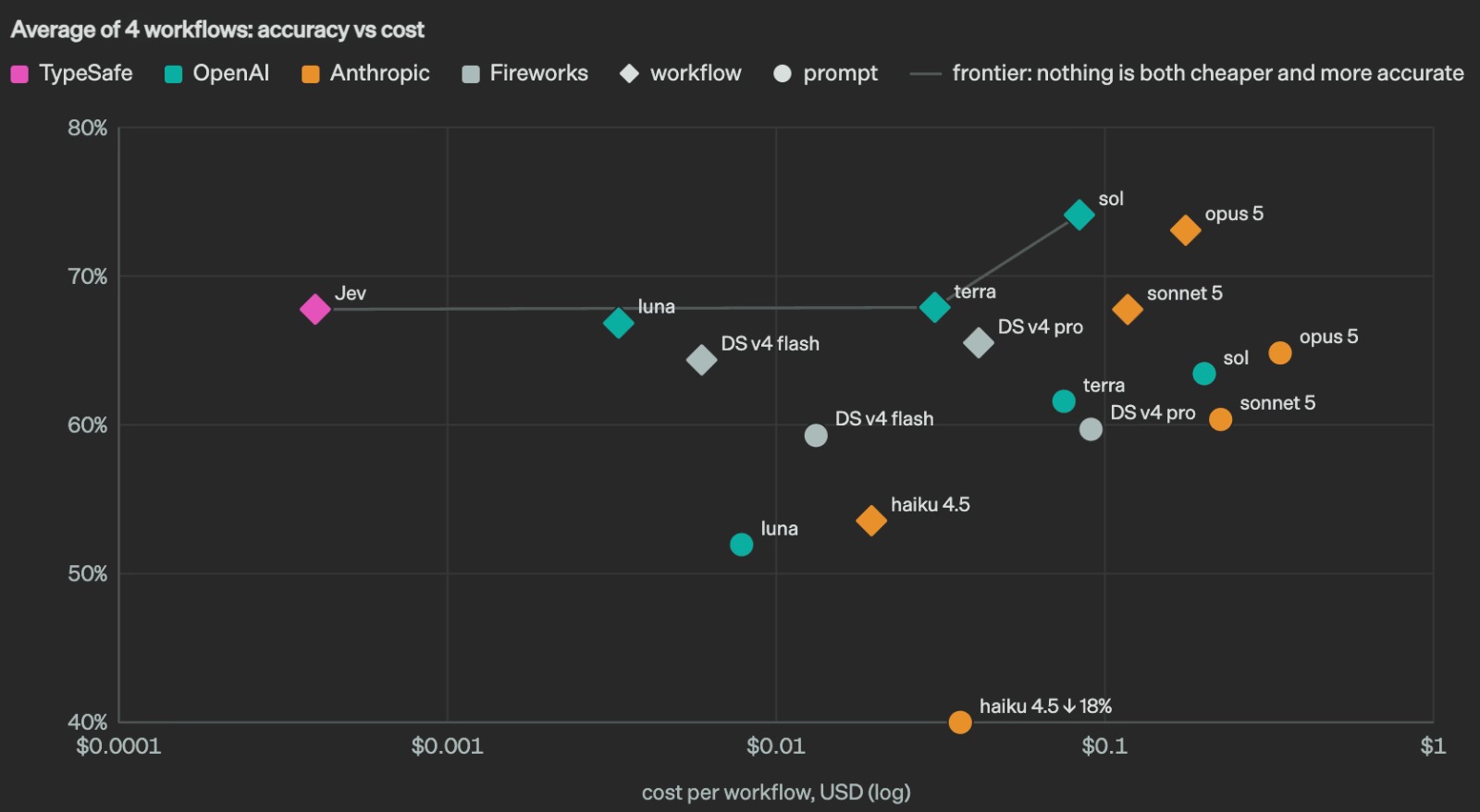
The useful way to look at Jev is as a different primitive.
An LLM remains better suited to investigation summaries, natural-language interaction, complex research and tasks where the output space cannot be defined beforehand.
Jev is more suited to questions such as:
Is this event malicious, benign or uncertain?
Which investigation path should run next?
Does this action require analyst approval?
Which risk tier should this entity receive?
That is why LangChain has already explored Jev within agent harnesses. Its implementation positions Jev at bounded decision points such as model routing, classification and tool-risk gating, where calling a larger generative model for every branch can introduce unnecessary latency and cost.
Cybersecurity contains a lot of exactly these decisions.
Use Case 1: Alert Triage at SOC Scale
Consider a SOC processing thousands of alerts.
Before an analyst investigates anything, the system needs to determine whether an alert has enough risk to warrant escalation. That decision may depend on asset criticality, identity context, prior activity, indicator reputation and detection confidence.
This is a strong decision-model problem.
Instead of asking a general-purpose LLM to write an assessment for every alert, Jev could be given the relevant state and asked to return a typed classification such as:
severity = high
escalate = true
confidence = 0.94
For a modern multi-agent SOC architecture, this model is relevant because alert triage is already one stage in a larger investigation process. These platforms typically correlate signals across identity, cloud, network and endpoint telemetry before specialized agents investigate the resulting case.
Jev would not replace that investigation. A decision model could help make selected routing and classification steps faster.
Use Case 2: Confidence-Based Escalation
One of the harder problems in SOC automation is deciding when the machine should stop.
A model may classify an alert as benign, but what happens when confidence is only 61 percent?
Jev’s probability-focused output could make confidence part of the workflow rather than an afterthought.
A SOC could define policy such as:
High-confidence benign decisions move toward automated closure.
Medium-confidence decisions receive additional enrichment.
Low-confidence or high-impact cases are escalated to an analyst.
This fits closely with the human-controlled model many AI SOC platforms already use, where a reasoning layer produces evidence-backed verdicts while consequential response actions remain governed.
The benefit is not autonomous security. It is clearer automation boundaries.
Use Case 3: Tool and Response Gating
Security agents increasingly have access to tools that can isolate endpoints, disable accounts or block indicators.
Every tool call should not carry the same risk.
A lookup against threat intelligence is very different from disabling a privileged account during production hours.
A decision model could evaluate the proposed action against context and return a structured decision:
allow
require_approval
deny
LangChain specifically identifies tool-risk gating as one area where Jev can sit within an agent harness.
This could be valuable for security platforms using human-in-the-loop response, where a responder stages actions while an analyst approves actions that can isolate, block or disable production resources.
Use Case 4: Threat Intelligence Prioritization
Threat intelligence teams process large volumes of indicators, advisories and vulnerability information.
The important question is rarely “what does this advisory say?” It is often “does this matter to us?”
A decision model could classify intelligence against organizational context:
Is the affected technology present?
Does the vulnerability expose an internet-facing asset?
Is exploitation relevant to the organization’s sector?
Should the intelligence be escalated now?
AI is already applied to threat intelligence processing this way in some platforms, assessing relevance, severity and urgency against deployed technologies and organizational context.
Decision models such as Jev point toward a way of making some of those repetitive classification steps faster while reserving richer generative models for analysis that requires explanation.
Use Case 5: Detection Engineering and Case Routing
Security operations also contain hundreds of smaller decisions that rarely need a large generative model.
Which detection rule should receive this event?
Which queue owns the case?
Does the alert match a known behavior pattern?
Should another enrichment step run?
Does the evidence satisfy the threshold for escalation?
Each decision may be small, but latency compounds when an agent chain makes dozens of model calls.
This is where Jev’s architecture becomes particularly interesting. LangChain argues that replacing bounded LLM decisions with Jev can reduce the cost and latency of agent loops while leaving the broader workflow under
Large language models are good at explaining, summarizing and generating text. Security operations often need something different: make a bounded decision quickly, return it in a predictable format and show how confident the system is.
Modern security operations centers already handle many of these decisions through specialized AI agents working across alert triage, investigation, threat intelligence and response coordination. That makes TypeSafe’s new Jev model worth examining from a security operations perspective. Jev is built specifically for fast, structured decisions within software workflows, which raises an important question: where could this type of model strengthen the decision points that already exist across an AI SOC?
TypeSafe describes Jev as its first System One Model. Instead of generating long-form responses, Jev takes the current state of a task and returns predefined, typed decisions with probabilities and confidence scores. For cybersecurity, that could be relevant to alert classification, escalation, tool selection, response gating and other points where the SOC needs a clear decision rather than another paragraph of generated text.
What Makes Jev Different From an LLM?
Traditional LLMs generate output token by token. Even when an application asks for JSON or structured output, the underlying model is still generating a string that must conform to a schema.
Jev takes a different approach.
TypeSafe calls it a System One Model, borrowing from the concept of fast decision-making. Developers define the possible output structure in advance. Jev evaluates the supplied state and returns typed values with associated probabilities rather than generating free-form prose.
In its official introduction to Jev, TypeSafe describes the model as effectively a frontier-intelligence function call: software provides state, and Jev returns decisions that can be consumed directly.
This gives Jev several characteristics that are relevant to automation:
Structured output: the possible output types are defined before inference, removing schema-formatting failures.
Probability-aware decisions: outputs include probabilities and confidence rather than only a final classification.
Parallel sampling: Jev evaluates outputs in parallel instead of generating them sequentially token by token.
Low latency: TypeSafe reports end-to-end response times between roughly 70 and 500 milliseconds for its tested workloads.
TypeSafe also reports large cost and latency improvements over frontier LLMs on its System One workflow evaluations, though the company is clear that these results come from tasks designed around the decision-model format and should not be generalized to every AI workload.
Jev Does Not Replace the LLM
The useful way to look at Jev is as a different primitive.
An LLM remains better suited to investigation summaries, natural-language interaction, complex research and tasks where the output space cannot be defined beforehand.
Jev is more suited to questions such as:
Is this event malicious, benign or uncertain?
Which investigation path should run next?
Does this action require analyst approval?
Which risk tier should this entity receive?
That is why LangChain has already explored Jev within agent harnesses. Its implementation positions Jev at bounded decision points such as model routing, classification and tool-risk gating, where calling a larger generative model for every branch can introduce unnecessary latency and cost.
Cybersecurity contains a lot of exactly these decisions.
Use Case 1: Alert Triage at SOC Scale
Consider a SOC processing thousands of alerts.
Before an analyst investigates anything, the system needs to determine whether an alert has enough risk to warrant escalation. That decision may depend on asset criticality, identity context, prior activity, indicator reputation and detection confidence.
This is a strong decision-model problem.
Instead of asking a general-purpose LLM to write an assessment for every alert, Jev could be given the relevant state and asked to return a typed classification such as:
severity = high
escalate = true
confidence = 0.94
For a modern multi-agent SOC architecture, this model is relevant because alert triage is already one stage in a larger investigation process. These platforms typically correlate signals across identity, cloud, network and endpoint telemetry before specialized agents investigate the resulting case.
Jev would not replace that investigation. A decision model could help make selected routing and classification steps faster.
Use Case 2: Confidence-Based Escalation
One of the harder problems in SOC automation is deciding when the machine should stop.
A model may classify an alert as benign, but what happens when confidence is only 61 percent?
Jev’s probability-focused output could make confidence part of the workflow rather than an afterthought.
A SOC could define policy such as:
High-confidence benign decisions move toward automated closure.
Medium-confidence decisions receive additional enrichment.
Low-confidence or high-impact cases are escalated to an analyst.
This fits closely with the human-controlled model many AI SOC platforms already use, where a reasoning layer produces evidence-backed verdicts while consequential response actions remain governed.
The benefit is not autonomous security. It is clearer automation boundaries.
Use Case 3: Tool and Response Gating
Security agents increasingly have access to tools that can isolate endpoints, disable accounts or block indicators.
Every tool call should not carry the same risk.
A lookup against threat intelligence is very different from disabling a privileged account during production hours.
A decision model could evaluate the proposed action against context and return a structured decision:
allow
require_approval
deny
LangChain specifically identifies tool-risk gating as one area where Jev can sit within an agent harness.
This could be valuable for security platforms using human-in-the-loop response, where a responder stages actions while an analyst approves actions that can isolate, block or disable production resources.
Use Case 4: Threat Intelligence Prioritization
Threat intelligence teams process large volumes of indicators, advisories and vulnerability information.
The important question is rarely “what does this advisory say?” It is often “does this matter to us?”
A decision model could classify intelligence against organizational context:
Is the affected technology present?
Does the vulnerability expose an internet-facing asset?
Is exploitation relevant to the organization’s sector?
Should the intelligence be escalated now?
AI is already applied to threat intelligence processing this way in some platforms, assessing relevance, severity and urgency against deployed technologies and organizational context.
Decision models such as Jev point toward a way of making some of those repetitive classification steps faster while reserving richer generative models for analysis that requires explanation.
Use Case 5: Detection Engineering and Case Routing
Security operations also contain hundreds of smaller decisions that rarely need a large generative model.
Which detection rule should receive this event?
Which queue owns the case?
Does the alert match a known behavior pattern?
Should another enrichment step run?
Does the evidence satisfy the threshold for escalation?
Each decision may be small, but latency compounds when an agent chain makes dozens of model calls.
This is where Jev’s architecture becomes particularly interesting. LangChain argues that replacing bounded LLM decisions with Jev can reduce the cost and latency of agent loops while leaving the broader workflow under deterministic code control.
What Jev Does Not Solve
Typed output prevents schema errors. It does not guarantee that every security decision is correct. A model can return a perfectly valid structured answer and still classify the underlying event incorrectly.
Security teams would still need evaluation datasets, confidence thresholds, monitoring and human review for consequential decisions.
That distinction matters in SOC environments. Reliability comes from the model, the surrounding workflow and the controls governing what happens after each decision.
A New Building Block for AI Security Operations
Jev is interesting because it treats AI decision-making as infrastructure rather than conversation.
For cybersecurity, that could mean using fast decision models for classification, routing, prioritization and gating while larger reasoning models handle investigations that genuinely require richer analysis.
That division of work fits where AI SOC architecture is heading.
Some AI SOC platforms already separate security operations into specialized functions rather than asking one model to perform every task. Decision models such as Jev introduce another design option: use the smallest suitable intelligence primitive at each point in the workflow.
The result could be faster security automation without handing every decision to an expensive general-purpose model.
The Limits Matter
The Limits Matter
Use Case 1: Alert Triage at SOC Scale
Consider a SOC processing thousands of alerts.
Before an analyst investigates anything, the system needs to determine whether an alert has enough risk to warrant escalation. That decision may depend on asset criticality, identity context, prior activity, indicator reputation and detection confidence.
This is a strong decision-model problem.
Instead of asking a general-purpose LLM to write an assessment for every alert, Jev could be given the relevant state and asked to return a typed classification such as:
severity = high
escalate = true
confidence = 0.94
For a modern multi-agent SOC architecture, this model is relevant because alert triage is already one stage in a larger investigation process. These platforms typically correlate signals across identity, cloud, network and endpoint telemetry before specialized agents investigate the resulting case.
Jev would not replace that investigation. A decision model could help make selected routing and classification steps faster.
Conclusion
Jev is interesting because it treats AI decision-making as a software primitive rather than a conversation.
For security operations, that opens a useful design question: which SOC tasks truly need a powerful generative model, and which only need a fast, calibrated decision?
For a multi-agent AI SOC, the answer could eventually matter across triage, routing, threat intelligence prioritization and response gating. A model that already separates security work by function could see those functions become even more specialized.
The value is not replacing analysts or replacing LLMs. It is using the right model for the right decision, while keeping evidence, confidence and human control at the center of the SOC.
What Jev Does Not Solve
Jev should not be treated as a universal security model.
Typed output prevents schema errors. It does not guarantee that every security decision is correct. A model can return a perfectly valid structured answer and still classify the underlying event incorrectly.
Security teams would still need evaluation datasets, confidence thresholds, monitoring and human review for consequential decisions.
That distinction matters in SOC environments. Reliability comes from the model, the surrounding workflow and the controls governing what happens after each decision.
A New Building Block for AI Security Operations
Jev is interesting because it treats AI decision-making as infrastructure rather than conversation.
For cybersecurity, that could mean using fast decision models for classification, routing, prioritization and gating while larger reasoning models handle investigations that genuinely require richer analysis.
That division of work fits where AI SOC architecture is heading.
Some AI SOC platforms already separate security operations into specialized functions rather than asking one model to perform every task. Decision models such as Jev introduce another design option: use the smallest suitable intelligence primitive at each point in the workflow.
The result could be faster security automation without handing every decision to an expensive general-purpose model.
The Limits Matter
Jev’s structured outputs should not be confused with guaranteed correct decisions.
Type safety means the model returns an answer in the expected form. It does not mean every classification is right. TypeSafe itself distinguishes schema guarantees from the broader question of model accuracy and publishes caveats alongside its benchmark results. TypeSafe AI
In cybersecurity, that means teams would still need evaluation datasets, confidence thresholds, monitoring and escalation paths before a decision model could be trusted within operational workflows.
A perfectly formatted wrong decision can still create a security incident.
Conclusion
Jev is interesting because it treats AI decision-making as a software primitive rather than a conversation.
For security operations, that opens a useful design question: which SOC tasks truly need a powerful generative model, and which only need a fast, calibrated decision?
For a multi-agent AI SOC, the answer could eventually matter across triage, routing, threat intelligence prioritization and response gating. A model that already separates security work by function could see those functions become even more specialized.
The value is not replacing analysts or replacing LLMs. It is using the right model for the right decision, while keeping evidence, confidence and human control at the center of the SOC.
See also:









 Dubai
Dubai