
 Cyber Strategy
 Cyber Secure
 Cyber Operations
 Cyber Response
 Cyber Resilience
Intelligence-Driven MDR vs Alert-Monitoring SOC is now an important decision for Kuwaiti organizations that need faster detection, stronger response, and better visibility across users, endpoints, cloud platforms, networks, and critical business systems. DTS Solution helps organizations in Kuwait and across the GCC move beyond passive alert handling through managed cyber operations, incident response, advisory services, and HawkEye, its Managed CSOC and XDR platform powered by DTS Solution.
The difference matters because many security programs still depend on a SOC model that watches alerts and escalates tickets. That model may help with basic monitoring, but it often breaks down when attackers use stolen credentials, trusted tools, cloud misconfigurations, remote access paths, or multi-stage intrusion tactics.
Kuwaiti organizations need security operations that can investigate, prioritize, and respond with context. That is where intelligence-driven MDR becomes more valuable.
What is an alert-monitoring SOC?
An alert-monitoring SOC is built around event collection and alert review. Logs are collected from security tools, alerts are shown in a SIEM or console, analysts review them, and tickets are created for follow-up.
This model can work when alerts are clear, assets are well documented, and the internal team has enough capacity to investigate quickly. The problem is that many organizations do not have that luxury.
A traditional alert-monitoring SOC may tell you that something happened. It may not always tell you whether the activity is part of a real attack, how it connects to other signals, what asset is affected, what the business impact is, or what the response team should do next.
This creates four common problems:
Alert fatigue from too many low-quality notifications
Delayed investigation because analysts lack context
Missed attack chains when signals are reviewed separately
Slow response because containment actions are not built into the workflow
For Kuwaiti organizations in banking, government, telecom, energy, healthcare, retail, and managed services, these gaps can create serious operational risk.
What is intelligence-driven MDR?
Managed Detection and Response, or MDR, combines continuous monitoring, expert investigation, threat hunting, event prioritization, and guided response. Fortinet defines MDR as a service that adds SOC expertise to an organization’s security operations through continuous monitoring, threat analysis, and incident response support for EDR or XDR tools.
The key difference is that MDR is not limited to watching alerts. It looks at events through the lens of attacker behavior, intelligence, asset context, business impact, and response urgency.
An intelligence-driven MDR service should answer practical questions:
Is this alert part of a real intrusion?
Has this technique been seen in the region?
Is the affected asset critical?
Is there evidence of lateral movement?
Which account, device, or workload should be contained?
What should the customer do now?
That is the difference between receiving alerts and receiving actionable response support.
Where the Two Models Actually Differ
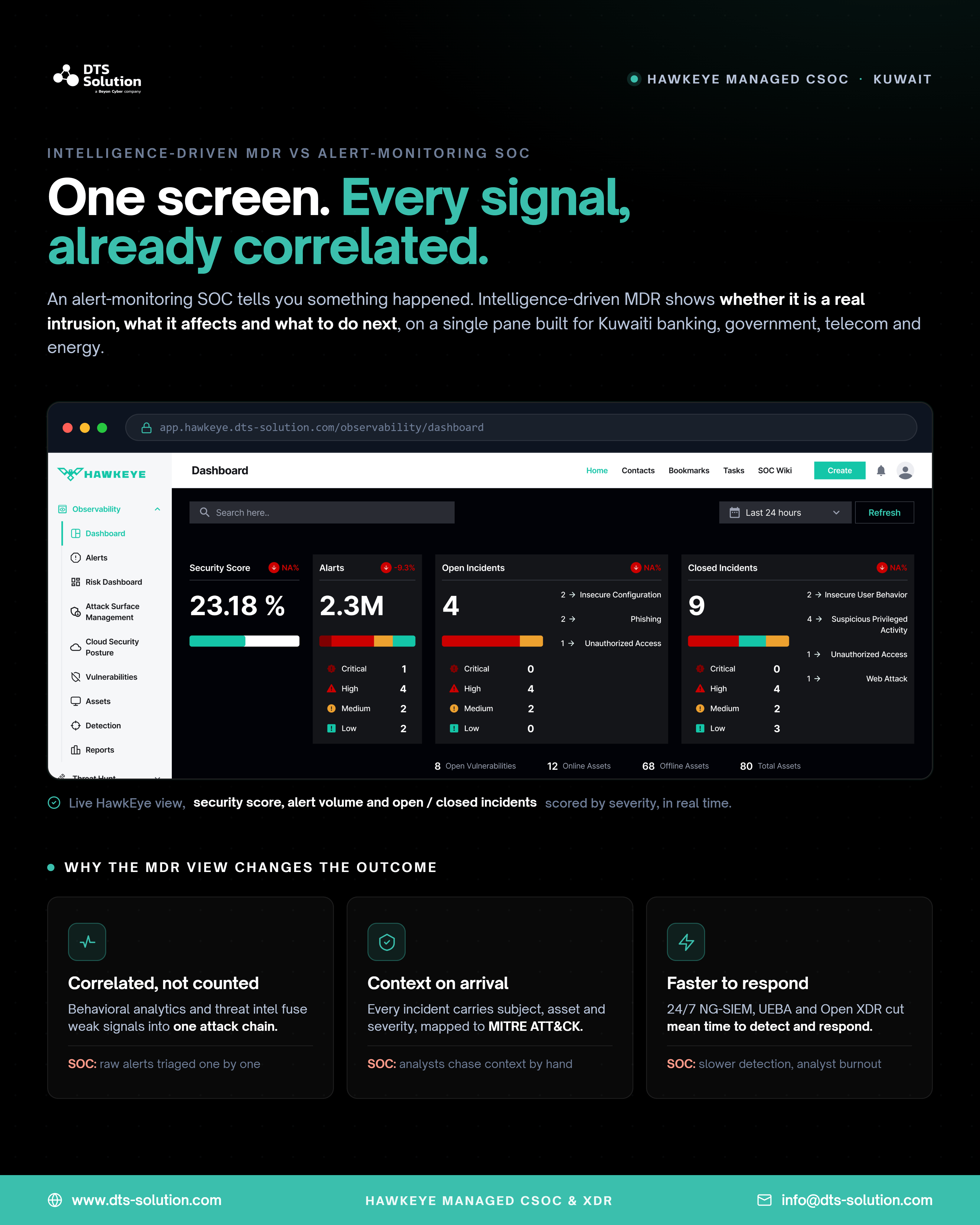
Area | Alert-Monitoring SOC | Intelligence-Driven MDR |
Detection basis | Known signatures and static rules | Behavioral analytics plus real-time threat intelligence |
Alert handling | Manual triage of high alert volumes | Automated correlation with human validation |
Threat hunting | Occasional, reactive | Proactive and ongoing |
Ownership | Fully in-house tools and staff | Delivered as a service, often with shared visibility |
Setup and cost | High upfront investment, ongoing hiring | Subscription-based, faster to operationalize |
Outcome | Slower detection, higher analyst burnout | Faster mean time to detect and respond |
Many organizations do not have to pick one over the other permanently. A hybrid setup, where an internal team retains oversight while an MDR partner handles round-the-clock detection and response, is common across the region and lets a company keep control of sensitive systems while closing coverage gaps at night and on weekends.
Why this matters for Kuwait
Kuwait’s organizations are under pressure to protect regulated data, payment systems, public services, telecom infrastructure, cloud workloads, and third-party connections. Many also work with regional partners, government entities, financial institutions, and critical service providers.
A basic SOC model may create activity, but activity is not the same as risk reduction. Security leaders need fewer false positives, better incident context, and clear actions that reduce exposure.
This is where HawkEye CSOC and XDR fits the requirement. HawkEye is a fully managed 24/7 CSOC and XDR service powered by DTS Solution. It provides continuous monitoring, NG-SIEM, UEBA, Open XDR, security event correlation, deep analytics, and managed extended detection and response. HawkEye also states that its CSOC and XDR service has regional coverage across the Middle East and Africa.
For Kuwaiti organizations, this model gives security teams access to managed analysts, threat hunters, correlation logic, detection engineering, and response support without forcing the organization to build every SOC capability internally.
Intelligence changes the quality of response
Threat intelligence makes MDR more useful because it adds meaning to security signals.
For example, a suspicious login may look routine in isolation. When combined with device behavior, IP reputation, recent adversary activity, failed MFA attempts, and unusual file access, it may become a high-confidence incident.
HawkEye’s Cyber Threat Intelligence capability focuses intelligence collection on key threats, vulnerabilities, and technology stacks used by clients. It also shares intelligence through SOC incidents for immediate threats or daily advisories for wider awareness. (hawk-eye.io)
That matters because Kuwait-based organizations do not only need generic alerts. They need regional relevance, sector relevance, and asset relevance.
Why DTS Solution matters in the model
DTS Solution’s Cyber Secure services cover offensive security, defensive security, advisory services, and security engineering across industry verticals. This makes DTS useful for organizations that need more than monitoring. They may also need architecture review, cloud security, penetration testing, incident response, governance support, or security maturity improvement.
When an incident happens, detection must connect to action. DTS Solution Incident Response and Forensics supports organizations with incident response frameworks, triage, chain of custody, forensic analysis, readiness assessments, attack simulation drills, and incident response retainer services.
This is important because MDR should not end at notification. It should support containment, investigation, recovery, and lessons learned.
DTS Solution’s article on AI-Powered SOC and agentic security operations also explains how HawkEye AI is built to reduce response times, improve prediction accuracy, lower false positives, and support human-led security operations across the GCC and EMEA.
Where HawkEye’s Model Fits
HawkEye’s architecture separates automated execution from human decision-making rather than relying on either extreme alone. Detection rules map directly to the MITRE ATT&CK framework, covering tactics such as credential access, initial access, and lateral movement, so alerts arrive with context about what stage of an attack they likely represent rather than a raw signature match. Behavior profiling and anomaly detection catch activity that static rules would miss, while HawkEye’s detection engineering continuously tunes these rules against real attacker techniques rather than a fixed rule set built once and left unchanged.
Operational consistency matters just as much as detection quality. Managing shift handovers, incident tracking, and analyst knowledge across a 24/7 operation is where many in-house SOCs lose consistency over time. DTS Solution built HawkEye CSOC WIKI specifically to manage this kind of operational continuity, tracking use case development and shift handover activity so institutional knowledge does not walk out the door when an analyst changes shifts or leaves the team.
Intelligence-Driven MDR vs Alert-Monitoring SOC is now an important decision for Kuwaiti organizations that need faster detection, stronger response, and better visibility across users, endpoints, cloud platforms, networks, and critical business systems. DTS Solution helps organizations in Kuwait and across the GCC move beyond passive alert handling through managed cyber operations, incident response, advisory services, and HawkEye, its Managed CSOC and XDR platform powered by DTS Solution.
The difference matters because many security programs still depend on a SOC model that watches alerts and escalates tickets. That model may help with basic monitoring, but it often breaks down when attackers use stolen credentials, trusted tools, cloud misconfigurations, remote access paths, or multi-stage intrusion tactics.
Kuwaiti organizations need security operations that can investigate, prioritize, and respond with context. That is where intelligence-driven MDR becomes more valuable.
What is an alert-monitoring SOC?
An alert-monitoring SOC is built around event collection and alert review. Logs are collected from security tools, alerts are shown in a SIEM or console, analysts review them, and tickets are created for follow-up.
This model can work when alerts are clear, assets are well documented, and the internal team has enough capacity to investigate quickly. The problem is that many organizations do not have that luxury.
A traditional alert-monitoring SOC may tell you that something happened. It may not always tell you whether the activity is part of a real attack, how it connects to other signals, what asset is affected, what the business impact is, or what the response team should do next.
This creates four common problems:
Alert fatigue from too many low-quality notifications
Delayed investigation because analysts lack context
Missed attack chains when signals are reviewed separately
Slow response because containment actions are not built into the workflow
For Kuwaiti organizations in banking, government, telecom, energy, healthcare, retail, and managed services, these gaps can create serious operational risk.
What is intelligence-driven MDR?
Managed Detection and Response, or MDR, combines continuous monitoring, expert investigation, threat hunting, event prioritization, and guided response. Fortinet defines MDR as a service that adds SOC expertise to an organization’s security operations through continuous monitoring, threat analysis, and incident response support for EDR or XDR tools.
The key difference is that MDR is not limited to watching alerts. It looks at events through the lens of attacker behavior, intelligence, asset context, business impact, and response urgency.
An intelligence-driven MDR service should answer practical questions:
Is this alert part of a real intrusion?
Has this technique been seen in the region?
Is the affected asset critical?
Is there evidence of lateral movement?
Which account, device, or workload should be contained?
What should the customer do now?
That is the difference between receiving alerts and receiving actionable response support.
Where the Two Models Actually Differ
Area | Alert-Monitoring SOC | Intelligence-Driven MDR |
Detection basis | Known signatures and static rules | Behavioral analytics plus real-time threat intelligence |
Alert handling | Manual triage of high alert volumes | Automated correlation with human validation |
Threat hunting | Occasional, reactive | Proactive and ongoing |
Ownership | Fully in-house tools and staff | Delivered as a service, often with shared visibility |
Setup and cost | High upfront investment, ongoing hiring | Subscription-based, faster to operationalize |
Outcome | Slower detection, higher analyst burnout | Faster mean time to detect and respond |
Many organizations do not have to pick one over the other permanently. A hybrid setup, where an internal team retains oversight while an MDR partner handles round-the-clock detection and response, is common across the region and lets a company keep control of sensitive systems while closing coverage gaps at night and on weekends.
Why this matters for Kuwait
Kuwait’s organizations are under pressure to protect regulated data, payment systems, public services, telecom infrastructure, cloud workloads, and third-party connections. Many also work with regional partners, government entities, financial institutions, and critical service providers.
A basic SOC model may create activity, but activity is not the same as risk reduction. Security leaders need fewer false positives, better incident context, and clear actions that reduce exposure.
This is where HawkEye CSOC and XDR fits the requirement. HawkEye is a fully managed 24/7 CSOC and XDR service powered by DTS Solution. It provides continuous monitoring, NG-SIEM, UEBA, Open XDR, security event correlation, deep analytics, and managed extended detection and response. HawkEye also states that its CSOC and XDR service has regional coverage across the Middle East and Africa.
For Kuwaiti organizations, this model gives security teams access to managed analysts, threat hunters, correlation logic, detection engineering, and response support without forcing the organization to build every SOC capability internally.
Intelligence changes the quality of response
Threat intelligence makes MDR more useful because it adds meaning to security signals.
For example, a suspicious login may look routine in isolation. When combined with device behavior, IP reputation, recent adversary activity, failed MFA attempts, and unusual file access, it may become a high-confidence incident.
HawkEye’s Cyber Threat Intelligence capability focuses intelligence collection on key threats, vulnerabilities, and technology stacks used by clients. It also shares intelligence through SOC incidents for immediate threats or daily advisories for wider awareness.
That matters because Kuwait-based organizations do not only need generic alerts. They need regional relevance, sector relevance, and asset relevance.
Why DTS Solution matters in the model
DTS Solution’s Cyber Secure services cover offensive security, defensive security, advisory services, and security engineering across industry verticals. This makes DTS useful for organizations that need more than monitoring. They may also need architecture review, cloud security, penetration testing, incident response, governance support, or security maturity improvement.
When an incident happens, detection must connect to action. DTS Solution Incident Response and Forensics supports organizations with incident response frameworks, triage, chain of custody, forensic analysis, readiness assessments, attack simulation drills, and incident response retainer services.
This is important because MDR should not end at notification. It should support containment, investigation, recovery, and lessons learned.
DTS Solution’s article on AI-Powered SOC and agentic security operations also explains how HawkEye AI is built to reduce response times, improve prediction accuracy, lower false positives, and support human-led security operations across the GCC and EMEA.
Where HawkEye's Model Fits
HawkEye’s architecture separates automated execution from human decision-making rather than relying on either extreme alone. Detection rules map directly to the MITRE ATT&CK framework, covering tactics such as credential access, initial access, and lateral movement, so alerts arrive with context about what stage of an attack they likely represent rather than a raw signature match. Behavior profiling and anomaly detection catch activity that static rules would miss, while HawkEye’s detection engineering continuously tunes these rules against real attacker techniques rather than a fixed rule set built once and left unchanged.
Operational consistency matters just as much as detection quality. Managing shift handovers, incident tracking, and analyst knowledge across a 24/7 operation is where many in-house SOCs lose consistency over time. DTS Solution built HawkEye CSOC WIKI specifically to manage this kind of operational continuity, tracking use case development and shift handover activity so institutional knowledge does not walk out the door when an analyst changes shifts or leaves the team.
The Practical Differences Side by Side
A few concrete distinctions separate the two models beyond the theory.
Detection method. Alert-monitoring SOCs typically rely on signature and threshold-based rules within a SIEM. Intelligence-driven MDR layers behavioral analysis and real-time threat context on top, catching activity that does not match a known signature but resembles current attacker behavior.
Triage speed. A SOC analyst manually reviewing every flagged event introduces delay proportional to alert volume. Automated triage in an intelligence-driven MDR model sorts the noise first, so human attention goes straight to what matters.
Cost structure. Building an internal SOC means hiring, training, and retaining analysts across every shift, plus the tooling to support them. MDR delivered as a service carries a more predictable ongoing cost, without the hiring risk of losing a senior analyst mid-contract.
Threat context. A SOC’s threat intelligence, where it exists at all, is often static and manually updated. Intelligence-driven MDR pulls from live campaign data, giving analysts a much clearer picture of whether a specific alert reflects an active, ongoing threat pattern.
The Practical Differences Side by Side
A few concrete distinctions separate the two models beyond the theory.
Detection method. Alert-monitoring SOCs typically rely on signature and threshold-based rules within a SIEM. Intelligence-driven MDR layers behavioral analysis and real-time threat context on top, catching activity that does not match a known signature but resembles current attacker behavior.
Triage speed. A SOC analyst manually reviewing every flagged event introduces delay proportional to alert volume. Automated triage in an intelligence-driven MDR model sorts the noise first, so human attention goes straight to what matters.
Cost structure. Building an internal SOC means hiring, training, and retaining analysts across every shift, plus the tooling to support them. MDR delivered as a service carries a more predictable ongoing cost, without the hiring risk of losing a senior analyst mid-contract.
Threat context. A SOC’s threat intelligence, where it exists at all, is often static and manually updated. Intelligence-driven MDR pulls from live campaign data, giving analysts a much clearer picture of whether a specific alert reflects an active, ongoing threat pattern.
Common Mistakes Kuwaiti Organizations Make
Assuming any 24/7 monitoring service qualifies as MDR. Vendors market pure alert forwarding as MDR without the threat intelligence enrichment or proactive hunting that actually defines the model. Ask specifically how detections get enriched and who investigates escalations.
Underestimating the cost of building an internal SOC properly. Staffing, tooling, and tuning a SOC well enough to match an established MDR provider’s detection accuracy usually costs more than expected, both in budget and in the time it takes to reach real maturity.
Treating compliance logging as equivalent to actual detection. Meeting NBCC’s audit logging requirement satisfies a checkbox. It does not mean anyone is actively reviewing those logs with the context needed to catch a real threat quickly.
The Bottom Line
The gap between an alert-monitoring SOC and an intelligence-driven MDR service is not marketing language. It shows up directly in how fast a real threat gets caught and how much context an analyst has when deciding whether to act. For Kuwaiti organizations facing a genuine skills shortage and increasingly specific regulatory expectations, a provider like DTS Solution, with over a decade of regional CSOC experience behind HawkEye, closes a gap that an internally built alert-monitoring SOC often struggles to close on its own.
Common Mistakes Kuwaiti Organizations Make
Assuming any 24/7 monitoring service qualifies as MDR. Vendors market pure alert forwarding as MDR without the threat intelligence enrichment or proactive hunting that actually defines the model. Ask specifically how detections get enriched and who investigates escalations.
Underestimating the cost of building an internal SOC properly. Staffing, tooling, and tuning a SOC well enough to match an established MDR provider’s detection accuracy usually costs more than expected, both in budget and in the time it takes to reach real maturity.
Treating compliance logging as equivalent to actual detection. Meeting NBCC’s audit logging requirement satisfies a checkbox. It does not mean anyone is actively reviewing those logs with the context needed to catch a real threat quickly.
The Bottom Line
The gap between an alert-monitoring SOC and an intelligence-driven MDR service is not marketing language. It shows up directly in how fast a real threat gets caught and how much context an analyst has when deciding whether to act. For Kuwaiti organizations facing a genuine skills shortage and increasingly specific regulatory expectations, a provider like DTS Solution, with over a decade of regional CSOC experience behind HawkEye, closes a gap that an internally built alert-monitoring SOC often struggles to close on its own.
See also:







 Dubai
Dubai