
 Cyber Strategy
 Cyber Secure
 Cyber Operations
 Cyber Response
 Cyber Resilience
AI-assisted cyber attacks are no longer a theoretical concern for security teams. In a recent DTS Solution red team investigation, we tested how AI could be used to accelerate reconnaissance, map exposed assets, review application behavior, support exploit chaining, and identify weaknesses that may not appear serious when viewed in isolation.
The result was clear: AI did not replace the attacker’s judgment. It increased the attacker’s speed.
What would normally require hours of manual review, repeated note-taking, payload refinement, script adjustment, and correlation across systems could be compressed into a faster attack workflow. The risk for organizations is not that AI creates completely new attack paths every time. The risk is that it helps attackers find and connect existing weaknesses faster than security teams can respond.
For organizations across finance, government, healthcare, energy, telecom, and enterprise operations, this changes the way offensive security testing must be approached. Vulnerability discovery can no longer stop at CVEs and scan outputs. Security teams need to know how weaknesses combine into real attack paths.
The Investigation: Testing AI-Assisted Attack Behavior
The engagement began with a controlled red team objective: assess how quickly an attacker could move from initial discovery to meaningful exposure using AI-assisted techniques. The DTS Solution team worked within an approved scope, using human-led testing supported by AI for research acceleration, hypothesis generation, payload refinement, pattern review, and documentation.
The goal was not to automate an attack blindly. Every action remained controlled by the red team. AI was used to speed up analysis and expand coverage, while human operators made the decisions that mattered: what to test, what to avoid, what was safe, what needed validation, and what could create real business impact.
This is an important distinction. AI-assisted red teaming is not about letting tools run loose across a client environment. It is about giving skilled operators a faster way to analyze complex systems, compare signals, and uncover paths that may be missed during standard testing.
What AI Helped the Red Team Do Faster
The first advantage appeared during reconnaissance. AI helped organize open-source information, identify likely technology patterns, summarize public-facing assets, and generate testing hypotheses from exposed service behavior. This reduced time spent on repetitive analysis and allowed the team to focus on validation.
The second advantage appeared during application review. AI assisted with code pattern interpretation, request analysis, payload variation, and logic testing. This helped the team move beyond generic scanning and focus on how the application behaved under specific conditions.
The third advantage appeared during attack path mapping. Findings that looked moderate on their own became more important when connected. A weak configuration, an exposed endpoint, a permissive role, an overlooked API behavior, or a leaked reference in documentation can become more serious when combined with other weaknesses.
That is where AI-assisted testing showed value. It helped the team compare evidence across several areas faster, then identify where a vulnerability could support a larger path toward privilege abuse, data exposure, or operational disruption.
The Attack Path Was the Real Finding
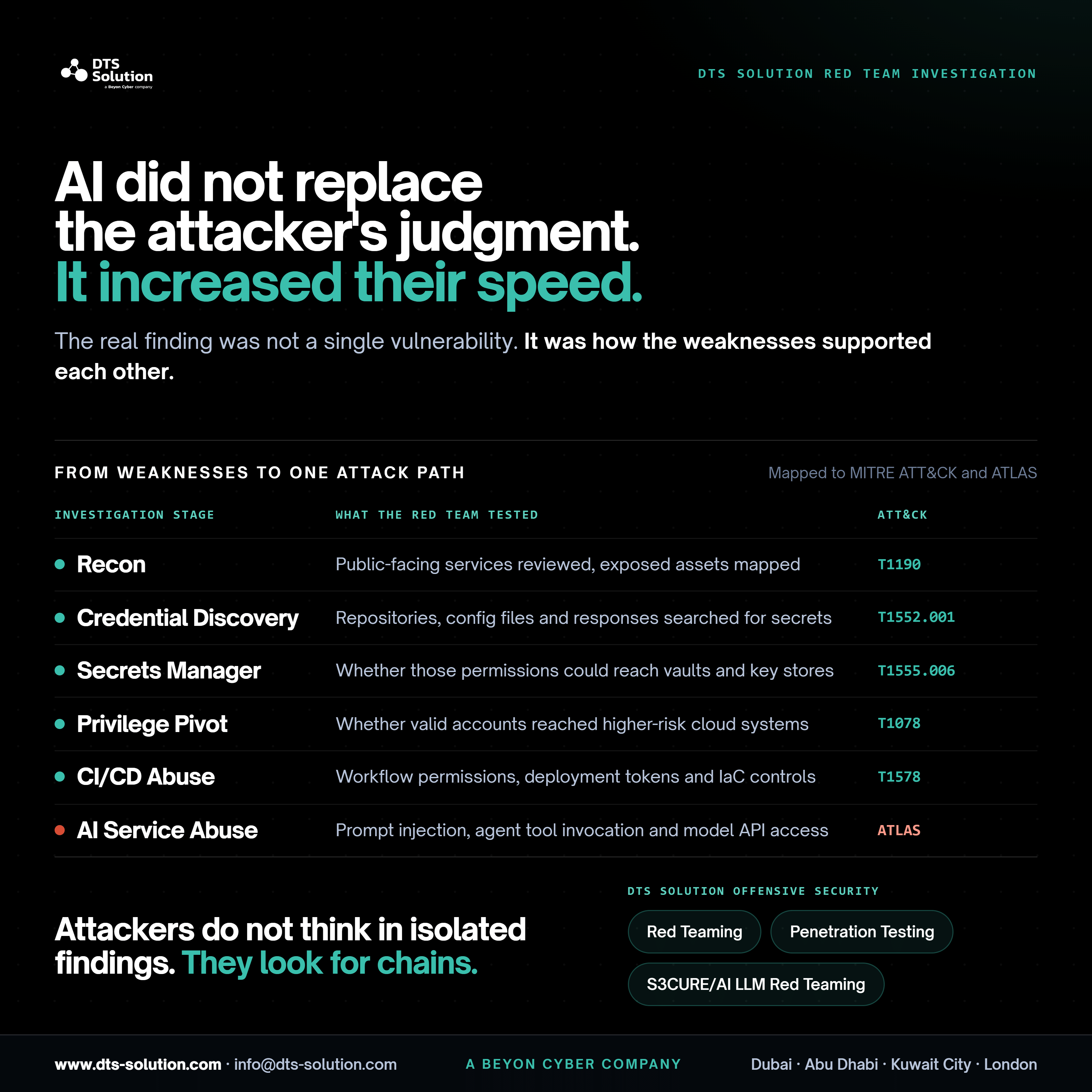
In many security assessments, findings are presented as separate issues. One vulnerability has a severity rating. One misconfiguration has a remediation note. One access-control weakness has an owner. That format is useful, but it can hide the real risk.
Attackers do not think in isolated findings. They look for chains.
In this investigation, the important discovery was not a single vulnerability. It was the way multiple weaknesses could support each other. AI helped accelerate the process of asking follow-up questions:
Could this exposed service reveal useful internal information?
Could that information support a more targeted authentication attempt?
Could a low-privilege account reach more than expected?
Could a misconfigured API expose sensitive records?
Could a weak control in one environment support movement into another?
Could logs detect the activity early enough?
These questions turned a standard technical assessment into a deeper attack-path review. The strongest output was not a list of issues. It was a clearer view of how an attacker could move from one opportunity to the next.
Investigation Mapping: From Weaknesses to Attack Paths
The table below shows how the DTS Solution red team mapped observed activity during the AI-assisted testing exercise. The MITRE ATT&CK column maps the activity to known enterprise techniques, while the AI-specific column explains how AI changed the speed, scale, or quality of the testing workflow. MITRE ATT&CK includes techniques such as public-facing application exploitation, network service discovery, credentials in files, cloud secrets access, valid accounts, and cloud infrastructure modification. MITRE ATLAS also tracks AI-specific attack behavior such as AI agent tool invocation, LLM prompt injection, AI model API access, and credential harvesting involving AI systems. (MITRE ATT&CK)
Investigation Stage | Red Team Action | MITRE ATT&CK Mapping | AI-Assisted Mapping | Control Tested |
Initial Access and Recon | Reviewed public-facing services, mapped exposed assets, and identified likely entry points for deeper testing. | T1190: Exploit Public-Facing Application; T1046: Network Service Discovery | AI-assisted reconnaissance and service mapping | Asset inventory, exposure management, WAF rules, internet-facing service hardening |
Credential Discovery | Reviewed repositories, configuration files, documentation, and application responses for secrets or token references. | T1552.001: Credentials in Files | AI-assisted code and documentation review for credential exposure | Secrets scanning, secure coding, repository governance, key rotation |
Secrets Manager Exposure | Tested whether obtained permissions could reach secrets vaults, password stores, or cloud credential repositories. | T1555.006: Cloud Secrets Management Stores | AI-assisted credential path analysis | Vault access policy, IAM least privilege, privileged access monitoring |
Privilege and Cloud Pivot | Checked whether valid credentials or excessive permissions could support movement into higher-risk systems. | T1078: Valid Accounts; T1578: Modify Cloud Compute Infrastructure | AI-assisted privilege path mapping | Cloud IAM, role boundaries, conditional access, cloud audit logging |
CI/CD Pipeline Abuse | Assessed whether workflow permissions, deployment tokens, or infrastructure-as-code controls could be abused. | T1059: Command and Scripting Interpreter; T1578: Modify Cloud Compute Infrastructure | AI-assisted pipeline and deployment logic review | Branch protection, workflow approvals, deployment secrets, IaC change control |
AI Service Abuse | Tested whether AI tools, APIs, retrieval sources, or agent workflows could expose data or execute unintended actions. | T1078: Valid Accounts; T1552.001: Credentials in Files | LLM prompt injection, AI model API access, AI agent tool invocation | Prompt-injection resistance, tool permission boundaries, AI logging, retrieval controls |
Detection and Response | Checked whether suspicious repository searches, secrets access, cloud API activity, and unusual automation behavior were detected early. | Detection objective across credential access, discovery, and cloud activity | AI-assisted attack-chain correlation | SIEM coverage, SOC escalation, alert tuning, incident response playbooks |
How DTS Solution Helps UAE Organizations Adopt Securely
AI-assisted attacks put pressure on slow security operations. If an attacker can use AI to shorten reconnaissance, refine scripts, summarize findings, and chain weaknesses quickly, defenders need faster validation and better visibility.
This affects several areas of cybersecurity. Identity teams need to know whether accounts, roles, tokens, and service credentials are tightly governed. Application teams need to know whether business logic can be abused. Cloud teams need to know whether permissions are excessive. SOC teams need to know whether early signals can be detected before the attack path becomes business-impacting.
A traditional vulnerability scan may find some of the issues. It may not show how those issues combine. That is the gap AI-assisted red teaming helps close.
DTS Solution Security Assessment supports this work through penetration testing, vulnerability assessment, application security testing, infrastructure review, wireless security assessment, red teaming, OSINT, and DARKINT. The purpose is to identify vulnerabilities, validate exposure, and show how weaknesses affect the wider enterprise architecture.
How DTS Solution Uses AI for Red Teaming
DTS Solution uses AI to elevate red team work in a controlled and responsible way. AI helps our teams review more data, test more hypotheses, correlate evidence faster, and produce clearer remediation insight. It does not replace operator skill, client-approved scope, or human decision-making.
In practice, this can support several areas:
AI can help generate attack hypotheses based on exposed assets and observed behavior. It can assist with reviewing configurations, logs, application responses, and code patterns. It can help compare findings against known attacker techniques. It can support faster documentation so remediation teams understand the business risk without reading raw technical output.
This matters because many organizations do not need another long report full of disconnected findings. They need to know which weaknesses create real exposure, which fixes should come first, and which controls failed to detect suspicious behavior.
DTS Solution Red Teaming and Offensive Security helps organizations test defenses against realistic attack behavior. AI-assisted methods strengthen that work by increasing speed, depth, and pattern discovery while keeping the engagement controlled by experienced offensive security specialists.
AI-assisted cyber attacks are no longer a theoretical concern for security teams. In a recent DTS Solution red team investigation, we tested how AI could be used to accelerate reconnaissance, map exposed assets, review application behavior, support exploit chaining, and identify weaknesses that may not appear serious when viewed in isolation.
The result was clear: AI did not replace the attacker’s judgment. It increased the attacker’s speed.
What would normally require hours of manual review, repeated note-taking, payload refinement, script adjustment, and correlation across systems could be compressed into a faster attack workflow. The risk for organizations is not that AI creates completely new attack paths every time. The risk is that it helps attackers find and connect existing weaknesses faster than security teams can respond.
For organizations across finance, government, healthcare, energy, telecom, and enterprise operations, this changes the way offensive security testing must be approached. Vulnerability discovery can no longer stop at CVEs and scan outputs. Security teams need to know how weaknesses combine into real attack paths.
The Investigation: Testing AI-Assisted Attack Behavior
The engagement began with a controlled red team objective: assess how quickly an attacker could move from initial discovery to meaningful exposure using AI-assisted techniques. The DTS Solution team worked within an approved scope, using human-led testing supported by AI for research acceleration, hypothesis generation, payload refinement, pattern review, and documentation.
The goal was not to automate an attack blindly. Every action remained controlled by the red team. AI was used to speed up analysis and expand coverage, while human operators made the decisions that mattered: what to test, what to avoid, what was safe, what needed validation, and what could create real business impact.
This is an important distinction. AI-assisted red teaming is not about letting tools run loose across a client environment. It is about giving skilled operators a faster way to analyze complex systems, compare signals, and uncover paths that may be missed during standard testing.
What AI Helped the Red Team Do Faster
The first advantage appeared during reconnaissance. AI helped organize open-source information, identify likely technology patterns, summarize public-facing assets, and generate testing hypotheses from exposed service behavior. This reduced time spent on repetitive analysis and allowed the team to focus on validation.
The second advantage appeared during application review. AI assisted with code pattern interpretation, request analysis, payload variation, and logic testing. This helped the team move beyond generic scanning and focus on how the application behaved under specific conditions.
The third advantage appeared during attack path mapping. Findings that looked moderate on their own became more important when connected. A weak configuration, an exposed endpoint, a permissive role, an overlooked API behavior, or a leaked reference in documentation can become more serious when combined with other weaknesses.
That is where AI-assisted testing showed value. It helped the team compare evidence across several areas faster, then identify where a vulnerability could support a larger path toward privilege abuse, data exposure, or operational disruption.
The Attack Path Was the Real Finding
In many security assessments, findings are presented as separate issues. One vulnerability has a severity rating. One misconfiguration has a remediation note. One access-control weakness has an owner. That format is useful, but it can hide the real risk.
Attackers do not think in isolated findings. They look for chains.
In this investigation, the important discovery was not a single vulnerability. It was the way multiple weaknesses could support each other. AI helped accelerate the process of asking follow-up questions:
Could this exposed service reveal useful internal information?
Could that information support a more targeted authentication attempt?
Could a low-privilege account reach more than expected?
Could a misconfigured API expose sensitive records?
Could a weak control in one environment support movement into another?
Could logs detect the activity early enough?
These questions turned a standard technical assessment into a deeper attack-path review. The strongest output was not a list of issues. It was a clearer view of how an attacker could move from one opportunity to the next.
Why This Matters for Security Teams
AI-assisted attacks put pressure on slow security operations. If an attacker can use AI to shorten reconnaissance, refine scripts, summarize findings, and chain weaknesses quickly, defenders need faster validation and better visibility.
This affects several areas of cybersecurity. Identity teams need to know whether accounts, roles, tokens, and service credentials are tightly governed. Application teams need to know whether business logic can be abused. Cloud teams need to know whether permissions are excessive. SOC teams need to know whether early signals can be detected before the attack path becomes business-impacting.
A traditional vulnerability scan may find some of the issues. It may not show how those issues combine. That is the gap AI-assisted red teaming helps close.
DTS Solution Security Assessment supports this work through penetration testing, vulnerability assessment, application security testing, infrastructure review, wireless security assessment, red teaming, OSINT, and DARKINT. The purpose is to identify vulnerabilities, validate exposure, and show how weaknesses affect the wider enterprise architecture.
How DTS Solution Uses AI for Red Teaming
DTS Solution uses AI to elevate red team work in a controlled and responsible way. AI helps our teams review more data, test more hypotheses, correlate evidence faster, and produce clearer remediation insight. It does not replace operator skill, client-approved scope, or human decision-making.
In practice, this can support several areas:
AI can help generate attack hypotheses based on exposed assets and observed behavior. It can assist with reviewing configurations, logs, application responses, and code patterns. It can help compare findings against known attacker techniques. It can support faster documentation so remediation teams understand the business risk without reading raw technical output.
This matters because many organizations do not need another long report full of disconnected findings. They need to know which weaknesses create real exposure, which fixes should come first, and which controls failed to detect suspicious behavior.
DTS Solution Red Teaming and Offensive Security helps organizations test defenses against realistic attack behavior. AI-assisted methods strengthen that work by increasing speed, depth, and pattern discovery while keeping the engagement controlled by experienced offensive security specialists.
Why ExploitBench Changes the Conversation
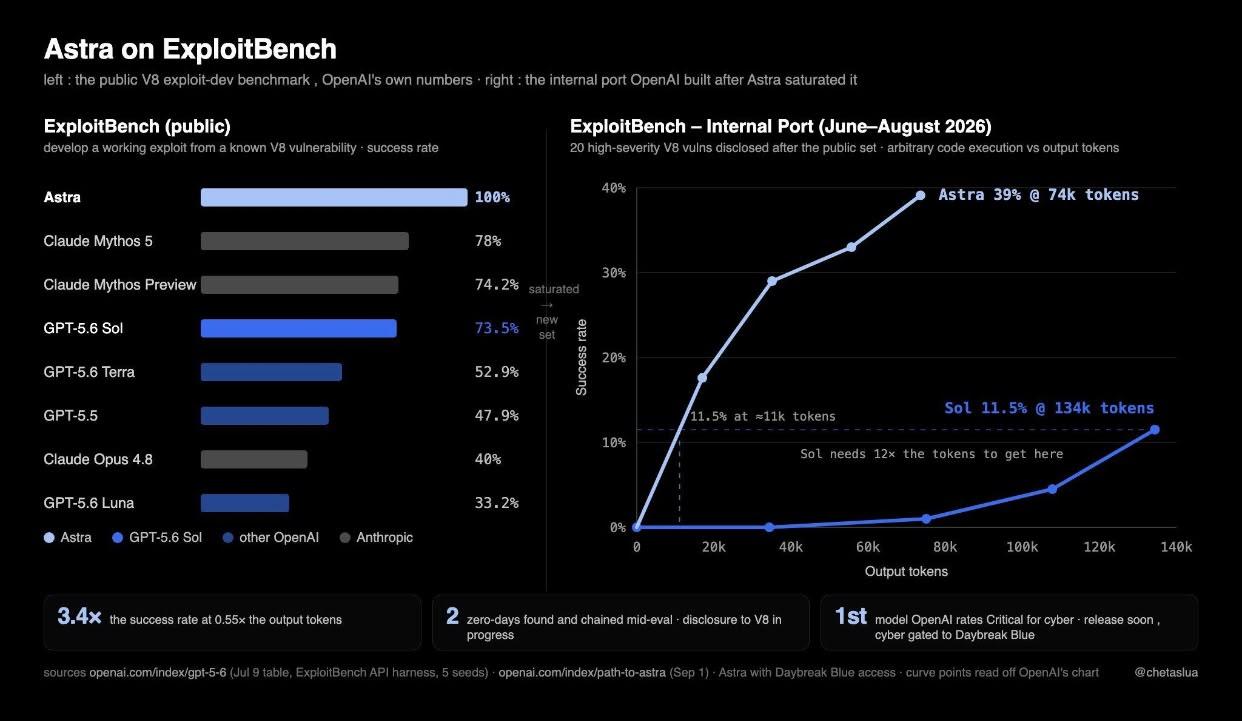
OpenAI’s recent Astra results show why AI-assisted red teaming matters for defenders. In its ExploitBench evaluation, Astra reached a 100% success rate on the public benchmark for developing working exploits from known V8 vulnerabilities. OpenAI also built an internal ExploitBench port using 20 high-severity V8 vulnerabilities disclosed after the public set, where Astra achieved higher arbitrary code-execution rates than GPT-5.6 Sol while using fewer output tokens. OpenAI said the model also discovered and used two zero-day vulnerabilities during the evaluation, with disclosure to maintainers in progress. (OpenAI)
The point is not that every attacker will have access to Astra or similar restricted capability. The point is that exploit development is becoming faster, more structured, and more scalable. When an AI system can move from vulnerable code to working exploit logic with that level of efficiency, security teams cannot rely on slow validation cycles and delayed remediation.
For red teams, this is a clear signal: testing has to move closer to attacker speed. AI can help offensive security teams review code paths, generate hypotheses, validate exploitability, compare behavior across targets, and connect weaknesses into attack paths. Human operators still control scope, safety, and final judgment, but AI reduces the time between discovery and validation.
For defenders, the lesson is sharper: patching, secrets management, CI/CD hardening, cloud permission review, and detection engineering must tighten. A vulnerability that once looked difficult to exploit may become practical faster than the business expects.
This is why DTS Solution uses AI-assisted red teaming carefully: to help organizations find exploitable paths before attackers do. The value is not a bigger vulnerability list. The value is knowing which weaknesses can become working attack paths, which controls failed to stop them, and which fixes should come first.
Testing AI Systems Themselves
The same approach also applies to organizations adopting AI systems. Chatbots, copilots, AI agents, retrieval systems, and automated workflows can create new attack surfaces when they connect to internal documents, business applications, APIs, ticketing systems, cloud services, or customer data.
DTS Solution Generative AI Security helps organizations assess these risks through S3CURE/AI, covering AI governance, LLM red teaming, penetration testing, AI validation, threat modeling, and infrastructure hardening.
This is important because AI risk often appears in the integration layer. A model may be safe in isolation, but the surrounding system may expose sensitive data, accept malicious prompts, execute unsafe tool calls, or grant access that was never intended.
Testing should cover prompt injection, excessive permissions, data leakage, insecure retrieval sources, unsafe plugins, weak API controls, poor logging, and lack of rollback procedures.
What Organizations Should Review Now
Security teams should start by reviewing the areas AI-assisted attackers can abuse quickly: exposed services, identity permissions, cloud roles, secrets, CI/CD pipelines, SaaS access, internal documentation, and unmanaged AI tools.
They should also review whether detection can keep pace. Suspicious repository searches, unusual secrets access, abnormal API calls, unexpected CI/CD activity, privilege changes, and strange cloud behavior should not sit unnoticed until the damage is done.
For teams that need to connect AI risk with governance, controls, evidence, and compliance workflows, Complyan can support the compliance side of AI adoption. For technical validation, DTS Solution helps organizations test how AI-assisted attack paths could affect real systems before attackers get the opportunity.
Conclusion
The DTS Solution investigation confirmed a simple point: AI-assisted cyber attacks do not always need new weaknesses. They can make existing weaknesses easier to find, faster to connect, and harder to contain once the attack chain starts moving.
That is why red teaming needs to evolve from isolated vulnerability discovery into attack-path validation. Security teams need to know how an attacker could combine identity gaps, application weaknesses, cloud misconfigurations, exposed secrets, and weak monitoring into one meaningful path.
AI gives attackers speed. Used responsibly, it also gives defenders a stronger way to test, validate, and fix the paths that matter most.
Why ExploitBench Changes the Conversation
OpenAI’s recent Astra results show why AI-assisted red teaming matters for defenders. In its ExploitBench evaluation, Astra reached a 100% success rate on the public benchmark for developing working exploits from known V8 vulnerabilities. OpenAI also built an internal ExploitBench port using 20 high-severity V8 vulnerabilities disclosed after the public set, where Astra achieved higher arbitrary code-execution rates than GPT-5.6 Sol while using fewer output tokens. OpenAI said the model also discovered and used two zero-day vulnerabilities during the evaluation, with disclosure to maintainers in progress.
The point is not that every attacker will have access to Astra or similar restricted capability. The point is that exploit development is becoming faster, more structured, and more scalable. When an AI system can move from vulnerable code to working exploit logic with that level of efficiency, security teams cannot rely on slow validation cycles and delayed remediation.
For red teams, this is a clear signal: testing has to move closer to attacker speed. AI can help offensive security teams review code paths, generate hypotheses, validate exploitability, compare behavior across targets, and connect weaknesses into attack paths. Human operators still control scope, safety, and final judgment, but AI reduces the time between discovery and validation.
For defenders, the lesson is sharper: patching, secrets management, CI/CD hardening, cloud permission review, and detection engineering must tighten. A vulnerability that once looked difficult to exploit may become practical faster than the business expects.
This is why DTS Solution uses AI-assisted red teaming carefully: to help organizations find exploitable paths before attackers do. The value is not a bigger vulnerability list. The value is knowing which weaknesses can become working attack paths, which controls failed to stop them, and which fixes should come first.
Testing AI Systems Themselves
The same approach also applies to organizations adopting AI systems. Chatbots, copilots, AI agents, retrieval systems, and automated workflows can create new attack surfaces when they connect to internal documents, business applications, APIs, ticketing systems, cloud services, or customer data.
DTS Solution Generative AI Security helps organizations assess these risks through S3CURE/AI, covering AI governance, LLM red teaming, penetration testing, AI validation, threat modeling, and infrastructure hardening.
This is important because AI risk often appears in the integration layer. A model may be safe in isolation, but the surrounding system may expose sensitive data, accept malicious prompts, execute unsafe tool calls, or grant access that was never intended.
Testing should cover prompt injection, excessive permissions, data leakage, insecure retrieval sources, unsafe plugins, weak API controls, poor logging, and lack of rollback procedures.
Starlink’s UAE launch gives organizations another way to improve connectivity, continuity, and remote-site access. That value is real, especially for locations where fibre or mobile coverage is limited, delayed, or unsuitable for the business need.
The security decision is also clear. Starlink should not be adopted as a standalone internet shortcut. It should be integrated into the enterprise security architecture, segmented properly, routed through approved controls, monitored by the SOC, tested before production, and governed through clear ownership.
For UAE businesses, the opportunity is stronger connectivity. The responsibility is secure adoption. DTS Solution can help make sure both happen together.
What Organizations Should Review Now
Security teams should start by reviewing the areas AI-assisted attackers can abuse quickly: exposed services, identity permissions, cloud roles, secrets, CI/CD pipelines, SaaS access, internal documentation, and unmanaged AI tools.
They should also review whether detection can keep pace. Suspicious repository searches, unusual secrets access, abnormal API calls, unexpected CI/CD activity, privilege changes, and strange cloud behavior should not sit unnoticed until the damage is done.
For teams that need to connect AI risk with governance, controls, evidence, and compliance workflows, Complyan can support the compliance side of AI adoption. For technical validation, DTS Solution helps organizations test how AI-assisted attack paths could affect real systems before attackers get the opportunity.
Conclusion
The DTS Solution investigation confirmed a simple point: AI-assisted cyber attacks do not always need new weaknesses. They can make existing weaknesses easier to find, faster to connect, and harder to contain once the attack chain starts moving.
That is why red teaming needs to evolve from isolated vulnerability discovery into attack-path validation. Security teams need to know how an attacker could combine identity gaps, application weaknesses, cloud misconfigurations, exposed secrets, and weak monitoring into one meaningful path.
AI gives attackers speed. Used responsibly, it also gives defenders a stronger way to test, validate, and fix the paths that matter most.
See also:







 Dubai
