
 Cyber Strategy
 Cyber Secure
 Cyber Operations
 Cyber Response
 Cyber Resilience
Cloud security services in Saudi Arabia are now a priority for government entities, financial institutions, healthcare providers, telecom operators, industrial companies, and enterprises moving critical workloads into cloud environments. DTS Solution Saudi Arabia supports organizations with cloud security assessment, compliance consulting, security engineering, managed detection, incident response, and advisory services aligned with Saudi regulatory expectations.
Cloud adoption gives Saudi organizations speed, scale, and flexibility, but it also changes the security model. Systems are no longer protected only by perimeter controls. Identity, configuration, encryption, logging, segmentation, workload protection, vendor governance, and continuous monitoring become central to security.
Why cloud security matters in Saudi Arabia
Saudi Arabia’s cloud adoption is closely tied to national transformation, digital government, fintech expansion, smart cities, healthcare modernization, and enterprise cloud migration. As more workloads move to IaaS, PaaS, and SaaS environments, security leaders need controls that match how cloud systems work.
The National Cybersecurity Authority’s Cloud Cybersecurity Controls provide requirements for cloud service providers and cloud service tenants. NCA’s CCC page states that the controls were developed to strengthen cloud cybersecurity and are supported by implementation guides for both providers and tenants.
For Saudi organizations, this means cloud security cannot be reduced to provider certifications alone. The cloud provider has responsibilities, but the customer still owns many critical controls. That includes account governance, identity access, workload configuration, data classification, key management, monitoring, backup, incident response, and third-party oversight.
The Shared Responsibility Model Everyone Gets Wrong
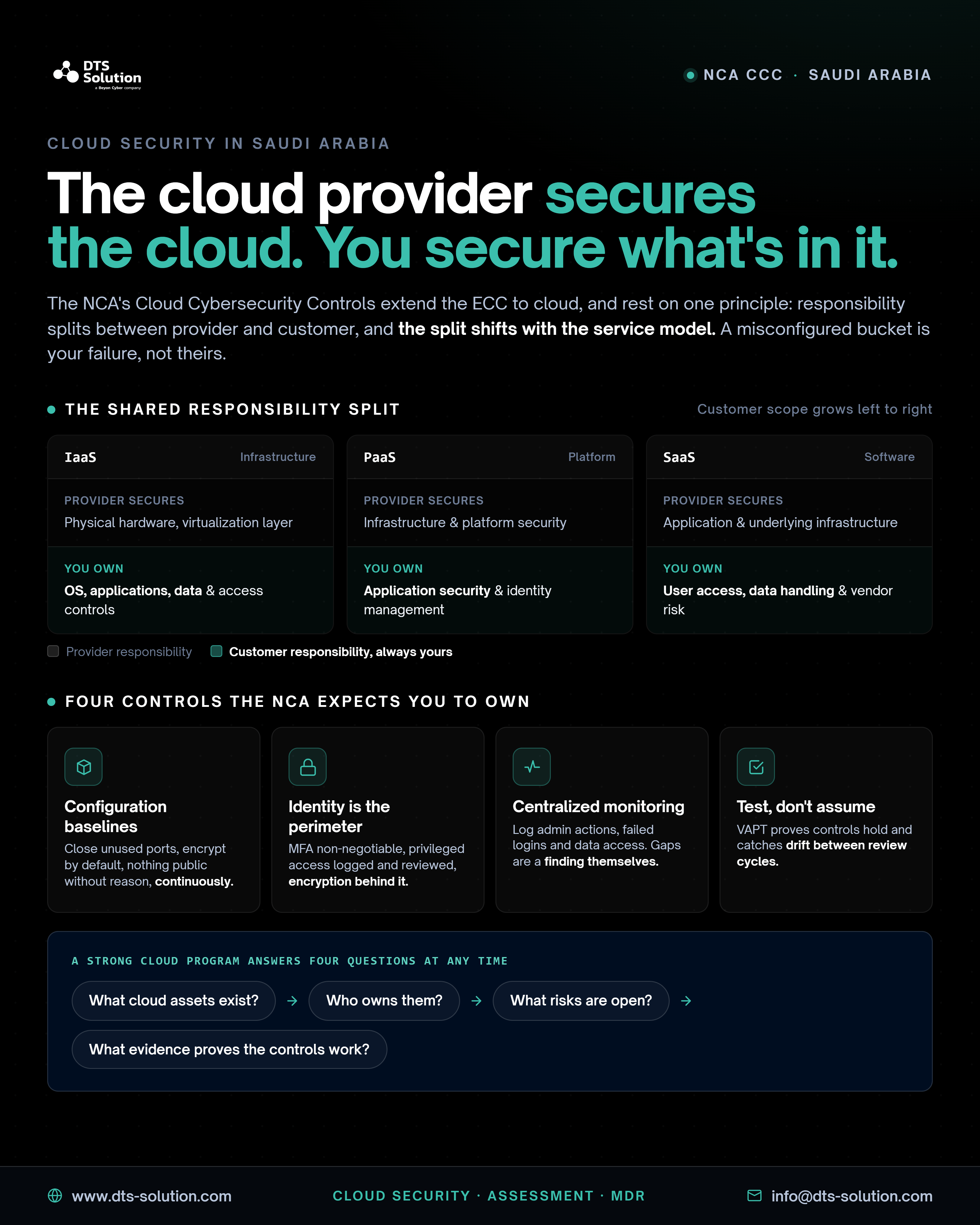
The NCA’s Cloud Cybersecurity Controls extend the Essential Cybersecurity Controls specifically to cloud environments, and the entire framework rests on one principle: security responsibility splits between the cloud provider and the customer, and that split changes depending on the service model.
For Infrastructure as a Service, the provider secures the physical hardware and virtualization layer, while the customer secures operating systems, applications, data, and access controls. For Platform as a Service, the provider takes on infrastructure and platform security, leaving the customer responsible for application security and identity management. For Software as a Service, the provider manages the application and infrastructure, but the customer still owns user access, data handling, and vendor risk oversight.
The most common failure here is assuming the provider handles everything once a workload moves to the cloud. An unpatched database left open, or a misconfigured storage bucket, is the customer’s failure under NCA guidelines, not the provider’s, regardless of which cloud platform is involved.
Configuration Baselines Are Not Optional Extras
The NCA expects every cloud asset to meet a defined security configuration baseline before it goes live. For infrastructure workloads, this means closing unused ports, encrypting storage by default, and making sure nothing sits open to the public internet without a documented reason. For SaaS environments, it means reviewing every third-party application connected to company data and restricting sharing permissions to only the people who genuinely need access.
Organizations that treat these baselines as a one-time setup step tend to drift out of compliance within months. Cloud environments change constantly, with new resources spun up and torn down in minutes, which is exactly why the NCA frames this as continuous configuration management rather than a project with a defined end date.
Identity Is the New Perimeter
A cloud environment does not have a physical wall to defend. The real perimeter is who can log in and what they can touch once they are inside. The NCA’s cloud controls make multi-factor authentication a non-negotiable requirement, since a stolen password alone should never be enough to reach sensitive systems.
Privileged access management deserves particular attention here. Administrator accounts carry outsized risk, and the NCA expects every privileged action to be logged and reviewed, not just permitted. Encryption further backs this up, protecting data even in the event that access controls fail somewhere upstream. DTS Solution’s broader governance, risk, and compliance practice builds identity governance directly into cloud compliance programs, since these two areas are impossible to separate cleanly in practice.
Monitoring That Actually Catches Something
Continuous monitoring and logging sit at the center of NCA cloud compliance, covering administrative actions, failed login attempts, and data access events. Without centralized logging, reconstructing what happened during an incident becomes nearly impossible, and auditors treat gaps in logging history as a compliance failure in their own right, separate from whatever the underlying incident was.
This is where many Saudi organizations underinvest. Logs scattered across multiple cloud accounts and services, with no central aggregation, create exactly the blind spot a patient attacker can operate inside for weeks without detection.
Cloud compliance must be built into the program
Cloud security services in Saudi Arabia should also support compliance requirements. Depending on the sector, organizations may need to align cloud controls with NCA ECC, NCA CCC, SAMA requirements, CSCC, ISO 27001, PCI DSS, CSA STAR, internal audit requirements, or customer security obligations.
DTS Solution Compliance Consulting helps organizations translate compliance standards into readiness programs, including ISO 27001, IEC 62443, PCI DSS, COBIT, and Cloud Security Alliance requirements. The service also lists Riyadh as one of DTS Solution’s regional locations.
The practical goal is to avoid duplicate work. One control can often support several frameworks if it is mapped correctly. For example, access review, vulnerability management, log retention, incident response, encryption, and third-party oversight may support multiple compliance obligations.
Why Testing Matters More Than the Policy Document
Configuring controls correctly on paper is only half the job. Vulnerability assessment and penetration testing verify that those controls actually hold up against real techniques, rather than simply existing as a checkbox. A detailed breakdown of NCA’s cloud requirements makes the same point directly: VAPT turns compliance from a paperwork exercise into verified protection, and it is often the specific evidence auditors ask to see before signing off.
Regular testing also catches configuration drift that accumulates silently between review cycles, the kind of gradual erosion that a point-in-time compliance snapshot would never surface on its own.
Building a Cloud Security Program That Holds Up
Map every cloud service against the shared responsibility model explicitly. Assuming coverage without confirming exactly what the provider does and does not secure is the single most common gap DTS Solution encounters during cloud security assessments.
Automate configuration monitoring rather than reviewing manually. Cloud environments change too quickly for periodic manual checks to catch drift before it becomes a real exposure.
Treat identity as the primary control, not a secondary one. MFA, privileged access management, and encryption should be foundational requirements for every cloud deployment, not add-ons considered after launch.
Centralize logging across every cloud account and service. Fragmented logs make incident reconstruction slow and unreliable exactly when speed matters most.
Test regularly, not once before an audit. DTS Solution’s cloud security posture management work, part of its broader 15-year track record securing GCC organizations, focuses specifically on catching misconfiguration and drift in real time rather than waiting for a scheduled review to surface it.
Cloud security services in Saudi Arabia are now a priority for government entities, financial institutions, healthcare providers, telecom operators, industrial companies, and enterprises moving critical workloads into cloud environments. DTS Solution Saudi Arabia supports organizations with cloud security assessment, compliance consulting, security engineering, managed detection, incident response, and advisory services aligned with Saudi regulatory expectations.
Cloud adoption gives Saudi organizations speed, scale, and flexibility, but it also changes the security model. Systems are no longer protected only by perimeter controls. Identity, configuration, encryption, logging, segmentation, workload protection, vendor governance, and continuous monitoring become central to security.
Why cloud security matters in Saudi Arabia
Saudi Arabia’s cloud adoption is closely tied to national transformation, digital government, fintech expansion, smart cities, healthcare modernization, and enterprise cloud migration. As more workloads move to IaaS, PaaS, and SaaS environments, security leaders need controls that match how cloud systems work.
The National Cybersecurity Authority’s Cloud Cybersecurity Controls provide requirements for cloud service providers and cloud service tenants. NCA’s CCC page states that the controls were developed to strengthen cloud cybersecurity and are supported by implementation guides for both providers and tenants.
For Saudi organizations, this means cloud security cannot be reduced to provider certifications alone. The cloud provider has responsibilities, but the customer still owns many critical controls. That includes account governance, identity access, workload configuration, data classification, key management, monitoring, backup, incident response, and third-party oversight.
The Shared Responsibility Model Everyone Gets Wrong
The NCA’s Cloud Cybersecurity Controls extend the Essential Cybersecurity Controls specifically to cloud environments, and the entire framework rests on one principle: security responsibility splits between the cloud provider and the customer, and that split changes depending on the service model.
For Infrastructure as a Service, the provider secures the physical hardware and virtualization layer, while the customer secures operating systems, applications, data, and access controls. For Platform as a Service, the provider takes on infrastructure and platform security, leaving the customer responsible for application security and identity management. For Software as a Service, the provider manages the application and infrastructure, but the customer still owns user access, data handling, and vendor risk oversight.
The most common failure here is assuming the provider handles everything once a workload moves to the cloud. An unpatched database left open, or a misconfigured storage bucket, is the customer’s failure under NCA guidelines, not the provider’s, regardless of which cloud platform is involved.
Configuration Baselines Are Not Optional Extras
The NCA expects every cloud asset to meet a defined security configuration baseline before it goes live. For infrastructure workloads, this means closing unused ports, encrypting storage by default, and making sure nothing sits open to the public internet without a documented reason. For SaaS environments, it means reviewing every third-party application connected to company data and restricting sharing permissions to only the people who genuinely need access.
Organizations that treat these baselines as a one-time setup step tend to drift out of compliance within months. Cloud environments change constantly, with new resources spun up and torn down in minutes, which is exactly why the NCA frames this as continuous configuration management rather than a project with a defined end date.
Identity Is the New Perimeter
A cloud environment does not have a physical wall to defend. The real perimeter is who can log in and what they can touch once they are inside. The NCA’s cloud controls make multi-factor authentication a non-negotiable requirement, since a stolen password alone should never be enough to reach sensitive systems.
Privileged access management deserves particular attention here. Administrator accounts carry outsized risk, and the NCA expects every privileged action to be logged and reviewed, not just permitted. Encryption further backs this up, protecting data even in the event that access controls fail somewhere upstream. DTS Solution’s broader governance, risk, and compliance practice builds identity governance directly into cloud compliance programs, since these two areas are impossible to separate cleanly in practice.
Monitoring That Actually Catches Something
Continuous monitoring and logging sit at the center of NCA cloud compliance, covering administrative actions, failed login attempts, and data access events. Without centralized logging, reconstructing what happened during an incident becomes nearly impossible, and auditors treat gaps in logging history as a compliance failure in their own right, separate from whatever the underlying incident was.
This is where many Saudi organizations underinvest. Logs scattered across multiple cloud accounts and services, with no central aggregation, create exactly the blind spot a patient attacker can operate inside for weeks without detection.
Cloud compliance must be built into the program
Cloud security services in Saudi Arabia should also support compliance requirements. Depending on the sector, organizations may need to align cloud controls with NCA ECC, NCA CCC, SAMA requirements, CSCC, ISO 27001, PCI DSS, CSA STAR, internal audit requirements, or customer security obligations.
DTS Solution Compliance Consulting helps organizations translate compliance standards into readiness programs, including ISO 27001, IEC 62443, PCI DSS, COBIT, and Cloud Security Alliance requirements. The service also lists Riyadh as one of DTS Solution’s regional locations.
The practical goal is to avoid duplicate work. One control can often support several frameworks if it is mapped correctly. For example, access review, vulnerability management, log retention, incident response, encryption, and third-party oversight may support multiple compliance obligations
Why Testing Matters More Than the Policy Document
Configuring controls correctly on paper is only half the job. Vulnerability assessment and penetration testing verify that those controls actually hold up against real techniques, rather than simply existing as a checkbox. A detailed breakdown of NCA’s cloud requirements makes the same point directly: VAPT turns compliance from a paperwork exercise into verified protection, and it is often the specific evidence auditors ask to see before signing off.
Regular testing also catches configuration drift that accumulates silently between review cycles, the kind of gradual erosion that a point-in-time compliance snapshot would never surface on its own.
Building a Cloud Security Program That Holds Up
Map every cloud service against the shared responsibility model explicitly. Assuming coverage without confirming exactly what the provider does and does not secure is the single most common gap DTS Solution encounters during cloud security assessments.
Automate configuration monitoring rather than reviewing manually. Cloud environments change too quickly for periodic manual checks to catch drift before it becomes a real exposure.
Treat identity as the primary control, not a secondary one. MFA, privileged access management, and encryption should be foundational requirements for every cloud deployment, not add-ons considered after launch.
Centralize logging across every cloud account and service. Fragmented logs make incident reconstruction slow and unreliable exactly when speed matters most.
Test regularly, not once before an audit. DTS Solution’s cloud security posture management work, part of its broader 15-year track record securing GCC organizations, focuses specifically on catching misconfiguration and drift in real time rather than waiting for a scheduled review to surface it.
The Bottom Line
Cloud security services in Saudi Arabia should help organizations secure cloud workloads, prove compliance, manage risk, and respond faster when incidents occur. The right program should cover architecture, identity, configuration, data protection, monitoring, testing, governance, and incident response.
DTS Solution helps Saudi organizations build that foundation through cloud security assessment, compliance consulting, security engineering, managed detection, and incident response support.
The strongest cloud programs can answer four questions at any time: what cloud assets exist, who owns them, what risks are open, and what evidence proves the controls are working.
The Bottom Line
Cloud security services in Saudi Arabia are now a priority for government entities, financial institutions, healthcare providers, telecom operators, industrial companies, and enterprises moving critical workloads into cloud environments. DTS Solution Saudi Arabia supports organizations with cloud security assessment, compliance consulting, security engineering, managed detection, incident response, and advisory services aligned with Saudi regulatory expectations.
Cloud adoption gives Saudi organizations speed, scale, and flexibility, but it also changes the security model. Systems are no longer protected only by perimeter controls. Identity, configuration, encryption, logging, segmentation, workload protection, vendor governance, and continuous monitoring become central to security.







 Dubai
