
 Cyber Strategy
 Cyber Secure
 Cyber Operations
 Cyber Response
 Cyber Resilience
Kuwait’s banks and financial institutions are modernising core systems, expanding cloud adoption and supporting more remote access. These changes improve service delivery, but they also weaken the traditional assumption that users and devices can be trusted simply because they are connected to the corporate network.
The Central Bank of Kuwait’s Cyber and Operational Resilience Framework, or CBK CORF, addresses this issue by requiring stronger identity controls, continuous verification, least-privilege access and secure-by-design architecture. For regulated institutions, Zero Trust provides a practical way to meet these expectations while upgrading network security without disrupting critical banking services.
DTS Solution helps financial institutions in Kuwait assess their current security posture and implement Zero Trust controls across identities, devices, applications and network access. Through its Zero Trust and Private Access capabilities, DTS Solution supports phased modernisation aligned with CBK CORF requirements.
CBK CORF Makes Zero Trust a Regulatory Requirement
CORF does not present Zero Trust as an optional architecture trend. Its Cyber Resilience Baselines state that security architecture across on-premises, cloud and hybrid systems must follow Zero Trust and secure-by-design principles.
The framework expects regulated entities to remove implicit trust and verify actions through identity and context. Access must be continuously assessed against behaviour and associated risk. CORF also requires least privilege, strong authentication and dynamic controls that respond to real-time signals.
For financial institutions in Kuwait, this means a corporate network connection cannot remain the primary security boundary. A user must still prove their identity. Their device must meet security requirements, while the requested action must match an approved role.
Where Zero Trust Fits Into CORF Compliance
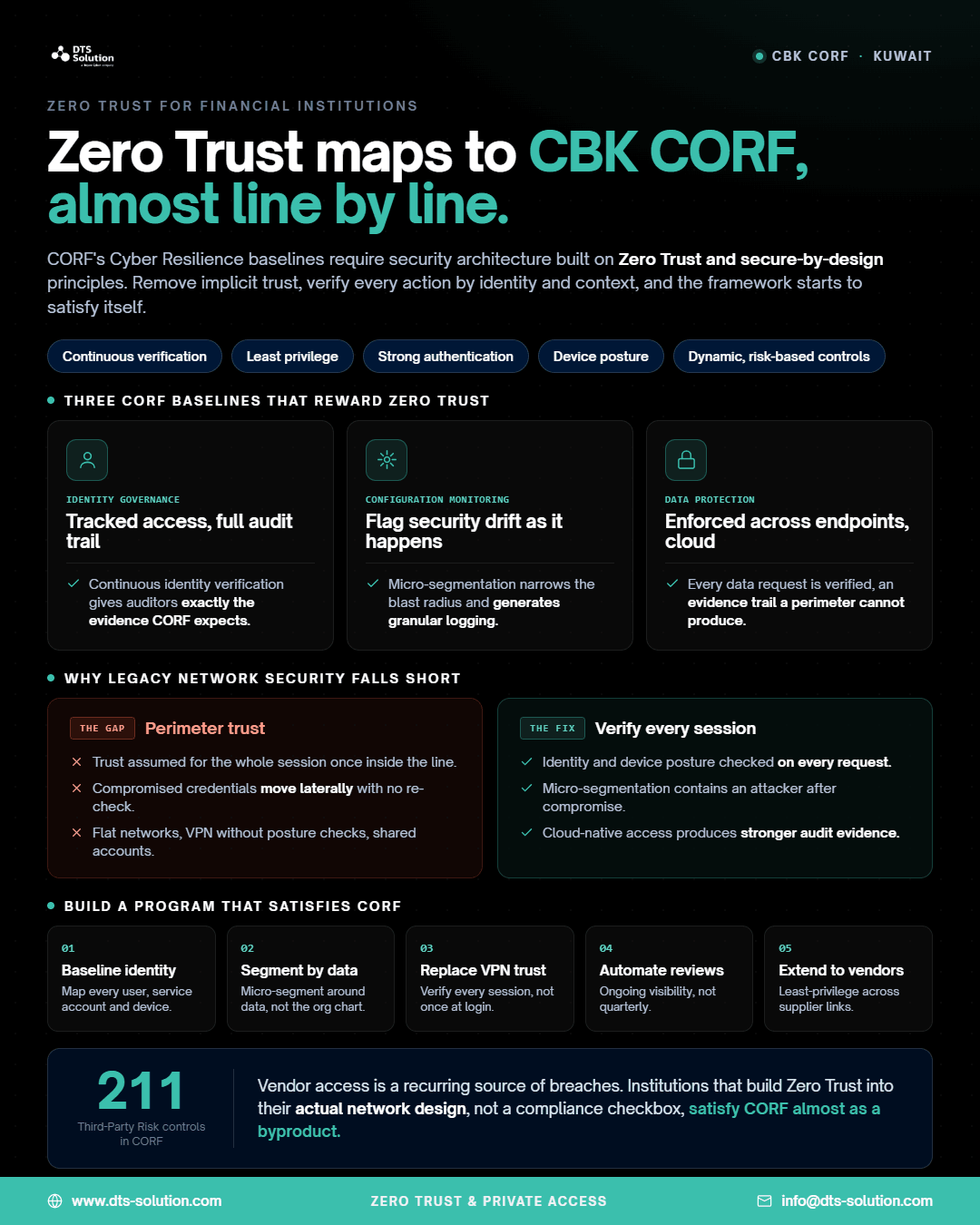
Three parts of the Cyber Resilience baseline map almost directly onto zero trust principles.
Identity Governance and Administration requires tracked access provisioning with a full audit trail. Zero trust, built on continuous identity verification rather than a one-time login, gives auditors exactly the evidence CORF expects.
Automated configuration monitoring calls for systems that flag security drift as it happens. A zero trust model, built on micro-segmentation and least-privilege access, narrows the blast radius when drift does occur, and generates the kind of granular logging that supports this control.
Data protection enforcement across endpoints and cloud environments lines up with zero trust’s insistence that every data request gets verified regardless of origin. A perimeter-based model cannot produce the same evidence trail.
Why Legacy Network Security Falls Short
Traditional network security draws a hard line between inside and outside the perimeter. Once a user or device gets past that line, trust is largely assumed for the rest of the session. That assumption is precisely what CORF auditors are trained to probe. If a compromised credential can move laterally through a bank’s internal systems without triggering additional verification, no amount of firewall logging will satisfy a third-party risk reviewer looking for evidence of least-privilege enforcement.
Kuwaiti financial institutions still running flat internal networks, VPN-based remote access without device posture checks, or shared service accounts are the ones most exposed here. These are common leftovers from network designs built before regulators started asking for continuous verification.
Building a Zero Trust Program That Satisfies CORF:
Start with an identity and access baseline. Map every user, service account, and device that touches sensitive systems. CORF’s identity governance controls expect this inventory to exist and stay current, not get assembled the week before an audit.
Segment the network around data sensitivity, not organizational charts. Micro-segmentation limits how far an attacker can move after an initial compromise, which directly supports both the Cyber Resilience baseline and the broader intent behind CORF’s operational resilience requirements.
Replace implicit VPN trust with continuous verification. A cloud-native access model that checks device posture and user identity on every session, rather than once at login, produces stronger audit evidence than a traditional VPN ever could. DTS Solution’s Zero Trust and Private Access practice is built around exactly this kind of readiness assessment, mapping an institution’s current architecture against a defined zero trust reference model before implementation begins.
Automate access reviews instead of running them quarterly. CORF’s third-party risk controls expect visibility into who can reach what, on an ongoing basis. Manual access reviews conducted a few times a year cannot keep pace with that expectation.
Extend zero trust principles to vendor connections. CORF’s Third-Party Risk Management baseline covers 211 controls specifically because vendor access is a recurring source of breaches. Applying the same least-privilege logic to supplier connections closes a gap that internal-only zero trust programs often miss.
Common Mistakes Institutions Make
A few patterns show up repeatedly as Kuwaiti banks and fintechs adopt zero trust under CORF.
Treating zero trust as a single product purchase. Buying one identity tool or one network access solution does not constitute a zero trust architecture. CORF auditors look for consistent enforcement across identity, network, and data layers, not a single control implemented in isolation.
Leaving legacy VPN access running alongside new zero trust tools. Parallel access paths create exactly the kind of inconsistency CORF’s configuration monitoring controls are designed to catch. A phased cutover plan, with a firm decommission date for legacy access, closes this gap.
Underestimating the third-party dimension. Many institutions build strong internal zero trust controls while leaving vendor and contractor access on older, less scrutinized pathways. CORF’s Third-Party Risk Management baseline carries 211 controls, so this is rarely a minor oversight in an audit.
Assuming maturity level four is a one-time achievement. CORF expects continuous evidence of control effectiveness, not a snapshot taken once during certification.
How DTS Solution Helps Financial Institutions in Kuwait
DTS Solution’s Zero Trust and Private Access services help banks and financial institutions in Kuwait assess their current readiness and develop a Zero Trust reference architecture. The approach covers identity, device access and application security while supporting continuous verification.
DTS Solution also assists institutions with network and infrastructure security, including segmentation, secure remote access and policy enforcement. Its capabilities cover architecture, implementation and operational validation, helping security teams modernize controls while maintaining focus on CBK CORF obligations.
For compliance tracking, Complyan, a product of DTS Solution, can support control mapping and evidence management through DTS Solution’s Governance, Risk and Compliance capabilities. This gives compliance teams a structured way to connect technical Zero Trust improvements with regulatory requirements.
Kuwait’s banks and financial institutions are modernising core systems, expanding cloud adoption and supporting more remote access. These changes improve service delivery, but they also weaken the traditional assumption that users and devices can be trusted simply because they are connected to the corporate network.
The Central Bank of Kuwait’s Cyber and Operational Resilience Framework, or CBK CORF, addresses this issue by requiring stronger identity controls, continuous verification, least-privilege access and secure-by-design architecture. For regulated institutions, Zero Trust provides a practical way to meet these expectations while upgrading network security without disrupting critical banking services.
DTS Solution helps financial institutions in Kuwait assess their current security posture and implement Zero Trust controls across identities, devices, applications and network access. Through its Zero Trust and Private Access capabilities, DTS Solution supports phased modernisation aligned with CBK CORF requirements.
CBK CORF Makes Zero Trust a Regulatory Requirement
CORF does not present Zero Trust as an optional architecture trend. Its Cyber Resilience Baselines state that security architecture across on-premises, cloud and hybrid systems must follow Zero Trust and secure-by-design principles.
The framework expects regulated entities to remove implicit trust and verify actions through identity and context. Access must be continuously assessed against behaviour and associated risk. CORF also requires least privilege, strong authentication and dynamic controls that respond to real-time signals.
For financial institutions in Kuwait, this means a corporate network connection cannot remain the primary security boundary. A user must still prove their identity. Their device must meet security requirements, while the requested action must match an approved role.
Where Zero Trust Fits Into CORF Compliance
Three parts of the Cyber Resilience baseline map almost directly onto zero trust principles.
Identity Governance and Administration requires tracked access provisioning with a full audit trail. Zero trust, built on continuous identity verification rather than a one-time login, gives auditors exactly the evidence CORF expects.
Automated configuration monitoring calls for systems that flag security drift as it happens. A zero trust model, built on micro-segmentation and least-privilege access, narrows the blast radius when drift does occur, and generates the kind of granular logging that supports this control.
Data protection enforcement across endpoints and cloud environments lines up with zero trust’s insistence that every data request gets verified regardless of origin. A perimeter-based model cannot produce the same evidence trail.
Why Legacy Network Security Falls Short
Traditional network security draws a hard line between inside and outside the perimeter. Once a user or device gets past that line, trust is largely assumed for the rest of the session. That assumption is precisely what CORF auditors are trained to probe. If a compromised credential can move laterally through a bank’s internal systems without triggering additional verification, no amount of firewall logging will satisfy a third-party risk reviewer looking for evidence of least-privilege enforcement.
Kuwaiti financial institutions still running flat internal networks, VPN-based remote access without device posture checks, or shared service accounts are the ones most exposed here. These are common leftovers from network designs built before regulators started asking for continuous verification.
Building a Zero Trust Program That Satisfies CORF:
Start with an identity and access baseline. Map every user, service account, and device that touches sensitive systems. CORF’s identity governance controls expect this inventory to exist and stay current, not get assembled the week before an audit.
Segment the network around data sensitivity, not organizational charts. Micro-segmentation limits how far an attacker can move after an initial compromise, which directly supports both the Cyber Resilience baseline and the broader intent behind CORF’s operational resilience requirements.
Replace implicit VPN trust with continuous verification. A cloud-native access model that checks device posture and user identity on every session, rather than once at login, produces stronger audit evidence than a traditional VPN ever could. DTS Solution’s Zero Trust and Private Access practice is built around exactly this kind of readiness assessment, mapping an institution’s current architecture against a defined zero trust reference model before implementation begins.
Automate access reviews instead of running them quarterly. CORF’s third-party risk controls expect visibility into who can reach what, on an ongoing basis. Manual access reviews conducted a few times a year cannot keep pace with that expectation.
Extend zero trust principles to vendor connections. CORF’s Third-Party Risk Management baseline covers 211 controls specifically because vendor access is a recurring source of breaches. Applying the same least-privilege logic to supplier connections closes a gap that internal-only zero trust programs often miss.
Common Mistakes Institutions Make
A few patterns show up repeatedly as Kuwaiti banks and fintechs adopt zero trust under CORF.
Treating zero trust as a single product purchase. Buying one identity tool or one network access solution does not constitute a zero trust architecture. CORF auditors look for consistent enforcement across identity, network, and data layers, not a single control implemented in isolation.
Leaving legacy VPN access running alongside new zero trust tools. Parallel access paths create exactly the kind of inconsistency CORF’s configuration monitoring controls are designed to catch. A phased cutover plan, with a firm decommission date for legacy access, closes this gap.
Underestimating the third-party dimension. Many institutions build strong internal zero trust controls while leaving vendor and contractor access on older, less scrutinized pathways. CORF’s Third-Party Risk Management baseline carries 211 controls, so this is rarely a minor oversight in an audit.
Assuming maturity level four is a one-time achievement. CORF expects continuous evidence of control effectiveness, not a snapshot taken once during certification.
How DTS Solution Helps Financial Institutions in Kuwait
DTS Solution’s Zero Trust and Private Access services help banks and financial institutions in Kuwait assess their current readiness and develop a Zero Trust reference architecture. The approach covers identity, device access and application security while supporting continuous verification.
DTS Solution also assists institutions with network and infrastructure security, including segmentation, secure remote access and policy enforcement. Its capabilities cover architecture, implementation and operational validation, helping security teams modernize controls while maintaining focus on CBK CORF obligations.
For compliance tracking, Complyan, a product of DTS Solution, can support control mapping and evidence management through DTS Solution’s Governance, Risk and Compliance capabilities. This gives compliance teams a structured way to connect technical Zero Trust improvements with regulatory requirements.
The Bottom Line
CORF was not written with zero trust as its explicit subject, but its identity governance, configuration monitoring, and third-party risk controls all reward the same architecture. Kuwaiti financial institutions that treat this as a compliance checkbox will keep struggling to produce the evidence CORF auditors want. Those that build zero trust into their actual network design end up satisfying the framework almost as a byproduct, while genuinely reducing the risk a modern financial institution faces every day.
The Bottom Line
CORF was not written with zero trust as its explicit subject, but its identity governance, configuration monitoring, and third-party risk controls all reward the same architecture. Kuwaiti financial institutions that treat this as a compliance checkbox will keep struggling to produce the evidence CORF auditors want. Those that build zero trust into their actual network design end up satisfying the framework almost as a byproduct, while genuinely reducing the risk a modern financial institution faces every day.
See also:






 Dubai
Dubai