
 Cyber Strategy
 Cyber Secure
 Cyber Operations
 Cyber Response
 Cyber Resilience
In 2011, cybersecurity in the GCC was a different discipline. Regulatory frameworks were nascent. Enterprise security teams were lean. And the managed security services market in the UAE was nowhere near the strategic priority it has since become.
DTS Solution was founded into that environment on purpose.
The bet made was not simply that the GCC cybersecurity market would grow. It was that they could build something capable of meeting it properly when it did. That has meant staying ahead of the curve rather than chasing it, building genuine operational capability before the demand was fully visible, and holding standards that the market had not yet required.
Fifteen years later, that approach is written into everything DTS Solution is.
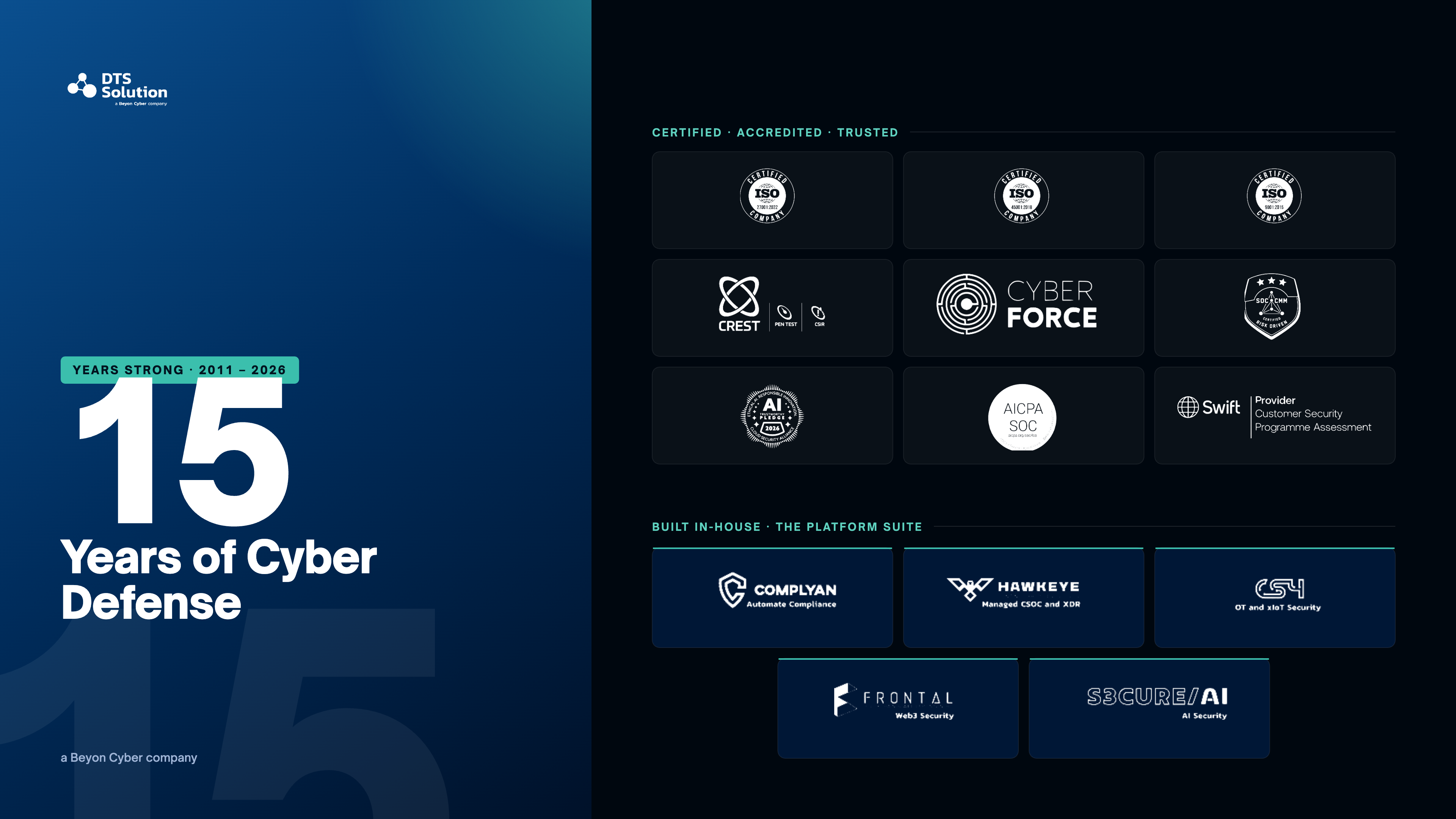
The firm’s certifications tell part of that story. Its AICPA SOC 2 Type 1 report independently validates the controls governing how client data and operations are handled. It holds SWIFT CSP authorised assessment provider status, conducting formal compliance assessments for financial institutions across the region. CREST certification covers both Penetration Testing and Cyber Security Incident Response, with analysts assessed against technical standards by an independent body. SOC maturity has been benchmarked through the SOC Capability Maturity Model. In 2026, it completed the CSA AI Trustworthy Pledge, committing publicly to responsible AI governance within its operations. Each of these required submitting to external assessment. None were self-issued.
“The certifications matter because they are not ours to give ourselves,” says Vahe Daghlian, CEO and Co-Founder. “They are the market’s way of saying the work holds up.”
The products tell a deeper story. DTS Solution built HawkEye into a managed CSOC and XDR service before AI-powered threat detection had a common name in this industry. The platform now runs 24/7 across enterprise and government environments in the UAE and GCC, with HawkEye AI and Hawk AI applying machine learning for behavioural profiling, anomaly detection, and automated triage at scale.
When GenAI adoption accelerated across the region, the firm responded with S3CURE/AI, a framework purpose-built for securing GenAI and LLM deployments across governance, red teaming, and infrastructure hardening, aligned to OWASP LLM Top 10 and MITRE ATLAS. Complyan AI brings intelligence to GRC, automating compliance workflows across DESC, ISR, NCA, SAMA, and ISO 27001 for organisations navigating some of the most demanding regulatory environments in the world.
HawkEye ADR addresses the application layer directly, where AI agents are increasingly both the operational tool and the attack target.
None of these products were acquired. All of them were built because DTS Solution identified a real problem in the market before the market had fully named it.
“Fifteen years of watching how attacks actually move through this region gives you a very different view of where the gaps are,” says Shah Sheikh, Co-Founder, and vCISO. “We build for what we see, not for what looks good on a product sheet.”
That regional specificity runs throughout the firm. The GCC cybersecurity landscape, shaped by frameworks including DESC, SAMA, NCA, and ADDA, is not a simplified version of a global standard. It demands practitioners who have been inside these frameworks long enough to understand not just what they require but how they are interpreted and enforced. That knowledge is not transferable from elsewhere. It is accumulated here, over time, through sustained presence.
The broader market context reinforces why this matters. Cyberattacks targeting UAE organisations surged to between 500,000 and 700,000 per day during periods of heightened geopolitical tension in early 2026. AI-driven attacks are compressing response windows across the region, with some incidents reaching operational impact in under 40 hours. The shift from reactive security models to continuous, adaptive cyber resilience is no longer a strategic aspiration. It is an operational requirement.
DTS Solution has been building for exactly this moment across the past 15 years. Managed CSOC and XDR operations running continuously. AI-native detection layered into SOC workflows. Cloud security posture management covering misconfiguration and drift in real time. And a zero trust and identity access governance practice that has tracked the evolution of that architecture from concept to GCC regulatory requirement.
The next chapter is already underway. Agentic security operations. AI governance at enterprise scale. Compliance automation built for the pace at which GCC regulation is now moving. The firm that enters its second decade is materially different from the one that opened its doors in Dubai in 2011. The direction of travel is clear.
Built in the GCC. Trusted across the region. Still building.
Explore DTS Solution’s AI-native managed security portfolio at dts-solution.com
In 2011, cybersecurity in the GCC was a different discipline. Regulatory frameworks were nascent. Enterprise security teams were lean. And the managed security services market in the UAE was nowhere near the strategic priority it has since become.
DTS Solution was founded into that environment on purpose.
The bet made was not simply that the GCC cybersecurity market would grow. It was that they could build something capable of meeting it properly when it did. That has meant staying ahead of the curve rather than chasing it, building genuine operational capability before the demand was fully visible, and holding standards that the market had not yet required.
Fifteen years later, that approach is written into everything DTS Solution is.
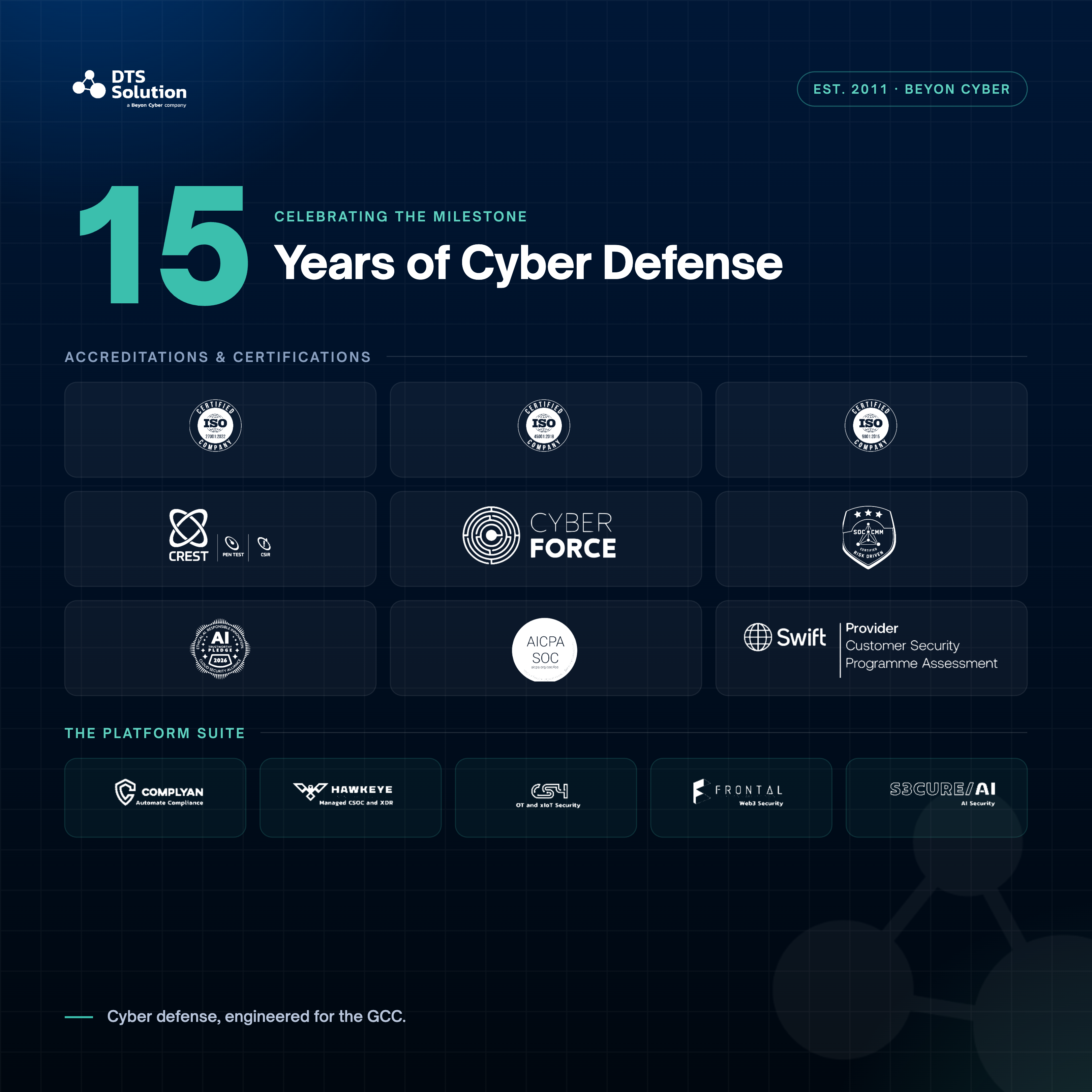
The firm’s certifications tell part of that story. Its AICPA SOC 2 Type 1 report independently validates the controls governing how client data and operations are handled. It holds SWIFT CSP authorised assessment provider status, conducting formal compliance assessments for financial institutions across the region. CREST certification covers both Penetration Testing and Cyber Security Incident Response, with analysts assessed against technical standards by an independent body. SOC maturity has been benchmarked through the SOC Capability Maturity Model. And in 2026 it completed the CSA AI Trustworthy Pledge, committing publicly to responsible AI governance within its operations. Each of these required submitting to external assessment. None were self-issued.
“The certifications matter because they are not ours to give ourselves,” says Vahe Daghlian, CEO and Co-Founder. “They are the market’s way of saying the work holds up.”
The products tell a deeper story. DTS Solution built HawkEye into a managed CSOC and XDR service before AI-powered threat detection had a common name in this industry. The platform now runs 24/7 across enterprise and government environments in the UAE and GCC, with HawkEye AI and Hawk AI applying machine learning for behavioural profiling, anomaly detection, and automated triage at scale.
When GenAI adoption accelerated across the region, the firm responded with S3CURE/AI, a framework purpose-built for securing GenAI and LLM deployments across governance, red teaming, and infrastructure hardening, aligned to OWASP LLM Top 10 and MITRE ATLAS. Complyan AI brings intelligence to GRC, automating compliance workflows across DESC, ISR, NCA, SAMA, and ISO 27001 for organisations navigating some of the most demanding regulatory environments in the world. And
HawkEye ADR addresses the application layer directly, where AI agents are increasingly both the operational tool and the attack target.
None of these products were acquired. All of them were built because DTS Solution identified a real problem in the market before the market had fully named it.
“Fifteen years of watching how attacks actually move through this region gives you a very different view of where the gaps are,” says Shah Sheikh, Co-Founder, and vCISO. “We build for what we see, not for what looks good on a product sheet.”
That regional specificity runs throughout the firm. The GCC cybersecurity landscape, shaped by frameworks including DESC, SAMA, NCA, and ADDA, is not a simplified version of a global standard. It demands practitioners who have been inside these frameworks long enough to understand not just what they require but how they are interpreted and enforced. That knowledge is not transferable from elsewhere. It is accumulated here, over time, through sustained presence.
The broader market context reinforces why this matters. Cyberattacks targeting UAE organisations surged to between 500,000 and 700,000 per day during periods of heightened geopolitical tension in early 2026. AI-driven attacks are compressing response windows across the region, with some incidents reaching operational impact in under 40 hours. The shift from reactive security models to continuous, adaptive cyber resilience is no longer a strategic aspiration. It is an operational requirement.
DTS Solution has been building for exactly this moment across the past 15 years. Managed CSOC and XDR operations running continuously. AI-native detection layered into SOC workflows. Cloud security posture management covering misconfiguration and drift in real time. And a zero trust and identity access governance practice that has tracked the evolution of that architecture from concept to GCC regulatory requirement.
The next chapter is already underway. Agentic security operations. AI governance at enterprise scale. Compliance automation built for the pace at which GCC regulation is now moving. The firm that enters its second decade is materially different from the one that opened its doors in Dubai in 2011. The direction of travel is clear.
Built in the GCC. Trusted across the region. Still building.
Explore DTS Solution’s AI-native managed security portfolio at dts-solution.com




 Dubai
Dubai