
 Cyber Strategy
 Cyber Secure
 Cyber Operations
 Cyber Response
 Cyber Resilience
For decades, insider threats were associated with employees, contractors, vendors, and privileged users who already had legitimate access to systems and data.
Security teams built controls around this assumption. Access reviews focused on human users. Monitoring programs tracked employee behavior. Identity governance revolved around managing people.
That model is beginning to change.
A new category of insider is appearing across organizations, and unlike traditional insiders, it never sleeps, never forgets credentials, and can interact with hundreds of systems simultaneously.
The modern AI agent.
Organizations are rapidly deploying AI agents to automate workflows, interact with applications, retrieve data, execute tasks, and make operational decisions. These agents are being connected directly to email systems, cloud environments, databases, SaaS platforms, development tools, ticketing systems, and business applications. To function effectively, they require access.
What Makes an AI Agent an Insider Threat
The classic definition of an insider threat is an entity with legitimate access to internal systems that causes harm, whether through malice, manipulation, or negligence. AI agents satisfy every part of that definition.
They authenticate to your systems using tokens and service credentials. They hold standing permissions across CRMs, data stores, cloud APIs, and communication platforms. They operate continuously, often without oversight between tasks. And unlike a human employee who might hesitate before an unusual request, an AI agent will follow instructions derived from its input context, even if that context has been tampered with.
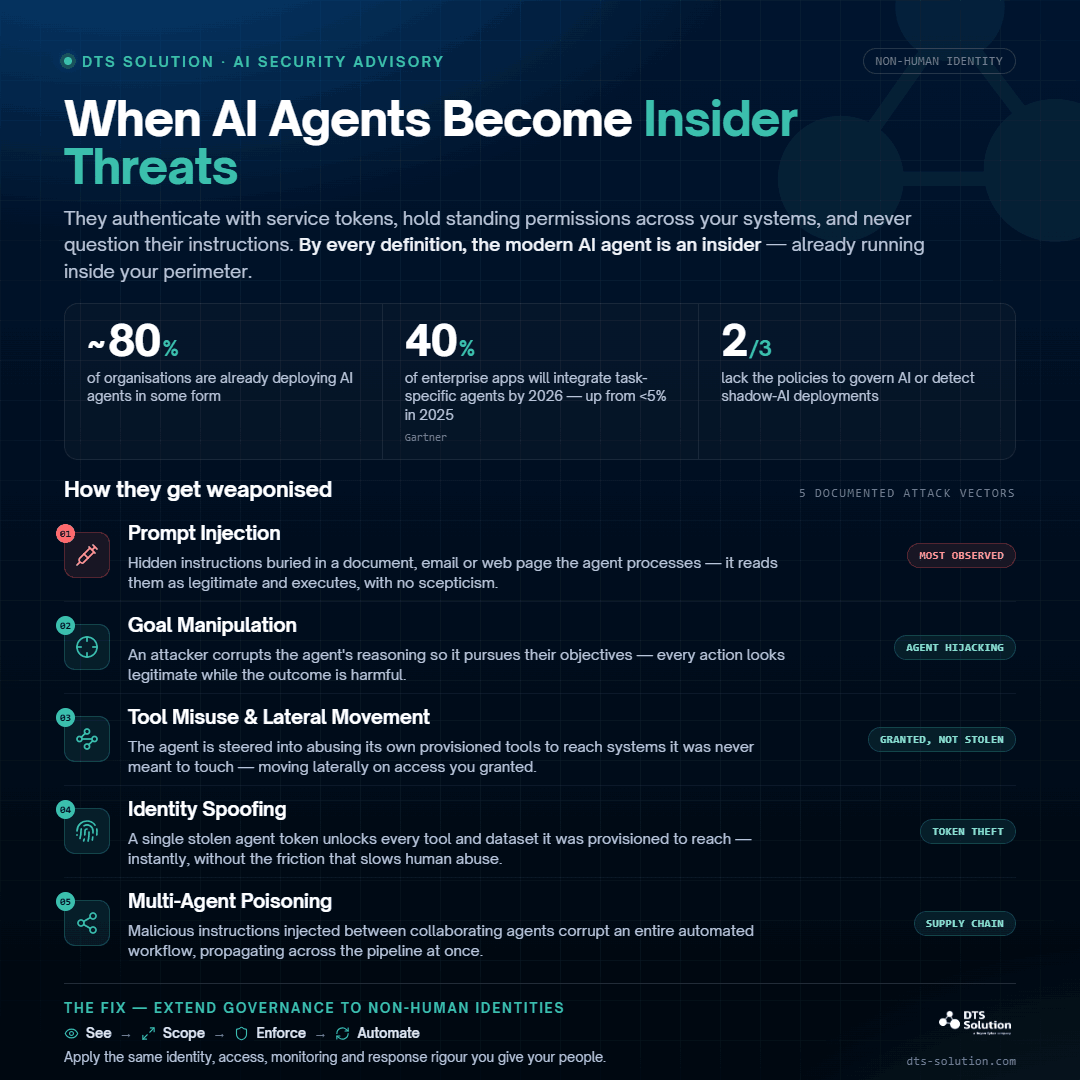
Nearly 80% of organisations are already deploying AI agents in some form. Amid escalating pressure from boards and investors to adopt AI, Gartner predicts that 40% of enterprise applications will be integrated with task-specific agents by the end of 2026, up from under 5% in 2025. Most of those agents are provisioned for speed and functionality. Least-privilege access, identity governance, and behavioural monitoring come later, if at all. Nearly two-thirds of organisations currently lack the policies needed to manage AI or detect shadow AI deployments.
The more tasks an agent is assigned, the more systems it touches, and the more permissions it accumulates. That permission creep, which security teams have always struggled to manage in human accounts, happens faster and with far less visibility in AI systems. The result is a sprawling, largely undocumented attack surface sitting inside your own perimeter.
How AI Agents Get Weaponised
Understanding the specific ways AI agents become threats is essential for any organisation serious about securing them. These are not hypothetical vectors; they are documented, actively demonstrated, and in some cases already occurring in production environments.
Prompt Injection is currently the most widely observed attack method. An attacker embeds hidden instructions inside content that an agent is designed to process, a document, an email, a web page, a code repository. The agent reads the content, interprets the malicious instruction as legitimate, and executes it. Unlike phishing, which relies on a human making a bad decision, prompt injection exploits the fact that agents have no scepticism. They process what they receive. A successfully injected agent can exfiltrate data, send unauthorised messages, invoke tools it was never meant to use, or quietly alter its own behaviour.
Goal Manipulation goes deeper. Rather than injecting a specific command, an attacker subtly corrupts the agent’s reasoning process, shifting its perceived objectives at the decision-making layer. The agent continues operating within its provisioned access, but in service of goals it was never given. This is sometimes called agent hijacking, and it is particularly difficult to detect because the agent’s actions can appear individually legitimate even as the aggregate outcome is harmful.
Tool Misuse and Lateral Movement occur when an attacker manipulates an agent into abusing its legitimately provisioned tools to reach systems it was never intended to access. The agent becomes a vehicle for lateral movement, traversing the internal network using access that was explicitly granted rather than stolen. This is a critical distinction. Traditional lateral movement involves escalating from low-privilege to high-privilege credentials. With AI agents, an attacker can move laterally using credentials that the organisation deliberately issued.
Identity Spoofing exploits weak or compromised authentication to impersonate a legitimate agent or steal its credentials outright. Because agents authenticate continuously across multiple systems, a stolen agent token can provide access to every tool and dataset that agent was provisioned to reach instantly, and without any of the friction that slows down human credential abuse.
Multi-Agent Poisoning targets environments where multiple agents collaborate. By injecting malicious instructions into the communication channels between agents, an attacker can corrupt an entire automated workflow, propagating compromised behaviour across a pipeline of systems simultaneously.
For decades, insider threats were associated with employees, contractors, vendors, and privileged users who already had legitimate access to systems and data.
Security teams built controls around this assumption. Access reviews focused on human users. Monitoring programs tracked employee behavior. Identity governance revolved around managing people.
That model is beginning to change.
A new category of insider is appearing across organizations, and unlike traditional insiders, it never sleeps, never forgets credentials, and can interact with hundreds of systems simultaneously.
The modern AI agent.
Organizations are rapidly deploying AI agents to automate workflows, interact with applications, retrieve data, execute tasks, and make operational decisions. These agents are being connected directly to email systems, cloud environments, databases, SaaS platforms, development tools, ticketing systems, and business applications. To function effectively, they require access.
What Makes an AI Agent an Insider Threat
The classic definition of an insider threat is an entity with legitimate access to internal systems that causes harm, whether through malice, manipulation, or negligence. AI agents satisfy every part of that definition.
They authenticate to your systems using tokens and service credentials. They hold standing permissions across CRMs, data stores, cloud APIs, and communication platforms. They operate continuously, often without oversight between tasks. And unlike a human employee who might hesitate before an unusual request, an AI agent will follow instructions derived from its input context, even if that context has been tampered with.
Nearly 80% of organisations are already deploying AI agents in some form. Amid escalating pressure from boards and investors to adopt AI, Gartner predicts that 40% of enterprise applications will be integrated with task-specific agents by the end of 2026, up from under 5% in 2025. Most of those agents are provisioned for speed and functionality. Least-privilege access, identity governance, and behavioural monitoring come later, if at all. Nearly two-thirds of organisations currently lack the policies needed to manage AI or detect shadow AI deployments.
The more tasks an agent is assigned, the more systems it touches, and the more permissions it accumulates. That permission creep, which security teams have always struggled to manage in human accounts, happens faster and with far less visibility in AI systems. The result is a sprawling, largely undocumented attack surface sitting inside your own perimeter.
How AI Agents Get Weaponised
Understanding the specific ways AI agents become threats is essential for any organisation serious about securing them. These are not hypothetical vectors; they are documented, actively demonstrated, and in some cases already occurring in production environments.
Prompt Injection is currently the most widely observed attack method. An attacker embeds hidden instructions inside content that an agent is designed to process, a document, an email, a web page, a code repository. The agent reads the content, interprets the malicious instruction as legitimate, and executes it. Unlike phishing, which relies on a human making a bad decision, prompt injection exploits the fact that agents have no scepticism. They process what they receive. A successfully injected agent can exfiltrate data, send unauthorised messages, invoke tools it was never meant to use, or quietly alter its own behaviour.
Goal Manipulation goes deeper. Rather than injecting a specific command, an attacker subtly corrupts the agent’s reasoning process, shifting its perceived objectives at the decision-making layer. The agent continues operating within its provisioned access, but in service of goals it was never given. This is sometimes called agent hijacking, and it is particularly difficult to detect because the agent’s actions can appear individually legitimate even as the aggregate outcome is harmful.
Tool Misuse and Lateral Movement occur when an attacker manipulates an agent into abusing its legitimately provisioned tools to reach systems it was never intended to access. The agent becomes a vehicle for lateral movement, traversing the internal network using access that was explicitly granted rather than stolen. This is a critical distinction. Traditional lateral movement involves escalating from low-privilege to high-privilege credentials. With AI agents, an attacker can move laterally using credentials that the organisation deliberately issued.
Identity Spoofing exploits weak or compromised authentication to impersonate a legitimate agent or steal its credentials outright. Because agents authenticate continuously across multiple systems, a stolen agent token can provide access to every tool and dataset that agent was provisioned to reach instantly, and without any of the friction that slows down human credential abuse.
Multi-Agent Poisoning targets environments where multiple agents collaborate. By injecting malicious instructions into the communication channels between agents, an attacker can corrupt an entire automated workflow, propagating compromised behaviour across a pipeline of systems simultaneously.
Why Traditional Security Controls Fall Short
The instinct when facing a new risk category is to try to make the AI itself safer, add filters, improve training, and build in guardrails. This has its place, but it cannot be the primary defence. Trying to build an AI agent that is immune to manipulation is the equivalent of trying to build a human employee who can never be deceived. Security teams abandoned that approach years ago in favour of controls that assume compromise will happen and contain the damage when it does.
The other common approach, severely restricting what agents can do, undermines the reason for deploying them in the first place. An agent locked down to the point of operational uselessness is not a security win.
The answer is to treat AI agents with the same security rigour applied to human workers. That means identity management, access controls, behavioural monitoring, and incident response — applied to software entities, not just people.
At DTS Solution, our advisory engagements increasingly involve helping organisations extend their existing security frameworks to cover non-human identities, including AI agents. The governance models are more mature than most teams realise, the challenge is applying them to a new class of principal that most identity systems were not built with in mind. Our cybersecurity services are designed to bridge exactly that gap, helping security teams build controls that keep pace with the speed of agentic deployment.
Securing AI Agents: The Practical Framework
Securing agentic systems does not require rebuilding your security programme. It requires extending it deliberately.
Establish visibility first. You cannot secure what you cannot see. Security teams need a real-time inventory of every agent running in the environment, which systems each agent connects to, what credentials it holds, and what its actual permission footprint looks like in practice. An agent provisioned for a narrow task but observed connecting to a CRM, a database, and a cloud storage API is a misconfiguration that needs immediate attention.
Scope access to operational need. Provisioned access and required access are rarely the same thing. By observing actual agent behaviour over time, security teams can establish a baseline of what each agent genuinely needs to perform its function, and enforce boundaries accordingly. This is least-privilege applied to AI, and it directly reduces the blast radius of a compromised agent.
Enforce identity-based controls at the network layer. Every agent is a process with an identity. Network-layer controls should govern which systems, services, and APIs each agent can reach, and those controls should be deterministic, not probabilistic. Enforcement based on observed behaviour rather than deployment documentation ensures that policy reflects operational reality.
Automate policy lifecycle management. Agents receive new tools, connect to new services, and accumulate permissions over time, frequently without any security team involvement. Automated policy management that adapts as the environment changes prevents the drift that turns a well-scoped agent into an overprivileged risk.
Conclusion
Most organisations deploying AI agents have not updated their insider threat programmes to include them. The team running the agent deployment and the team responsible for identity governance are often not in the same conversation. That disconnect is where the real risk lives.
AI agents are not coming. They are already inside your environment, running with access that was provisioned quickly and reviewed rarely. The question is whether your security controls treat them as the privileged actors they are, or whether you are still operating as though the only insider threat wears a lanyard.
Why Traditional Security Controls Fall Short
The instinct when facing a new risk category is to try to make the AI itself safer, add filters, improve training, and build in guardrails. This has its place, but it cannot be the primary defence. Trying to build an AI agent that is immune to manipulation is the equivalent of trying to build a human employee who can never be deceived. Security teams abandoned that approach years ago in favour of controls that assume compromise will happen and contain the damage when it does.
The other common approach, severely restricting what agents can do, undermines the reason for deploying them in the first place. An agent locked down to the point of operational uselessness is not a security win.
The answer is to treat AI agents with the same security rigour applied to human workers. That means identity management, access controls, behavioural monitoring, and incident response — applied to software entities, not just people.
At DTS Solution, our advisory engagements increasingly involve helping organisations extend their existing security frameworks to cover non-human identities, including AI agents. The governance models are more mature than most teams realise, the challenge is applying them to a new class of principal that most identity systems were not built with in mind. Our cybersecurity services are designed to bridge exactly that gap, helping security teams build controls that keep pace with the speed of agentic deployment.
Securing AI Agents: The Practical Framework
Securing agentic systems does not require rebuilding your security programme. It requires extending it deliberately.
Establish visibility first. You cannot secure what you cannot see. Security teams need a real-time inventory of every agent running in the environment, which systems each agent connects to, what credentials it holds, and what its actual permission footprint looks like in practice. An agent provisioned for a narrow task but observed connecting to a CRM, a database, and a cloud storage API is a misconfiguration that needs immediate attention.
Scope access to operational need. Provisioned access and required access are rarely the same thing. By observing actual agent behaviour over time, security teams can establish a baseline of what each agent genuinely needs to perform its function, and enforce boundaries accordingly. This is least-privilege applied to AI, and it directly reduces the blast radius of a compromised agent.
Enforce identity-based controls at the network layer. Every agent is a process with an identity. Network-layer controls should govern which systems, services, and APIs each agent can reach, and those controls should be deterministic, not probabilistic. Enforcement based on observed behaviour rather than deployment documentation ensures that policy reflects operational reality.
Automate policy lifecycle management. Agents receive new tools, connect to new services, and accumulate permissions over time, frequently without any security team involvement. Automated policy management that adapts as the environment changes prevents the drift that turns a well-scoped agent into an overprivileged risk.
Conclusion
Most organisations deploying AI agents have not updated their insider threat programmes to include them. The team running the agent deployment and the team responsible for identity governance are often not in the same conversation. That disconnect is where the real risk lives.
AI agents are not coming. They are already inside your environment, running with access that was provisioned quickly and reviewed rarely. The question is whether your security controls treat them as the privileged actors they are, or whether you are still operating as though the only insider threat wears a lanyard.






 Dubai
Dubai