
 Cyber Strategy
 Cyber Secure
 Cyber Operations
 Cyber Response
 Cyber Resilience
SWIFT CSCF in Kuwait is a key compliance and security priority for banks, exchange companies, payment institutions, and financial organizations that use SWIFT services. For Kuwaiti financial institutions that need SWIFT Customer Security Programme support, compliance advisory, technical assessment, and control validation, DTS Solution provides regional cybersecurity expertise across financial services, governance, risk, compliance, and security testing.
Many teams still refer to the requirement as SWIFT CSF, but the formal name is SWIFT Customer Security Controls Framework, or CSCF. It sits under the SWIFT Customer Security Programme, which was created to help SWIFT users secure their local SWIFT-related infrastructure, reduce fraud risk, and improve control maturity across the global financial messaging community.
For Kuwait’s banking and financial sector, SWIFT CSCF should not be handled as a once-a-year attestation task. It should be treated as a security operating program with clear ownership, current evidence, technical validation, management reporting, and remediation tracking.
Why SWIFT CSCF matters in Kuwait
Kuwaiti financial institutions depend on secure messaging, reliable settlement workflows, correspondent banking relationships, and trusted payment operations. A weakness in a SWIFT-connected environment can create financial loss, operational disruption, audit pressure, and reputational damage.
SWIFT CSCF focuses on the security of the customer’s own environment. That includes how SWIFT systems are accessed, protected, monitored, maintained, and reviewed. The framework helps organizations reduce the risk of compromise across endpoints, operator accounts, connectivity, infrastructure, and supporting systems.
The official SWIFT Customer Security Programme V2026 training page references the SWIFT Customer Security Controls Framework v2026 and the mandatory and advisory security controls to be implemented by every SWIFT user in 2026.
Why Kuwait's Banks Cannot Treat This as Optional
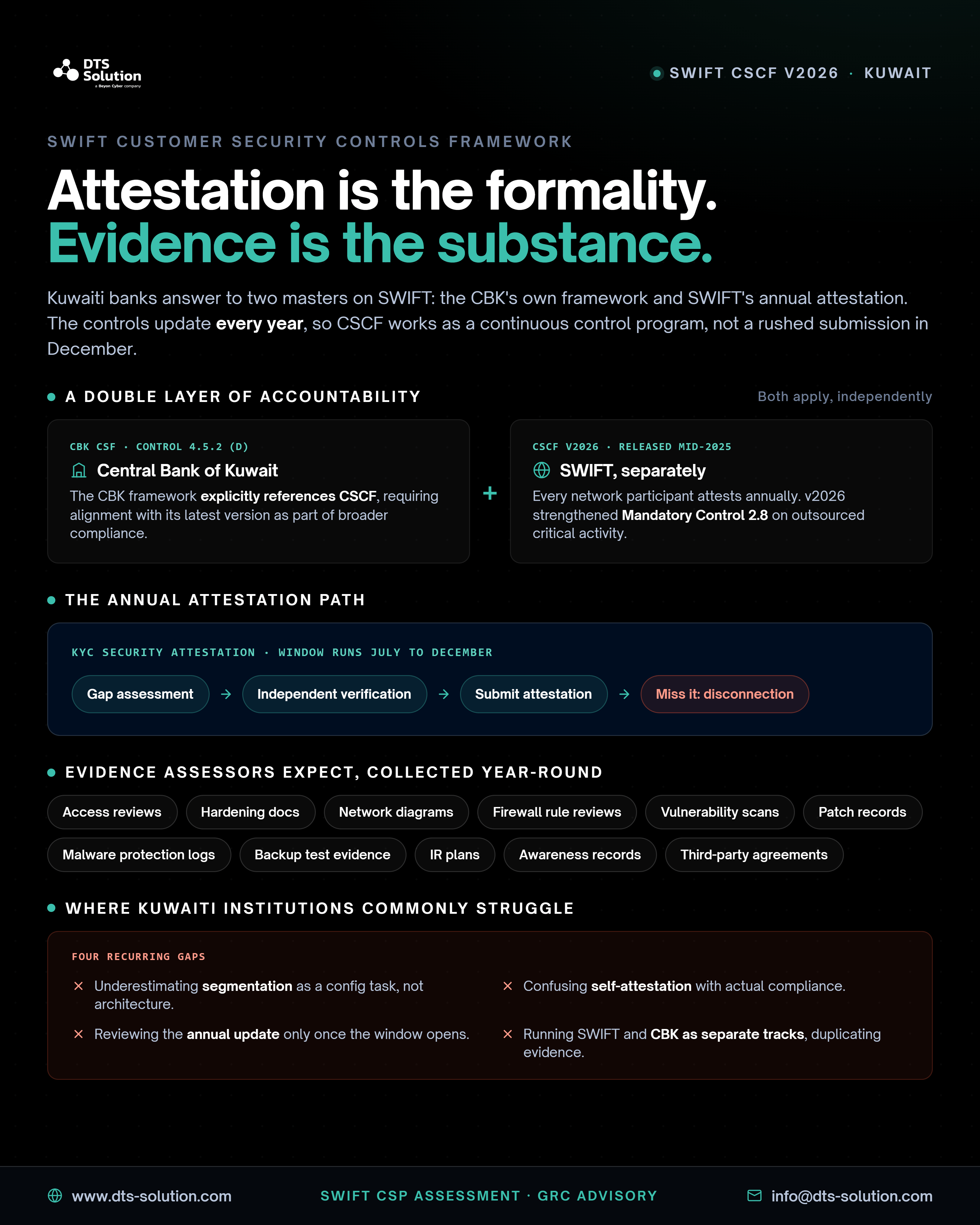
The Central Bank of Kuwait’s Cybersecurity Framework for the banking sector explicitly references SWIFT CSCF under Control No. 4.5.2, item (d), requiring regulated entities to align with the framework’s latest version as part of their broader compliance obligation. This means Kuwaiti banks face a double layer of accountability: the CBK’s own supervisory expectations, and SWIFT’s separate annual attestation process that every network participant must complete regardless of local regulation.
The framework itself updates annually, unlike standards on longer release cycles. The current version, CSCF v2026, released in mid-2025, strengthened Mandatory Control 2.8 around outsourced critical activity protection, placing more explicit weight on how institutions manage risk tied to third parties handling SWIFT-related functions. For a bank already working through vendor and cloud oversight under the CBK’s broader cybersecurity requirements, this update reinforces rather than duplicates that existing effort.
Map controls to evidence
SWIFT CSCF readiness depends on evidence. A policy alone is not enough. Teams need proof that controls are implemented and maintained.
Evidence may include access review records, system hardening documentation, network diagrams, firewall rule reviews, vulnerability scan results, patch records, malware protection logs, backup test evidence, incident response plans, security awareness records, and third-party support agreements.
This is where financial institutions should move away from spreadsheet-heavy compliance. Every control should have an owner, evidence source, review cycle, status, remediation action, and management view.
DTS Solution Governance, Risk and Compliance supports organizations with cybersecurity governance, risk management, compliance functions, reporting, and third-party risk programs. For SWIFT CSCF, this helps financial institutions connect control status with risk, evidence, and accountability.
The Annual Attestation Process
Every SWIFT user must submit a Know Your Customer Security Attestation between July and December each year, confirming compliance against the mandatory controls. Since community standards changes took effect, these self-attestations require independent verification, either through an external SWIFT CSP assessment provider or an internal review conducted by a bank’s own second or third line of defense function with appropriate expertise.
Failing to submit an accurate attestation on schedule carries real consequences. SWIFT can impose network restrictions or, in serious cases, disconnect a non-compliant institution entirely, cutting it off from the primary channel for international financial transactions.
Where Kuwaiti Institutions Commonly Struggle
Underestimating the scope of network segmentation work. Properly isolating SWIFT-related infrastructure from general IT systems often requires significant architectural change, and institutions that treat this as a quick configuration task tend to discover the real scope only mid-project.
Confusing self-attestation with actual compliance. Submitting an attestation is a formality. Demonstrating that the underlying controls genuinely operate as described, with evidence an assessor can independently verify, is the substance behind it.
Treating the annual update as a minor formality. Each new CSCF version can shift specific control requirements meaningfully, as the 2026 update to outsourced activity protection shows. Institutions that review changes only after the attestation window opens leave themselves little room to remediate genuine gaps.
Managing SWIFT compliance separately from broader CBK obligations. SWIFT CSCF and the CBK’s own Cybersecurity Framework overlap significantly in governance, access control, and incident response. Running them as two unrelated compliance tracks duplicates evidence collection that could be mapped once.
Building a Program That Survives Independent Assessment
Start with a gap assessment against the current CSCF version specifically. Controls that satisfied last year’s requirements may not fully cover this year’s updates, particularly around third-party and outsourced activity protection.
Choose an assessment provider with genuine accreditation, not just claimed experience. SWIFT maintains a formal directory of authorised CSP assessment providers, and verifying a provider’s actual listing matters more than a general claim of cybersecurity expertise. DTS Solution’s governance, risk, and compliance practice builds SWIFT readiness directly into broader CBK compliance programs, rather than treating it as an isolated annual exercise.
Document evidence continuously, not just before the attestation window. Independent assessors expect to see controls operating throughout the year, not evidence assembled specifically for the July through December submission period.
Map SWIFT and CBK requirements together. A single control library referenced against both frameworks removes duplicated effort and closes gaps that appear when institutions manage each requirement in isolation. Baker Tilly Kuwait’s coverage of the CBK’s direct reference to SWIFT CSCF confirms this overlap is written into the regulation itself, not an assumption.
SWIFT CSCF in Kuwait is a key compliance and security priority for banks, exchange companies, payment institutions, and financial organizations that use SWIFT services. For Kuwaiti financial institutions that need SWIFT Customer Security Programme support, compliance advisory, technical assessment, and control validation, DTS Solution provides regional cybersecurity expertise across financial services, governance, risk, compliance, and security testing.
Many teams still refer to the requirement as SWIFT CSF, but the formal name is SWIFT Customer Security Controls Framework, or CSCF. It sits under the SWIFT Customer Security Programme, which was created to help SWIFT users secure their local SWIFT-related infrastructure, reduce fraud risk, and improve control maturity across the global financial messaging community.
For Kuwait’s banking and financial sector, SWIFT CSCF should not be handled as a once-a-year attestation task. It should be treated as a security operating program with clear ownership, current evidence, technical validation, management reporting, and remediation tracking.
Why SWIFT CSCF matters in Kuwait
Kuwaiti financial institutions depend on secure messaging, reliable settlement workflows, correspondent banking relationships, and trusted payment operations. A weakness in a SWIFT-connected environment can create financial loss, operational disruption, audit pressure, and reputational damage.
SWIFT CSCF focuses on the security of the customer’s own environment. That includes how SWIFT systems are accessed, protected, monitored, maintained, and reviewed. The framework helps organizations reduce the risk of compromise across endpoints, operator accounts, connectivity, infrastructure, and supporting systems.
The official SWIFT Customer Security Programme V2026 training page references the SWIFT Customer Security Controls Framework v2026 and the mandatory and advisory security controls to be implemented by every SWIFT user in 2026.
Why Kuwait's Banks Cannot Treat This as Optional
The Central Bank of Kuwait’s Cybersecurity Framework for the banking sector explicitly references SWIFT CSCF under Control No. 4.5.2, item (d), requiring regulated entities to align with the framework’s latest version as part of their broader compliance obligation. This means Kuwaiti banks face a double layer of accountability: the CBK’s own supervisory expectations, and SWIFT’s separate annual attestation process that every network participant must complete regardless of local regulation.
The framework itself updates annually, unlike standards on longer release cycles. The current version, CSCF v2026, released in mid-2025, strengthened Mandatory Control 2.8 around outsourced critical activity protection, placing more explicit weight on how institutions manage risk tied to third parties handling SWIFT-related functions. For a bank already working through vendor and cloud oversight under the CBK’s broader cybersecurity requirements, this update reinforces rather than duplicates that existing effort.
Map controls to evidence
SWIFT CSCF readiness depends on evidence. A policy alone is not enough. Teams need proof that controls are implemented and maintained.
Evidence may include access review records, system hardening documentation, network diagrams, firewall rule reviews, vulnerability scan results, patch records, malware protection logs, backup test evidence, incident response plans, security awareness records, and third-party support agreements.
This is where financial institutions should move away from spreadsheet-heavy compliance. Every control should have an owner, evidence source, review cycle, status, remediation action, and management view.
DTS Solution Governance, Risk and Compliance supports organizations with cybersecurity governance, risk management, compliance functions, reporting, and third-party risk programs. For SWIFT CSCF, this helps financial institutions connect control status with risk, evidence, and accountability.
The Annual Attestation Process
Every SWIFT user must submit a Know Your Customer Security Attestation between July and December each year, confirming compliance against the mandatory controls. Since community standards changes took effect, these self-attestations require independent verification, either through an external SWIFT CSP assessment provider or an internal review conducted by a bank’s own second or third line of defense function with appropriate expertise.
Failing to submit an accurate attestation on schedule carries real consequences. SWIFT can impose network restrictions or, in serious cases, disconnect a non-compliant institution entirely, cutting it off from the primary channel for international financial transactions.
Where Kuwaiti Institutions Commonly Struggle
Underestimating the scope of network segmentation work. Properly isolating SWIFT-related infrastructure from general IT systems often requires significant architectural change, and institutions that treat this as a quick configuration task tend to discover the real scope only mid-project.
Confusing self-attestation with actual compliance. Submitting an attestation is a formality. Demonstrating that the underlying controls genuinely operate as described, with evidence an assessor can independently verify, is the substance behind it.
Treating the annual update as a minor formality. Each new CSCF version can shift specific control requirements meaningfully, as the 2026 update to outsourced activity protection shows. Institutions that review changes only after the attestation window opens leave themselves little room to remediate genuine gaps.
Managing SWIFT compliance separately from broader CBK obligations. SWIFT CSCF and the CBK’s own Cybersecurity Framework overlap significantly in governance, access control, and incident response. Running them as two unrelated compliance tracks duplicates evidence collection that could be mapped once.
Building a Program That Survives Independent Assessment
Start with a gap assessment against the current CSCF version specifically. Controls that satisfied last year’s requirements may not fully cover this year’s updates, particularly around third-party and outsourced activity protection.
Choose an assessment provider with genuine accreditation, not just claimed experience. SWIFT maintains a formal directory of authorised CSP assessment providers, and verifying a provider’s actual listing matters more than a general claim of cybersecurity expertise. DTS Solution’s governance, risk, and compliance practice builds SWIFT readiness directly into broader CBK compliance programs, rather than treating it as an isolated annual exercise.
Document evidence continuously, not just before the attestation window. Independent assessors expect to see controls operating throughout the year, not evidence assembled specifically for the July through December submission period.
Map SWIFT and CBK requirements together. A single control library referenced against both frameworks removes duplicated effort and closes gaps that appear when institutions manage each requirement in isolation. Baker Tilly Kuwait’s coverage of the CBK’s direct reference to SWIFT CSCF confirms this overlap is written into the regulation itself, not an assumption.
Conclusion
SWIFT CSCF in Kuwait should be managed as a continuous control program, not a rushed annual attestation. Financial institutions need clear scope, strong ownership, current evidence, tested technical controls, third-party governance, and leadership reporting.
DTS Solution helps banks, exchange companies, payment institutions, and financial organizations build that foundation through SWIFT CSP assessment support, GRC advisory, financial services cybersecurity, penetration testing, and compliance consulting.
The goal is simple: protect SWIFT-connected operations, prove control maturity, reduce payment risk, and keep the organization ready before assessment pressure begins.
Conclusion
SWIFT CSCF in Kuwait should be managed as a continuous control program, not a rushed annual attestation. Financial institutions need clear scope, strong ownership, current evidence, tested technical controls, third-party governance, and leadership reporting.
DTS Solution helps banks, exchange companies, payment institutions, and financial organizations build that foundation through SWIFT CSP assessment support, GRC advisory, financial services cybersecurity, penetration testing, and compliance consulting.
The goal is simple: protect SWIFT-connected operations, prove control maturity, reduce payment risk, and keep the organization ready before assessment pressure begins.
See also:






 Dubai
Dubai