
 Cyber Strategy
 Cyber Secure
 Cyber Operations
 Cyber Response
 Cyber Resilience
The role of a CISO has shifted far beyond technical oversight. Boards now treat cybersecurity as a core business risk, and regulators demand clearer accountability from senior leadership. As a result, CISOs are operating in a pressure zone where business strategy, operational resilience, and cyber defense meet. The expectations placed on the position have multiplied, and the decisions made in this role influence everything from revenue protection to national compliance obligations.
The position of Chief Information Security Officer has undergone a remarkable transformation, what began as a technical role focused primarily on protecting IT infrastructure has evolved into a strategic executive position that sits at the intersection of risk management, business enablement, and organizational resilience.
Beyond the Technical Roots
Historically, CISOs were expected to manage firewalls, monitor intrusion detection systems, and respond to security incidents. Their world was confined to the IT department, often operating in isolation from broader business objectives. Today’s reality demands something entirely different.
According to the World Economic Forum‘s recent white paper, modern security leaders must act as business strategists, operational risk leaders, and trusted advisers to executive leadership and boards. This shift reflects a fundamental change in how organizations view cybersecurity, not as a cost center or compliance checkbox, but as a critical business imperative.
An interesting aspect of this profession is that approximately 50% of CISOs come from non-IT backgrounds. This statistic reveals something crucial about the role: technical expertise alone is no longer sufficient. Success requires a blend of business acumen, communication skills, and strategic thinking that transcends traditional IT knowledge.
The Collaboration Network That Now Defines CISO Success
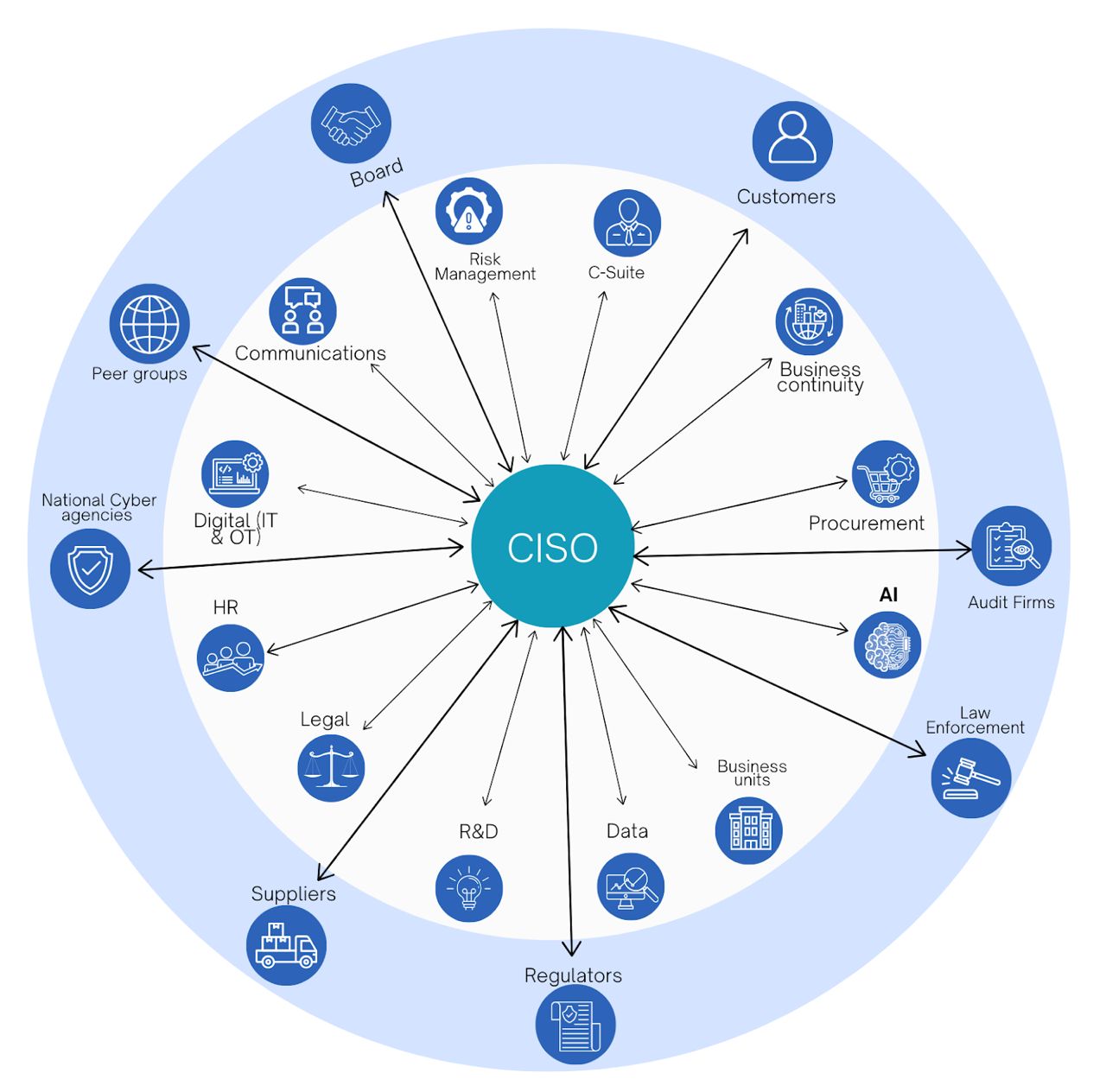
The modern CISO operates at the center of a complex network of internal and external stakeholders. Success depends on cultivating strong relationships that enable both tactical and strategic collaboration.
Internally, CISOs must work closely with the C-suite, risk management teams, digital and AI teams, procurement, legal, HR, business continuity, and communications departments. Each relationship requires a different approach. With the C-suite, the focus is on aligning cyber strategy with business objectives. With procurement teams, it involves providing guidance on third-party risk assessment criteria. With HR, it means developing security awareness programs and enforcing policies while maintaining a positive organizational culture.
Externally, CISOs engage with boards, customers, suppliers, regulators, national cybersecurity agencies, law enforcement, audit firms, and peer groups. These relationships form the foundation of collective defense and information sharing that strengthens security posture across entire industries.
The board relationship deserves special attention. Most CISOs from the World Economic Forum’s CISO community report interacting with their board quarterly. These interactions should feel collaborative rather than adversarial. CISOs must raise risks and challenges before they become critical issues, ensuring no surprises when incidents occur. Some organizations have established dedicated security committees to maintain focus on cybersecurity between board meetings.
The Expanding Mandate
The responsibilities facing today’s CISO have multiplied exponentially. They must navigate an increasingly complex environment shaped by several converging forces:
Geopolitical tensions now directly influence cybersecurity strategy in nearly 60% of organizations. Security leaders must adapt their approaches based on international relations, regulatory changes, and regional technology restrictions. Data sovereignty debates further complicate this picture, making it harder to aggregate security data across fragmented systems.
Regulatory complexity continues to grow. While 78% of leaders believe cyber and privacy regulations effectively reduce risk, the proliferation of requirements across different jurisdictions creates a compliance challenge. CISOs must devote significant resources to managing multiple, sometimes contradictory, regulatory frameworks.
Emerging technologies present both opportunities and risks. The World Economic Forum reports that 66% of surveyed respondents believe AI will significantly affect cybersecurity within the next year, yet only 37% have processes in place for safe AI deployment. With AI-related spending projected to reach $639 billion by 2028, CISOs must balance innovation speed with security requirements.
Supply chain vulnerabilities remain a pressing concern. More than half of large organizations cite third-party risk management as a major challenge. CISOs must foster collaborative security practices while ensuring visibility across their supplier ecosystem.
Talent shortages add another layer of difficulty. Current estimates suggest between 2.8 and 4.8 million unfilled cybersecurity positions globally. Two in three organizations report moderate to critical skills gaps, and research shows these shortages create additional cyber risks for 70% of organizations.
The role of a CISO has shifted far beyond technical oversight. Boards now treat cybersecurity as a core business risk, and regulators demand clearer accountability from senior leadership. As a result, CISOs are operating in a pressure zone where business strategy, operational resilience, and cyber defense meet. The expectations placed on the position have multiplied, and the decisions made in this role influence everything from revenue protection to national compliance obligations.
The position of Chief Information Security Officer has undergone a remarkable transformation, what began as a technical role focused primarily on protecting IT infrastructure has evolved into a strategic executive position that sits at the intersection of risk management, business enablement, and organizational resilience.
Beyond the Technical Roots
Historically, CISOs were expected to manage firewalls, monitor intrusion detection systems, and respond to security incidents. Their world was confined to the IT department, often operating in isolation from broader business objectives. Today’s reality demands something entirely different.
According to the World Economic Forum’s recent white paper, modern security leaders must act as business strategists, operational risk leaders, and trusted advisers to executive leadership and boards. This shift reflects a fundamental change in how organizations view cybersecurity, not as a cost center or compliance checkbox, but as a critical business imperative.
An interesting aspect of this profession is that approximately 50% of CISOs come from non-IT backgrounds. This statistic reveals something crucial about the role: technical expertise alone is no longer sufficient. Success requires a blend of business acumen, communication skills, and strategic thinking that transcends traditional IT knowledge.
The Collaboration Network That Now Defines CISO Success
The modern CISO operates at the center of a complex network of internal and external stakeholders. Success depends on cultivating strong relationships that enable both tactical and strategic collaboration.
Internally, CISOs must work closely with the C-suite, risk management teams, digital and AI teams, procurement, legal, HR, business continuity, and communications departments. Each relationship requires a different approach. With the C-suite, the focus is on aligning cyber strategy with business objectives. With procurement teams, it involves providing guidance on third-party risk assessment criteria. With HR, it means developing security awareness programs and enforcing policies while maintaining a positive organizational culture.
Externally, CISOs engage with boards, customers, suppliers, regulators, national cybersecurity agencies, law enforcement, audit firms, and peer groups. These relationships form the foundation of collective defense and information sharing that strengthens security posture across entire industries.
The board relationship deserves special attention. Most CISOs from the World Economic Forum’s CISO community report interacting with their board quarterly. These interactions should feel collaborative rather than adversarial. CISOs must raise risks and challenges before they become critical issues, ensuring no surprises when incidents occur. Some organizations have established dedicated security committees to maintain focus on cybersecurity between board meetings.
The Expanding Mandate
The responsibilities facing today’s CISO have multiplied exponentially. They must navigate an increasingly complex environment shaped by several converging forces:
Geopolitical tensions now directly influence cybersecurity strategy in nearly 60% of organizations. Security leaders must adapt their approaches based on international relations, regulatory changes, and regional technology restrictions. Data sovereignty debates further complicate this picture, making it harder to aggregate security data across fragmented systems.
Regulatory complexity continues to grow. While 78% of leaders believe cyber and privacy regulations effectively reduce risk, the proliferation of requirements across different jurisdictions creates a compliance challenge. CISOs must devote significant resources to managing multiple, sometimes contradictory, regulatory frameworks.
Emerging technologies present both opportunities and risks. The World Economic Forum reports that 66% of surveyed respondents believe AI will significantly affect cybersecurity within the next year, yet only 37% have processes in place for safe AI deployment. With AI-related spending projected to reach $639 billion by 2028, CISOs must balance innovation speed with security requirements.
Supply chain vulnerabilities remain a pressing concern. More than half of large organizations cite third-party risk management as a major challenge. CISOs must foster collaborative security practices while ensuring visibility across their supplier ecosystem.
Talent shortages add another layer of difficulty. Current estimates suggest between 2.8 and 4.8 million unfilled cybersecurity positions globally. Two in three organizations report moderate to critical skills gaps, and research shows these shortages create additional cyber risks for 70% of organizations.
Seven Dimensions of CISO Leadership
Modern CISOs must embody multiple roles simultaneously:
As business partners, they balance risk and opportunity while enabling safe adoption of new technologies. This requires deep understanding of organizational priorities and the ability to align security initiatives with business goals.
As resilience guardians, they must remain steady during crises, making clear decisions under pressure and maintaining organizational confidence when stakes are highest.
As community leaders, they build bridges across the organization and with external stakeholders, including regulators and government bodies. They shape organizational culture and serve as ambassadors for security awareness.
As storytellers, they translate technical risks into compelling business narratives. This means communicating security posture to boards and customers in ways that demonstrate transparency and accountability.
As people leaders, they build attractive teams, nurture talent internally, and ensure employee wellbeing. They must leverage technology to augment team capacity while focusing on professional development.
As cultural drivers, they establish environments where everyone understands and participates in managing cyber risk. Security becomes a shared responsibility rather than the burden of a single department.
As negotiators, they balance security needs with business priorities and risk appetite, advocating for resources while influencing cross-functional decisions.
Bridging the Communication Gap
One of the most critical challenges facing CISOs is the disconnect between security concerns and executive priorities. The World Economic Forum’s Global Cybersecurity Outlook 2025 survey revealed that almost twice as many CISOs as CEOs identified brand damage and loss of customer trust as top concerns amid geopolitical tensions. This gap highlights ongoing misalignment at the executive level regarding cyber risk prioritization.
Effective CISOs speak in business terms rather than technical jargon. When reporting to boards, they focus on business impact, financial exposure, regulatory implications, and reputational risks. They use metrics that resonate with business leaders, demonstrating return on investment and articulating risks without resorting to fear-based tactics.
The Board’s Role in CISO Success
Security leaders cannot succeed in isolation. Boards and executive leadership must provide the foundation for CISO effectiveness through several key enablers:
Clear mandate: CISOs need the authority to provide accurate assessments of organizational cyber risk posture without fear of consequences. They require visibility at board meetings with dedicated time for cybersecurity discussions.
Active engagement: Regular board communication ensures cybersecurity remains a strategic priority rather than an afterthought. Some organizations establish dedicated security committees or board subcommittees focused specifically on cyber risk.
Relationship development: CISOs must have the mandate to build strong relationships with key stakeholders, both internally and externally. Their collaborative role should be recognized and supported.
Appropriate accountability: Organizations need mechanisms to address cyber risk management failures fairly while maintaining psychological safety for honest risk reporting.
Dedicated resources: Ring-fenced budgets for cybersecurity initiatives, including tooling and team development, demonstrate organizational commitment to security.
Conclusion
The evolution of the CISO role reflects broader changes in how organizations operate in an interconnected world. As digital transformation accelerates and cyber risks become more sophisticated, security leadership will only grow in importance.
Success in this role requires moving beyond traditional boundaries. CISOs must engage across business lines, stay aligned with technological developments, and ensure cybersecurity supports overall organizational resilience. They need to adopt a “Yes, and…” mindset rather than being seen as blockers who simply say no to innovation.
The organizations that will thrive are those whose leaders treat cybersecurity as an enabler for trust, innovation, and competitive advantage. This requires collective action from CISOs who step up as broader business leaders and from boards that provide the mandate, resources, and support structures necessary for security teams to succeed.
The journey from technical specialist to strategic executive is challenging, but it represents a significant opportunity. CISOs who embrace this evolution position themselves not just as defenders of infrastructure but as architects of organizational resilience and drivers of business value. The role has moved beyond security to encompass business strategy, risk management, and organizational transformation.
Reference: World Economic Forum. (2025). Elevating Cybersecurity: Ensuring Strategic and Sustainable Impact for CISOs. White Paper, October 2025.
Seven Dimensions of CISO Leadership
Modern CISOs must embody multiple roles simultaneously:
As business partners, they balance risk and opportunity while enabling safe adoption of new technologies. This requires deep understanding of organizational priorities and the ability to align security initiatives with business goals.
As resilience guardians, they must remain steady during crises, making clear decisions under pressure and maintaining organizational confidence when stakes are highest.
As community leaders, they build bridges across the organization and with external stakeholders, including regulators and government bodies. They shape organizational culture and serve as ambassadors for security awareness.
As storytellers, they translate technical risks into compelling business narratives. This means communicating security posture to boards and customers in ways that demonstrate transparency and accountability.
As people leaders, they build attractive teams, nurture talent internally, and ensure employee wellbeing. They must leverage technology to augment team capacity while focusing on professional development.
As cultural drivers, they establish environments where everyone understands and participates in managing cyber risk. Security becomes a shared responsibility rather than the burden of a single department.
As negotiators, they balance security needs with business priorities and risk appetite, advocating for resources while influencing cross-functional decisions.
Bridging the Communication Gap
One of the most critical challenges facing CISOs is the disconnect between security concerns and executive priorities. The World Economic Forum’s Global Cybersecurity Outlook 2025 survey revealed that almost twice as many CISOs as CEOs identified brand damage and loss of customer trust as top concerns amid geopolitical tensions. This gap highlights ongoing misalignment at the executive level regarding cyber risk prioritization.
Effective CISOs speak in business terms rather than technical jargon. When reporting to boards, they focus on business impact, financial exposure, regulatory implications, and reputational risks. They use metrics that resonate with business leaders, demonstrating return on investment and articulating risks without resorting to fear-based tactics.
The Board’s Role in CISO Success
Security leaders cannot succeed in isolation. Boards and executive leadership must provide the foundation for CISO effectiveness through several key enablers:
Clear mandate: CISOs need the authority to provide accurate assessments of organizational cyber risk posture without fear of consequences. They require visibility at board meetings with dedicated time for cybersecurity discussions.
Active engagement: Regular board communication ensures cybersecurity remains a strategic priority rather than an afterthought. Some organizations establish dedicated security committees or board subcommittees focused specifically on cyber risk.
Relationship development: CISOs must have the mandate to build strong relationships with key stakeholders, both internally and externally. Their collaborative role should be recognized and supported.
Appropriate accountability: Organizations need mechanisms to address cyber risk management failures fairly while maintaining psychological safety for honest risk reporting.
Dedicated resources: Ring-fenced budgets for cybersecurity initiatives, including tooling and team development, demonstrate organizational commitment to security.
Conclusion
The evolution of the CISO role reflects broader changes in how organizations operate in an interconnected world. As digital transformation accelerates and cyber risks become more sophisticated, security leadership will only grow in importance.
Success in this role requires moving beyond traditional boundaries. CISOs must engage across business lines, stay aligned with technological developments, and ensure cybersecurity supports overall organizational resilience. They need to adopt a “Yes, and…” mindset rather than being seen as blockers who simply say no to innovation.
The organizations that will thrive are those whose leaders treat cybersecurity as an enabler for trust, innovation, and competitive advantage. This requires collective action from CISOs who step up as broader business leaders and from boards that provide the mandate, resources, and support structures necessary for security teams to succeed.
The journey from technical specialist to strategic executive is challenging, but it represents a significant opportunity. CISOs who embrace this evolution position themselves not just as defenders of infrastructure but as architects of organizational resilience and drivers of business value. The role has moved beyond security to encompass business strategy, risk management, and organizational transformation.
Reference: World Economic Forum. (2025). Elevating Cybersecurity: Ensuring Strategic and Sustainable Impact for CISOs. White Paper, October 2025.
See also:




 Dubai
Dubai