
 Cyber Strategy
 Cyber Secure
 Cyber Operations
 Cyber Response
 Cyber Resilience
Starlink has officially launched in the UAE. The Telecommunications and Digital Government Regulatory Authority granted Elon Musk’s satellite internet provider Starlink a 10-year general space services licence, adding a space-based layer to the country’s digital infrastructure alongside existing fibre and 5G networks. DTS Solution has spent over a decade securing network transitions across the Gulf, and this one carries its own specific considerations businesses should not overlook in the rush to connect.
DTS Solution helps UAE organizations adopt technologies like Starlink securely by assessing how new connectivity fits into the wider enterprise security model. A satellite internet link may support resilience, but once it carries corporate traffic, cloud access, operational data, or user authentication, it becomes part of the organization’s attack surface.
What Was Approved
The licence permits Starlink to establish, operate, and manage a public satellite communications network across the UAE, covering individuals, businesses, and government entities. The regulator specifically named maritime and aviation transport, energy, logistics, and emergency response as sectors expected to benefit, since these operations often run in locations where fibre and cellular coverage remain limited or unreliable.
The UAE joins a region already moving quickly on satellite connectivity. Bahrain became the first GCC country to license Starlink back in 2022, and Dubai-based Emirates has been rolling out the service across its fleet, reportedly surpassing a million in-flight Wi-Fi connections within seven months. Reports from local users already describe the UAE rollout hitting capacity limits and waitlists within weeks of approval, a strong signal of how quickly demand is building.
Fast Connectivity Adoption Needs a Security Conversation
Satellite internet solves a real problem: reliable connectivity in locations where terrestrial infrastructure struggles, from offshore platforms to remote logistics sites to branch offices outside dense urban coverage. The security risk shows up in how quickly and informally that connectivity often gets adopted.
A remote site or branch office connecting a Starlink terminal directly to a local switch, without routing that connection through the same security stack as the rest of the network, creates an unmanaged path into the business. Traffic that never passes through a firewall, secure web gateway, or inspection policy is traffic the security team cannot see, regardless of how reliable the underlying connection is. This is the same shadow IT risk organizations have dealt with for years around unauthorized Wi-Fi hotspots, just with a much stronger and more capable connection behind it this time.
Fast Connectivity Adoption Needs a Security Conversation
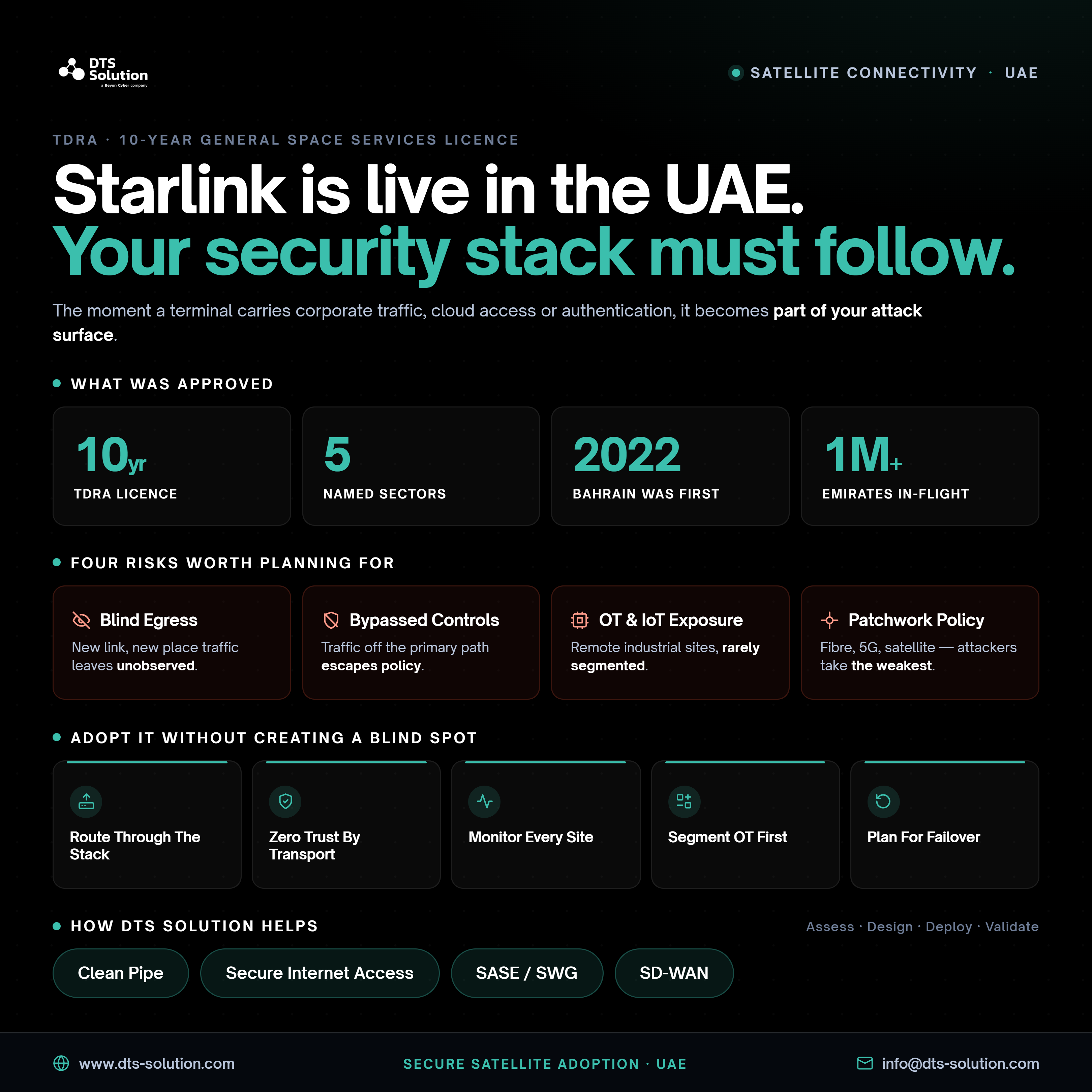
Unmonitored egress points: Every new internet connection is a new place traffic can leave the network unobserved. A satellite terminal installed at a remote site without integration into existing monitoring creates exactly this kind of blind spot.
Bypassed security controls: If a branch office finds Starlink faster or more reliable than its existing connection and starts routing traffic directly through it, security policies enforced on the primary network simply do not apply to that traffic anymore.
OT and IoT exposure at remote sites: Energy, logistics, and maritime operations often deploy sensors and industrial control systems in exactly the remote locations where satellite connectivity is most attractive. Connecting these systems directly to the internet without the same segmentation and monitoring applied to core operations multiplies the exposure this equipment already carries.
Inconsistent policy enforcement across connection types: An organization with different security postures for its fibre, cellular, and satellite connections ends up with a patchwork of protection rather than a consistent one, and attackers only need the weakest link to matter.
Adopting Starlink Without Creating a Blind Spot
Treat every new connection as part of the network, not separate from it: A satellite terminal should route through the same security stack as any other internet connection, not sit outside it because it was installed quickly to solve an urgent connectivity gap.
Apply zero trust principles regardless of transport: The security model should not care whether traffic arrives over fibre, 5G, or satellite. Identity verification, device posture checks, and policy enforcement need to apply consistently across every path into the business. DTS Solution’s FYNSEC Cloud SASE, built on Cato Networks and Fortinet technology, is designed around exactly this principle, delivering consistent security policy regardless of which underlying connection a site or user relies on.
Extend monitoring to every remote site, not just headquarters: Visibility built around a central office network misses activity at the maritime, energy, or logistics sites most likely to adopt satellite connectivity first.
Segment OT and IoT traffic before connecting it to satellite internet: Industrial systems deployed at remote sites deserve the same isolation from general internet traffic they would receive on any other network, regardless of how the site connects.
Plan for capacity and failover deliberately: With early UAE users already reporting waitlists, organizations relying on Starlink for critical operations should treat it as one layer in a resilient connectivity strategy, not a single point of failure replacing existing infrastructure. Running this decision through a proper risk assessment, the kind DTS Solution’s governance, risk, and compliance practice builds into broader network planning, keeps the rollout deliberate rather than reactive.
How DTS Solution Helps UAE Organizations Adopt Securely
DTS Solution can help UAE organizations assess, design, deploy, and validate secure Starlink adoption across enterprise, government, remote-site, and critical operation use cases. The work should start with a connectivity risk assessment that reviews business need, site profile, data flows, regulatory exposure, traffic routing, identity controls, monitoring coverage, and continuity requirements.
Through DTS Solution Cloud Security, organizations can review how Starlink-enabled sites connect to cloud platforms, SaaS applications, identity services, and business workloads. This is especially important where satellite connectivity supports remote access to AWS, Azure, OCI, Google Cloud, Microsoft 365, ERP platforms, or operational dashboards.
Through DTS Solution UAE cybersecurity services, organizations can align Starlink adoption with UAE-focused security requirements, including UAE IA V2, DESC ISR, ADHICS, UAE DPR, ISO 42001, managed SOC and XDR, penetration testing, cloud security, CSPM, vCISO, and GRC consulting. DTS Solution’s UAE page lists these capabilities for organizations operating across Dubai, Abu Dhabi, and the wider UAE.
For incident readiness, DTS Solution Incident Response and Forensics can help organizations define how satellite-connected sites should be handled during cyber incidents, outages, failover scenarios, ransomware events, and forensic investigations.
Starlink has officially launched in the UAE. The Telecommunications and Digital Government Regulatory Authority granted Elon Musk’s satellite internet provider Starlink a 10-year general space services licence, adding a space-based layer to the country’s digital infrastructure alongside existing fibre and 5G networks. DTS Solution has spent over a decade securing network transitions across the Gulf, and this one carries its own specific considerations businesses should not overlook in the rush to connect.
DTS Solution helps UAE organizations adopt technologies like Starlink securely by assessing how new connectivity fits into the wider enterprise security model. A satellite internet link may support resilience, but once it carries corporate traffic, cloud access, operational data, or user authentication, it becomes part of the organization’s attack surface.
What Was Approved
The licence permits Starlink to establish, operate, and manage a public satellite communications network across the UAE, covering individuals, businesses, and government entities. The regulator specifically named maritime and aviation transport, energy, logistics, and emergency response as sectors expected to benefit, since these operations often run in locations where fibre and cellular coverage remain limited or unreliable.
The UAE joins a region already moving quickly on satellite connectivity. Bahrain became the first GCC country to license Starlink back in 2022, and Dubai-based Emirates has been rolling out the service across its fleet, reportedly surpassing a million in-flight Wi-Fi connections within seven months. Reports from local users already describe the UAE rollout hitting capacity limits and waitlists within weeks of approval, a strong signal of how quickly demand is building.
Fast Connectivity Adoption Needs a Security Conversation
Satellite internet solves a real problem: reliable connectivity in locations where terrestrial infrastructure struggles, from offshore platforms to remote logistics sites to branch offices outside dense urban coverage. The security risk shows up in how quickly and informally that connectivity often gets adopted.
A remote site or branch office connecting a Starlink terminal directly to a local switch, without routing that connection through the same security stack as the rest of the network, creates an unmanaged path into the business. Traffic that never passes through a firewall, secure web gateway, or inspection policy is traffic the security team cannot see, regardless of how reliable the underlying connection is. This is the same shadow IT risk organizations have dealt with for years around unauthorized Wi-Fi hotspots, just with a much stronger and more capable connection behind it this time.
The Specific Risks Worth Planning For
Unmonitored egress points: Every new internet connection is a new place traffic can leave the network unobserved. A satellite terminal installed at a remote site without integration into existing monitoring creates exactly this kind of blind spot.
Bypassed security controls: If a branch office finds Starlink faster or more reliable than its existing connection and starts routing traffic directly through it, security policies enforced on the primary network simply do not apply to that traffic anymore.
OT and IoT exposure at remote sites: Energy, logistics, and maritime operations often deploy sensors and industrial control systems in exactly the remote locations where satellite connectivity is most attractive. Connecting these systems directly to the internet without the same segmentation and monitoring applied to core operations multiplies the exposure this equipment already carries.
Inconsistent policy enforcement across connection types: An organization with different security postures for its fibre, cellular, and satellite connections ends up with a patchwork of protection rather than a consistent one, and attackers only need the weakest link to matter.
Adopting Starlink Without Creating a Blind Spot
Treat every new connection as part of the network, not separate from it: A satellite terminal should route through the same security stack as any other internet connection, not sit outside it because it was installed quickly to solve an urgent connectivity gap.
Apply zero trust principles regardless of transport: The security model should not care whether traffic arrives over fibre, 5G, or satellite. Identity verification, device posture checks, and policy enforcement need to apply consistently across every path into the business. DTS Solution’s FYNSEC Cloud SASE, built on Cato Networks and Fortinet technology, is designed around exactly this principle, delivering consistent security policy regardless of which underlying connection a site or user relies on.
Extend monitoring to every remote site, not just headquarters: Visibility built around a central office network misses activity at the maritime, energy, or logistics sites most likely to adopt satellite connectivity first.
Segment OT and IoT traffic before connecting it to satellite internet: Industrial systems deployed at remote sites deserve the same isolation from general internet traffic they would receive on any other network, regardless of how the site connects.
Plan for capacity and failover deliberately: With early UAE users already reporting waitlists, organizations relying on Starlink for critical operations should treat it as one layer in a resilient connectivity strategy, not a single point of failure replacing existing infrastructure. Running this decision through a proper risk assessment, the kind DTS Solution’s governance, risk, and compliance practice builds into broader network planning, keeps the rollout deliberate rather than reactive.
Conclusion
Starlink’s UAE launch gives organizations another way to improve connectivity, continuity, and remote-site access. That value is real, especially for locations where fibre or mobile coverage is limited, delayed, or unsuitable for the business need.
The security decision is also clear. Starlink should not be adopted as a standalone internet shortcut. It should be integrated into the enterprise security architecture, segmented properly, routed through approved controls, monitored by the SOC, tested before production, and governed through clear ownership.
For UAE businesses, the opportunity is stronger connectivity. The responsibility is secure adoption. DTS Solution can help make sure both happen together.
Conclusion
Starlink’s UAE launch gives organizations another way to improve connectivity, continuity, and remote-site access. That value is real, especially for locations where fibre or mobile coverage is limited, delayed, or unsuitable for the business need.
The security decision is also clear. Starlink should not be adopted as a standalone internet shortcut. It should be integrated into the enterprise security architecture, segmented properly, routed through approved controls, monitored by the SOC, tested before production, and governed through clear ownership.
For UAE businesses, the opportunity is stronger connectivity. The responsibility is secure adoption. DTS Solution can help make sure both happen together.
See also:








 Dubai
Dubai